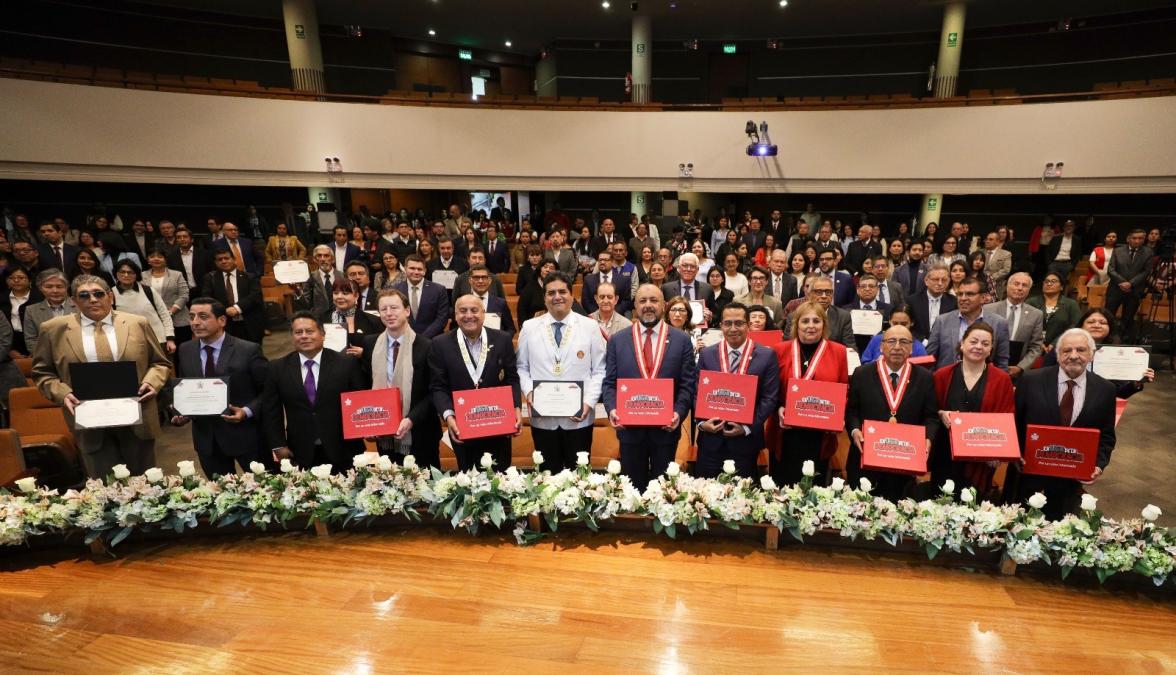
In order to encourage responsible voting by citizens in the next General Elections 2026 (EG 2026), various social organizations, public and private institutions, companies and media signed the Social Pact for an Informed Vote “League of Democracy”, promoted by the National Election Jury (JNE).
The initiative has the purpose of providing voters with official and reliable information about the elections, through different communication channels, and generating confidence in the electoral process and democracy, through a strategic alliance with adhering institutions and organizations.
In this way, greater transparency can be ensured in the electoral process, by providing voters with tools that allow them to better compare and choose their representatives, contributing to the full exercise of citizens’ right to vote.
The president of the JNE, Roberto Burneo, highlighted the commitment of the various allied entities that join this social pact, which, he said, is a very powerful citizen network at the service of democracy.
“Faced with the immense challenge of the EG 2026, we need allies that allow us to reach citizens so that they assume their civic role. The League for Democracy is an institutional and citizen response articulated from the JNE to protect three essential values: informed voting, massive participation and electoral peace,” he expressed.
He explained that its scope of application will not only be in Lima, but will reach the regions, provinces, coastal, Andean and Amazonian communities and all sectors, as well as young people who will vote for the first time, workers, entrepreneurs, students and citizens in general.
The magistrate recalled that the JNE “does not compete or govern”, but rather “arbitrates independently, administers electoral justice, is accountable, is the governing body of the system and guarantees the legality of the process.”
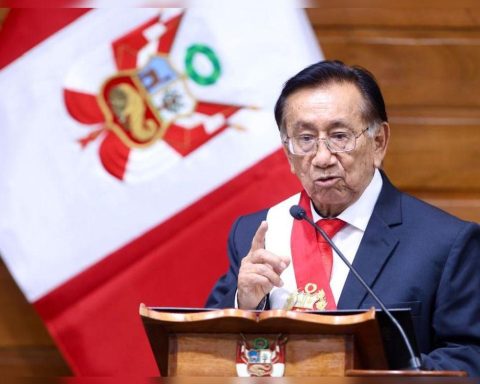
For his part, Pedro Riega López, dean president of the Board of Directors of the College of Deans of Professional Colleges of Peru, congratulated the JNE for the initiative and pointed out that the agreement represents the sum of wills of institutions committed to the development, transparency and legitimacy of the electoral processes.
“This agreement is a reflection of our civic spirit and our ethical responsibility to contribute by example and technical knowledge to the consolidation of political culture based on principles, values and unrestricted respect for the popular will,” he stated.
The minutes were signed by representatives of the Medical College of Peru, the Association of Winegrowers of Peru, the Transparency Civil Association, the Peruvian Book Chamber, the Autonomous Central of Workers of Peru, the Unitary Central of Workers of Peru, the Peruvian Civil Collective of the State, the National Confederation of Radio and Television, the Coordinator of Local Media Medios Perú, Conadis and Editora Perú.
Likewise, from the Roundtable for the fight against poverty, Reniec, ONPE, ONP, Society and Disability (Sodis), National Society of Industries, UNICEF, Consortium for Economic and Social Research (CIES), as well as the universities of Engineering and Technology, Jaime Bausate and Meza, of Lima and San Ignacio de Loyola.
The Banco de la Nación, Caja Municipal de Paita, National Chamber of Tourism Production and Services of Peru, Superintendence of the Environment, and other entities that will sign the document in the coming days will also join.
By signing the aforementioned social pact, the entities committed to supporting the dissemination of the JNE Informed Vote Program campaign, through the distribution of merchandising in their premises, placement of banners, posters, among other educational materials in their service centers and/or facades.
Likewise, they will broadcast television and radio spots of the campaign in their programming and/or closed circuit, as well as the electoral debates, when appropriate. They will also disseminate informative content on their social networks (flyer, banner, reels, gallery, etc.), among other actions.
The event, held in the auditorium of the Medical College of Peru, in Miraflores, was attended by members of the Plenary Session and officials of the JNE; the British ambassador to Peru, Gavin Cook; Alissar Chaker, resident representative of the UNDP, as well as representatives of public and private institutions.
RECOMMENDED VIDEO