Residents of Maiquecito and La Sombrilla took to the streets after more than a week without electricity or water, while in Santiago de Cuba neighbors blocked a street due to the accumulation of garbage and the lack of state response.
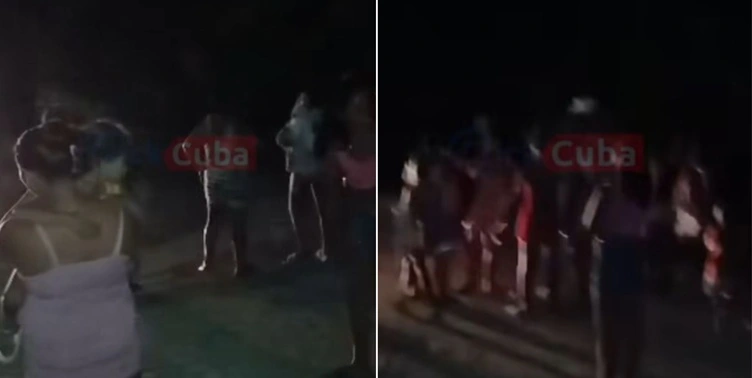
MADRID, Spain.- Residents of at least two communities in the province of Guantánamo, including Maiquecito and La Sombrilla, took to the streets this Thursday night to protest against the lack of electricity and water, amid the consequences left by the passage of the Hurricane Melissa. The demonstrations were recorded in areas close to the Guantanamo Naval Baseaccording to videos and testimonies shared on social networks by journalists and citizens of the area.
Independent journalist José Luis Tan Estrada released night images of the protest in Maiquecito (initially shared by Click Cuba) taken during a blackout. In them you see mothers with children in their arms. The publication generated reactions from affected residents. A user identified as Cecil Ramos Lameda commented: “A lot of people really don’t know how to demand their rights, myself included, I think that whatever little is done we have to support them. They are the most forgotten. My province Guantanamo; Cuba needs freedom.”
Another neighbor, Glenys Suárez, denounced the deliberate interruption of the internet service after the protest: “Since last night they had taken down our internet until now, so that the people would not see that they had gone down because they are terrified that everyone will go down!”
Click Cuba noted that the inhabitants of Maiquecito had been without electricity for “10 consecutive days” and were also facing a drinking water crisis. “The cisterns are empty, the pipes are dry and desperation is growing among residents, who report living in inhumane conditions,” the digital media reported. A neighbor quoted by the platform said that “only when someone dares to shout ‘Down with communism!’ or place a sign on the street, water magically arrives. Otherwise, we are condemned to drought.”
In La Sombrilla, a nearby town, the situation was described as similar: protests and accumulated unrest due to the absence of a state response.
Journalist José Raúl Gallego reported that, according to residents, the internet service in Guantánamo was cut off after the protests and only began to be restored this Friday: “After the protest in Maqueicito last night, I have not been able to communicate with anyone there,” he wrote. Residents confirmed to Gallego the mobile data blackout and the partial restoration of service during the day.
Protests also in Santiago de Cuba
Demonstrations also took place in Santiago de Cuba this Thursday over similar problems linked to the collapse of basic services. Independent journalist Yosmany Mayeta shared videos of neighbors who closed Cristina Street, in the Mariana de la Torre neighborhood, due to the accumulation of garbage and the lack of electricity.
“After days with the garbage accumulated without anyone from the State removing it, the Electric Company reported that they could not restore the service because the waste prevented work in the area,” Mayeta explained. Faced with this situation, the neighbors completely blocked the road to demand a solution.
Affected residents reacted by denouncing the extension of the blackout and the health risk. Rubén Vicents said: “Today we have been 9 days since Hurricane Melissa passed and 10 days without power and the authorities […] They have not commented on the collection of solid waste and the arrangement of electrical cables […] the level of infestation chicungunya “It’s tall.”
Another resident, Tata, added that on the block “there are small children and they don’t care.” Ileana Ferro questioned the lack of official response: “A cyclone of such magnitude that they said there were already brigades prepared […] For more than a week almost all the streets are full of debris […] the proliferation of the virus on the rise.”
Noelia Ulloa described the situation as “a lack of respect for the people,” pointing out that the accumulated garbage dumps are causing diseases.
The protests reflect an increase in community discontent in areas affected by recent meteorological phenomena, where the population denounces state abandonment, prolonged electricity cuts, lack of water, accumulation of waste and no health response.