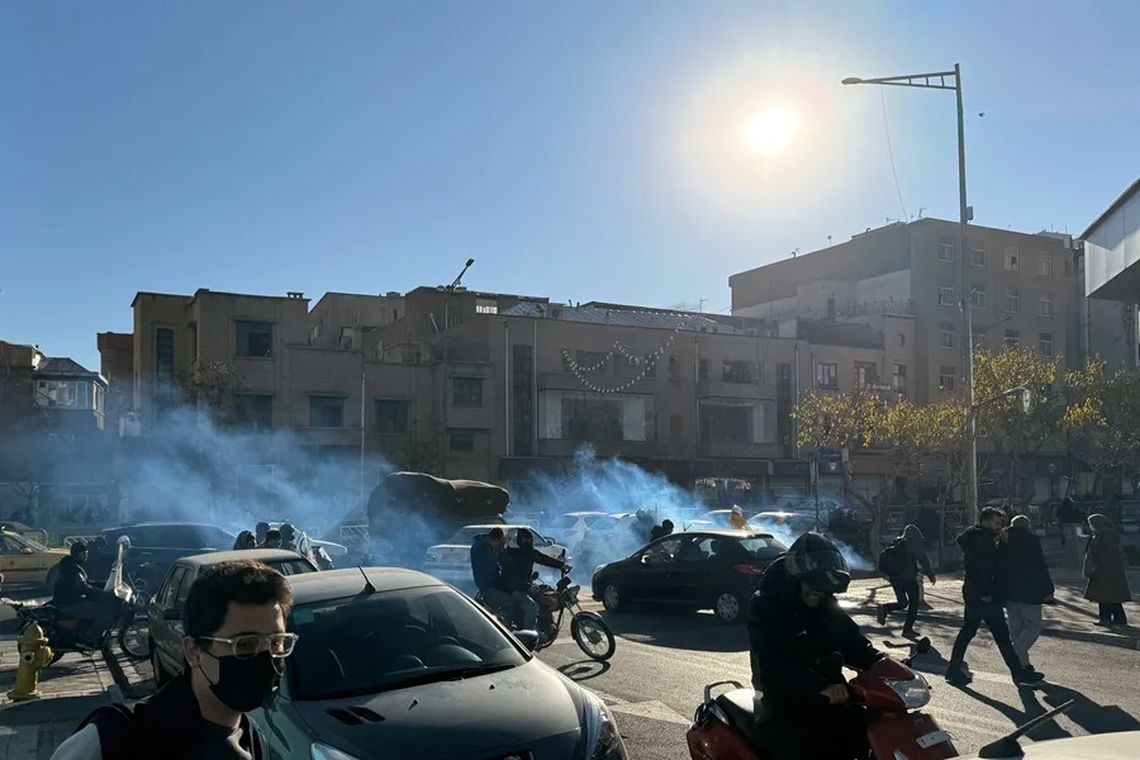
Iranian protesters occupied the historic Grand Bazaar of Tehran, the commercial epicenter of the capital, on Thursday, while the government ordered a general shutdown of the Internet in an attempt to stop the spread of the protest.
The mobilization, initiated by merchants hit by inflation and the collapse of the rial, became the most visible symbol of the economic crisis that has unleashed the largest wave of social unrest in years.
According to the NGO Iran Human Rights (IHR), based in Oslo (Norway), at least 45 people have died, including eight minors, since the beginning of the protests that have shaken Iran since the end of December 2025.
Mahmood Amiry-Moghaddam, director of the IHR, denounced that “the repression is spreading and becoming more violent every day.” In addition, “hundreds” of people have been injured and more than 2,000 have been arrested, with Wednesday being the deadliest day, with 13 protesters dead.
For their part, the media and Persian government authorities have reported the death of five members of the security forces in the first twelve days.
Iran rejects Trump threats
This Friday, Iran rejected the claims of the president of the United States, donald trumpthat he would come to the aid of protesters in the Persian country in the event of state repression, and warned that any foreign interference would have serious consequences, reported the Spanish agency EFE.
“Trump must know that US interference in this internal matter would mean destabilizing the entire region and destroying US interests,” the secretary of Iran’s Supreme National Security Council, Ali Larijani, said on the X social network.
Larijani warned that the American people must know that “Trump started this adventure. They must be careful with the safety of their soldiers.”
The US president, who in October 2025 authorized an attack on Iranian nuclear facilities, issued harsh warnings against Tehran, assuring that Washington will intervene militarily if Iranian forces shoot and kill peaceful protesters.
The Grand Bazaar as the epicenter of unrest
The occupation of the Grand Bazaar, considered the economic heart of Tehran, has a strong symbolic impact.
Merchants closed their stalls and joined the demonstrations, denouncing that the depreciation of the currency and the increase in prices have made their businesses unviable.
The paralysis of this commercial artery sent a clear message: the crisis has reached the core of Iranian economic life.
The security forces tried to disperse the protesters, but the concentration continued for hours, with slogans against the economic deterioration and the lack of structural solutions.
The Internet shutdown, applied in several cities, sought to limit the coordination of protests and the flow of images abroad.
Subsidy as an immediate response
The government announced over the weekend a monthly subsidy of one million Tomans — about $7 — per person for four months, credited to accounts as credit for basic products.
Spokesperson Fatemeh Mohajerani presented the measure as a relief for families, although analysts consider it insufficient in the face of inflation and the loss of purchasing power.
“It is a palliative, not a solution,” commented a local economist. In a country where the minimum wage is around 100 dollars and the monthly average barely reaches 200, the subsidy covers only a fraction of basic needs.
Western sanctions
The root of the crisis is Western sanctions, led by the United States, which have hit the energy and financial sector hard. Oil production, which in 1999 reached 3.5 million barrels per day, was reduced to just over 1.1 million in 2025, limiting the inflow of foreign currency.
Iranian banks were blocked from the international SWIFT system, making global transactions and payments difficult. Additionally, Washington sanctioned individuals and companies from Iran and Venezuela for supporting the drone and missile trade, freezing assets linked to the government.
The consequences are visible in everyday life. Year-on-year inflation reached 52% in December 2025, while the rial lost more than a third of its value against the dollar in one year. Merchants and families denounce that the prices of basic foods have skyrocketed, and that the announced subsidy barely covers a fraction of their needs.
The protests began with complaints from merchants in Tehran and soon spread to other provinces.
Accusations against the United States and Israel
The Chief of the General Staff of the Armed Forces, Abdolrahim Mousavi, accused the United States and Israel of taking advantage of the demonstrations to generate unrest through “psychological operations and cognitive warfare.” According to Mousavi, trained agents tried to infiltrate the protests to destabilize the country.
The government insists that the mobilizations are manipulated from abroad, although independent organizations point out that the root of the discontent is internal and responds to the economic crisis. “People are protesting because they can’t live with these prices, not because someone is manipulating them,” said one activist in Tehran.
Demonstrations have been repressed in some cities, with reports of clashes and arrests. Human rights organizations denounce excessive use of force, while the government affirms that it seeks to preserve security.