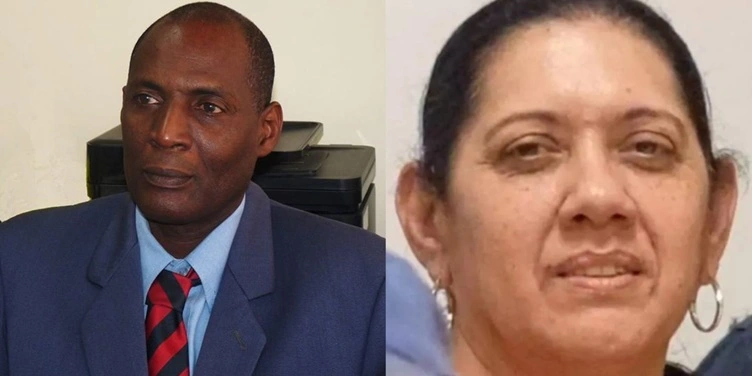
Prosecutor Edward Roberts Campbell intervened in proceedings against activists such as Sulmira Martínez Pérez, while a public complaint exposes that her daughter sells foreign currency in the Cuban informal market.
MADRID, Spain.- The Foundation for Human Rights in Cuba (FHRC) added to his list of repressors to the prosecutor Edward Roberts Campbell and the judge Paula Joaquina Rodríguez Sánchez, both directly linked to the judicial process against the former Minister of Economy Alejandro Gil Fernández, recently sentenced in Cuba to life imprisonment. The organization denounces that the two officials acted as operators of a judicial system used for political purposes and lacking guarantees of independence.
In the case of Roberts Campbell, the FHRC highlights its role as prosecutor in charge of supporting the accusation that led to Gil’s final conviction. Career prosecutor since the 1980sSince December 2020, Campbell has held the position of Chief Prosecutor of the Directorate for Combating Corruption and Illegalities of the Attorney General’s Office of the Republic. From this position, the regime claims to combat administrative abuses and economic crimes, although its name appears associated with judicial processes considered exemplary by human rights organizations.
In addition to the Gil case, Roberts Campbell has intervened in cases of repression of the people. Among them, the prosecutor’s request for 10 years in prison against the young influencer and activist stands out. Sulmira Martínez Pérezknown as “Salem de Cuba”.
Martínez Pérez was tried for critical publications on social networks and is still awaiting a final sentence months after the trial.
In this context, the journalist Mario Pentón reported on social networks a situation that shows contradictions within the environment of senior judicial officials. Pentón shared a screenshot of a Facebook post attributed to Gabriela Roberts Molinet, identified as the daughter of prosecutor Edward Roberts Campbell, in which services for sending remittances, transfers and selling dollars to Cuba are offered, with rates aligned with the informal market reflected by the platform. The Touch.
“How do you explain that the daughter of two prosecutors – responsible for requesting more than 10 years in prison against citizens for publishing criticism of the regime on Facebook – is dedicated today to selling dollars on social networks at the rate of The Touch” wrote Pentón. In his message he added that these types of practices expose “the double standards of the perpetrators of the Cuban regime: repression for some, ‘informal’ market for theirs.”
The prosecutor’s responsibility is aggravated by the fact that he has participated in international programs and forums on judicial transparency and the rule of law, including spaces financed by the European Union, theoretically oriented towards the promotion of legal guarantees and human rights.
For her part, Judge Paula Joaquina Rodríguez Sánchez, member of the State Security Crimes Chamber of the Supreme People’s Court, was the one who handed down the sentence of life imprisonment against Alejandro Gil. His judicial career has been linked to other repressive decisions, such as the review and ratification of sentences imposed on protesters of the July 11, 2021 (11J), in processes where prison sentences were upheld against dozens of citizens, including young people.
Rodríguez Sánchez has also participated in official delegations of the Cuban State to international organizations, where he has defended the island’s penal system against complaints of torture, cruel treatment and systematic violations of human rights against political prisoners.
The trial against Alejandro Gil Fernández took place under marked secrecy. The Supreme People’s Court reported that the former deputy prime minister was sentenced to life imprisonment for crimes that include espionage, bribery and others linked to economic activity, and an additional 20 years in prison in a second criminal case, in addition to accessory sanctions such as confiscation of assets and deprivation of public rights.
However, authorities have not publicly specified the personal benefits obtained by Gil, the foreign firms involved, the bribed officials, or the classified information he allegedly handled. This lack of transparency has fueled questions and has led experts and users on social networks to point out that the former minister could be used as a scapegoat in the midst of the deep economic crisis that the country is going through.
The FHRC explained that the inclusion of Roberts Campbell and Rodríguez Sánchez in its database seeks to document the individual responsibility of judges and prosecutors who, from their positions, contribute to state repression, as well as facilitate eventual accountability processes at the international level.