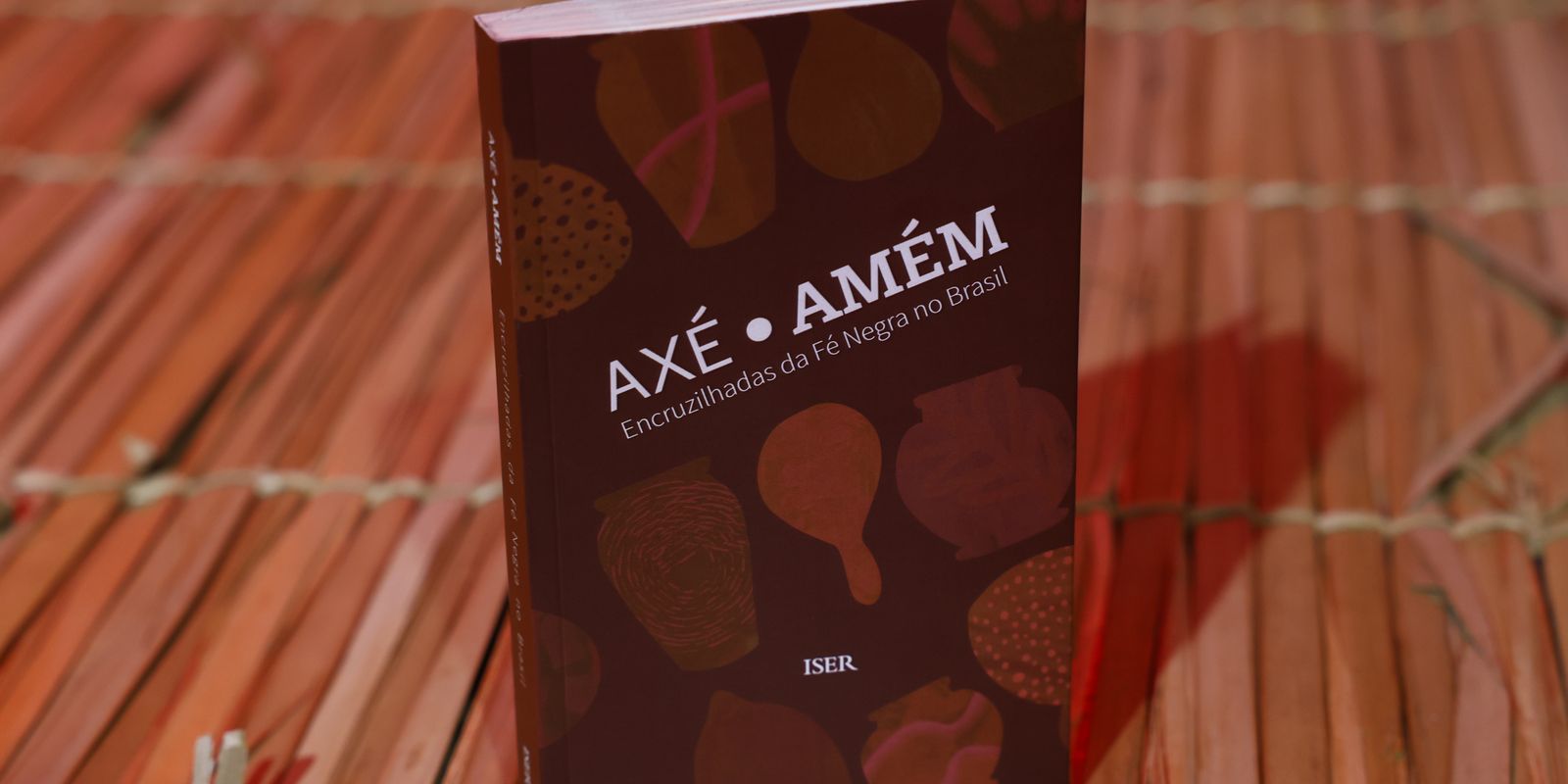
Building bridges between different expressions of faith in Brazil is the center of Formação Axé-Amém, an initiative that brought together black evangelical people and people from African-based religions to articulate strategies to combat religious racism and promote integration through faith. 
The initiative is from the Institute of Religious Studies (Iser) which, over four months, received 37 writers selected to produce the book “Axé-Amém: Crossroads of Black Faith in Brazil”.
The publication brings together the authors’ experiences of dual religious belonging (feeling of identification and connection with a faith, community or religious tradition), family memories, political formation and practices of spiritual resistance, based on the concept of Writing, developed by writer Conceição Evaristo. A writing that starts from the individual to narrate stories of the collective of a community.
For Amanda Damasceno, one of the authors, the initiative to participate in the Axé-Amém training came after a process of transformation and family acceptance. A mother of two children and an evangelical, she had difficulty accepting it when her eldest daughter started practicing Candomblé at the age of 16.

Book Axé-Amém: Crossroads of Black Faith in Brazil is launched in Rio – Photo Fernando Frazão/Agência Brasil
“As an evangelical, I was always taught that religions of African origin were demonized. At the same time as I wanted to support my daughter, I was very afraid, what if she came in here wearing those clothes? That’s why I always say, today my purpose is to combat religious racism in society, but to do so I had to fight it within myself, the transformation had to come from me”, she says.
Babalorixá Igor Almeida believes that the project is a way to break paradigms and build a new perspective of respect between the aspects of black religiosity in Brazil.
“Our country is pluralistic, we have a plurality of religions here, of endings, not just black, indigenous, Mamluks, and we need to learn to have respect, not only in religious endings, but in the simple fact of wanting to be someone within a society”, he stated.
The publication was launched last Tuesday (2), in Rio de Janeiro. Carolina Rocha, researcher at Ier and one of the creators of the Axé-Amém training, hopes that the book can be a tool for debate and religious education.
“We hope that the book works as a bridge, not as a wall. It was designed to be read in churches, terreiros, communities, libraries, schools and training circles”, he states.

Candomblecista historian Carolina Rocha at the launch of the book Axé-Amém: Encruzilhadas da Fé Negra no Brasil – Photo Fernando Frazão/Agência Brasil
She classifies the initiative as an “affective cartography of existences that do not fit into hate speech.” The authors were selected through a public notice, and the high number of evangelical people joining the project was a pleasant surprise for the creators.
*Intern under the supervision of journalist Tâmara Freire