“I am very proud of being able to see my name in the credits of books that are truly incredible, knowing that I am part of a work whose reading can, eventually, be the reading of someone’s life”.

Self-employed editor and publisher, Hugo Maciel de Carvalho graduated in Law and worked at a law firm, but adjusted his path and opened new paths in the book market.
In the context of the expansion of the publishing and bookselling sector in the country in recent years, with an increase in the number of companiesas shown by a survey by the Brazilian Book Chamber (CBL), professionals interviewed by Brazil Agency reported how the sector allows them to see purpose in their work.
Since finding his new direction, Hugo admits that he has lost count of how many books have his name in the credits.
“In the end, what really matters is knowing that, in some way, I helped shape ideas that circulate, are read, discussed, questioned ─ and continue to produce meaning in the world.”
The book he is most fond of is The Arid Landby author TS Eliot, translated by Gilmar Leal Santos.
“It’s one of my favorite poems of all time. This was the first book I published under my own label, as a publisher”, said Hugo, adding that he values projects that help us think about the future.
“The crisis in Venezuela reminded me of two books that deserve to be read together. I worked as a text preparer on both”, he recalled.
The first of them ─ Autonoramaby Peter Norton ─ shows what kind of political choices shaped the world to create an infrastructure that corrodes social life. The second ─ Road to Nowhereby Paris Marx ─ expands this diagnosis, by analyzing various mechanisms of concentration of power, privatization of infrastructure and social control.
“Norton explains how we got here. Marx shows the direction in which we are now being pushed,” he concluded.
He also highlighted a book he worked on that has not yet been published: Jacob’s Ladderby Russian writer Liudmila Ulítskaia.
“It is a monumental novel, built from letters, diaries and documents, which follows several generations of a Russian family throughout the 20th century, going through revolution, war, Stalinism, exile and the end of the Soviet Union”, said the editor.
“This was one of the most demanding and intellectually stimulating projects of my career, because each page intersects literature, linguistics, philosophy, music, science and history with a density that is rare in contemporary fiction”, he explained.
Family tradition
Reading is like a family tradition, Hugo has been reading to his son since he was born. In addition to books at home, they make weekly visits to public libraries.
“He now knows how to read on his own, but every night my wife and I read to him, or alongside him, and this is very good for the three of us, for our emotional memory as readers. It’s good for our future.”
“I love books. When I was 12 years old, my grandfather gave me his book to comment on. It all started there. One day, he arrived at my house and went straight to my room, closed the door and took a manuscript out of an envelope. He just told me: ‘read it, I want your opinion, when you’re ready, let me know; but it’s a secret, don’t tell anyone'”, he revealed to the reporter.
Hugo supported his grandfather’s wishes, they worked on the book “in secret” until they published the first edition.
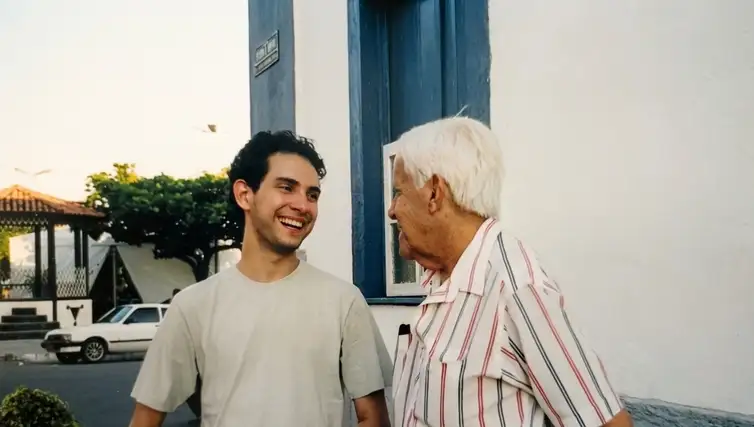
Freelance editor and publisher Hugo Maciel de Carvalho and his grandfather. Photo: Hugo Maciel de Carvalho/Personal archive
“After that, we continued working together on his books, four in total. When he passed away, we were still working on the books. One day I will publish his ‘Complete Works’.”
The editor reveals that the work pace is intense and requires a lot of focus, with many pages per day.
“It’s not something you read and that’s it, like a book you throw in a hammock to read on a Saturday afternoon; you need to read it, reread it, go back to the beginning to see if there are any contradictions, discuss it with the author or the publisher, read it again to see if it’s good. I work a lot in the early hours of the morning, because of the silence.”
“It pays very little. People think that being a proofreader is an interesting ‘gig’. But it’s a lot of work, if you know what you’re doing. And there’s not always demand. So, there are times when you need to invent work or you’ll end up reviewing the late bills that accumulate”, reported Hugo, with good humor.
An independent publisher
For Florencia Ferrari, partner at Ubu, independent publishers, in general, are the result of a desire on the part of editors who want to publish works they like and admire.
“I don’t break the rule,” he said.
She says that she sees Ubu as a project platform, where there is an opportunity for creation and learning, including with designers, artists and authors.
The meaning of this work, for her, goes beyond generating income: “it is a place of fulfillment and a way of being in the world”.
She also highlights the importance of good working relationships in this context. “I’ve experienced toxic, competitive, surveillance, control work environments. And I like to think that at Ubu we created an environment that is characterized by exchange, learning, collaboration, support, care and the leadership of people who know their areas.”
In addition to a healthy work environment, the production of knowledge and the dissemination of ideas, Florencia emphasizes that ethical and political positioning is part of the publisher’s way of operating.
“I think this is also characteristic of some independent publishers: I see Ubu as a place of positioning and thinking, including a critical attitude, in the sense of Foucault, a political attitude, of taking a stand. Not making it a form of activism, but rather a political ethic”, he explained.
More than 500 books
Currently a professor at the Federal University of Rio Grande (FURG), but without leaving the profession of translator, Adail Sobral has already translated more than 500 books. He was also a member of the Jabuti Prize judging panel in 2004, 2007, 2008 and 2018.
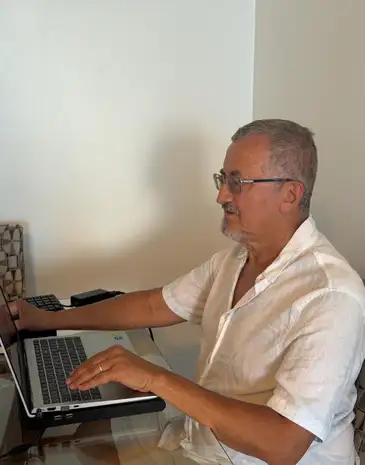
Professor at the Federal University of Rio Grande and translator Adail Sobral. Photo: Adail Sobral/Personal Archive
“I started by chance, but then I fell in love with translating. And I haven’t stopped.”
The translation of the first book ─ Speech actsby John Searle ─ happened while I was a postgraduate student, in 1981, when translation was part of academic activities.
“They invited everyone to start translating. It was the university that translated and it was part of our activities. We translated for free. There, it wasn’t professional yet”, said Adail.
From 1985 to 1999, he dedicated himself completely to the profession, largely with his wife at the time, Maria Stela Gonçalves (1954-2015).
“At one time, I translated a lot of IT stuff. It was what supported me. Then, I started translating in the humanities area, and then there were a lot of things”, recalled Adail, citing authors such as Jean Baudrillard, Jonathan Barnes, David Harvey and Félix Guattari, as well as religious titles. Afterwards, the translator specialized in the field of medicine. “That’s what made money”, he reveals.
One of the works he most enjoyed working on was Hero with a Thousand Facesby Joseph Campbell.
“He writes about mythology in a way that is literary and also technical. So it is a beautiful book, which aesthetically pleases, not only the content but the form, the way it is organized. And this translation had a particularity. There was no time to be edited, there was no revision. The revision was mine, I translated it myself, I revised it myself”, he recalled.
“I also enjoyed translating, together with Maria Stela, Jean Baudrillard: Symbolic exchange and deathwhich came out in 1996. This book also has a particularity: its first chapter is a transcription of speech. We managed to reproduce the speech in writing, it was very beautiful”, he said.
The couple also translated the complete works of Santa Teresa de Jesus, which is another of the works that brought them the most satisfaction, despite requiring intense dedication.
“It was an original from the 16th century, and the translation had to be adapted for modern times. It was 2 thousand pages. We spent a year translating,180 [páginas] a month, more or less”, he recalled.
“These three [trabalhos] I love it. I love these books anyway. And Santa Teresa, imagine, we spent a year living with a work”, he said enthusiastically.
Professional appreciation
Adail mentions the fatigue caused by the job and his long working hours, even though he found himself in the profession.
“I spent 15 years translating outside of university. Then, I decided to come back because I was tired of just translating. At one time, I translated 14 hours a day, I had two or three clients [ao mesmo tempo]”, he recalled.
Regarding the hiring model in the publishing and bookselling sector at that time, he assesses that it was an almost paternalistic relationship.
“In a way, we weren’t considered professionals. The pay wasn’t good, you had to translate a lot to survive. Today I think it’s a little better, but not that much either.”
Adail mentions that employers justified a lower salary due to payments to the National Social Security Institute (INSS). Currently, translators provide services as legal entities, but there is still professional devaluation.
“The big publishers [no país] determine what price they will pay for the translation. The smaller ones negotiate a little, but they don’t have the power to pay”, he commented on the difficulties of the profession in the country.
According to him, professionals achieve better remuneration when translating technical areas ─ which require terminological precision ─ and when providing services to foreign clients.