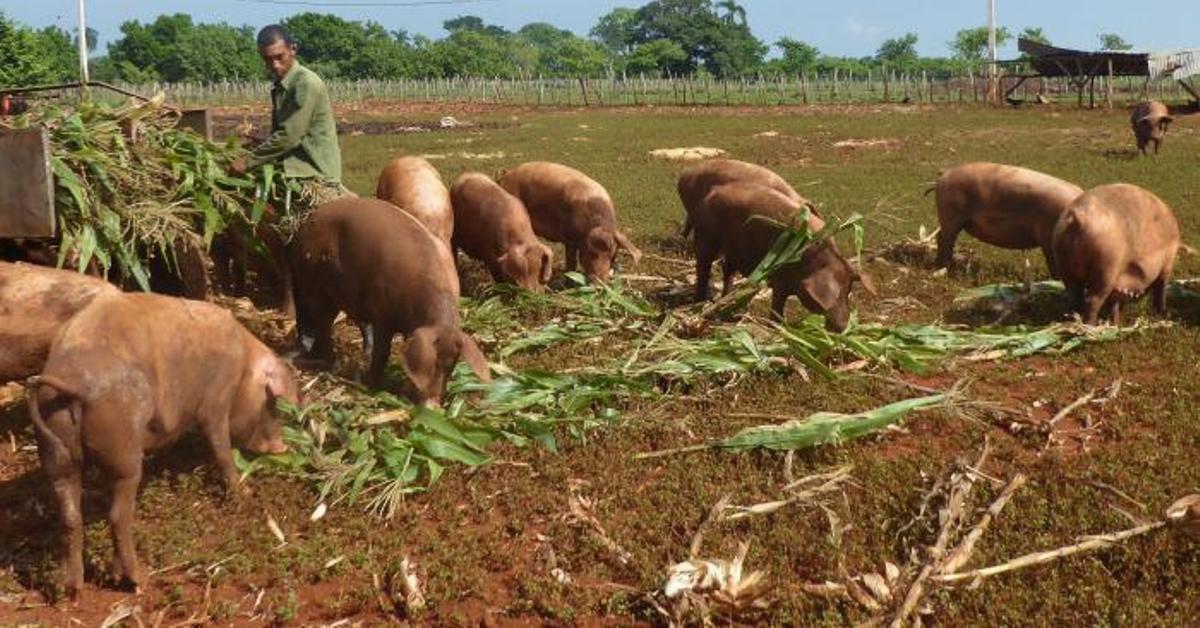
Madrid/Even when there is good news in Cuba, something tarnishes it when it does not blacken. The official press celebrates this Tuesday that the Granma Pig Company managed to close the year with positive figures in 2025: not only did it distribute profits, but it recovered livestock mass and genetic objectives. And all, thanks to private producers, says a note published in Granma.
“The state company has gone from being a direct producer to a manager and facilitator. Today, 95% of the meat, which meets its annual plan, comes from agreements with private producers included in the program,” the media highlights, while praising the “practical turn” carried out by Porceg. The result allowed pork to be sold in bands for roasting during the end-of-year fairs, although it was only done in Bayamo and Manzanillo, since the situation is not suitable for launching fireworks either.
“The company exceeded its goal of pure breed breeders (208 compared to 200 planned) and reached 106 dark coat breeders out of one hundred planned, and the feed factory operated at 105% of its capacity. These indicators are the basis for a 2026 with greater growth aspirations,” says Olemnis Tamayo Milan, director of Porceg.
There are 50 producers involved in the project who “assume the risk and cost of fattening, while the company provides genetics and technical assistance”
The note explains that there are 50 producers involved in the project who “assume the risk and cost of fattening, while the company provides genetics and technical assistance.” In addition, the participation of the Valenzuela Multiplier, in Buey Arriba, is also key, which provides the replacement of piglets (an animal that is preparing to have babies) to each of the units.
At the end of November 2025, they did so with almost 500 animals – including breed and Creole heads – that had “indicators of excellence.”
The note also addresses the contribution of the Pedregales production unit, which has two lines in its breeding system, the cc-21 breed stallion and the Yordan breeding female, a cross between the York and Landrace breeds. Its final product is the result of crossing these two, with good quality, according to the company.
However – and although they have 190 breeding animals, 253 offspring, one hundred pre-fattening animals, and five boars – their director, Alejandro Marcos Borges Briñones, regrets that poor nutrition prevents them from recovering the historical capacity they had, estimated at about 8,000 head.
“To address this limitation, a production plan adjusted to the available supply has been implemented, incorporating food alternatives such as sweet potato, cassava and pumpkin. In addition, nutrition has been improved through the preparation of fish meal in silage and the incorporation of starter feed for fry and pre-fattening, which has improved feed conversion,” he points out, although part of the population finds that this type of feed does not provide a good flavor to the meat.
Despite this, the results have improved. About 9.7 calves are born per birth – out of a target of 9.5 – and mortality, estimated at a maximum of 21%, has been reduced to 15%, which means seven fewer deaths in breeding and 20 fewer in pre-fattening. Quite an achievement if compared to the 40% mortality rate that occurred two years ago.
The note once again touches on the serious problem of the costs of importing feed, given the fall in national production. “The provincial factory operates with a constant juggling of volatile raw materials: national corn, rice powder, fish meal. There is no mandatory agricultural program that guarantees protein or energy crops dedicated to the sector,” he laments. Granma.
The little that is obtained by selling 30% to AgroCuba must be used to import feed again
The consequence is the loss of foreign currency, since the little obtained by selling 30% to AgroCuba must be used to import feed again.
“What limits us the most is food,” says Borges Briñones conclusively, who doubts that we can return to the figures that were once reached no matter how much they try to imaginatively make up for the shortage of imported feed.
Mariela Parra Céspedes, production manager at Multiplier Valenzuela, admits that the plan for transferred pigs amounts to 706, but it is at 418, and cites water – or, rather, its poor supply – as another problem. “At the beginning of the year, the lack of water directly affected production, a problem that, although partially resolved, still demands a definitive solution. Currently, the supply is ensured by pumping water from the river with its own oil turbine and distributing it manually with forklifts, which implies complex and limiting operational logistics,” he indicates.
The note recalls that pork production in Cuba amounted to about 200,000 tons in 2018, while in 2024 it reached a scandalous minimum, with 9,300 tons, which has meant prices that the majority of the population cannot afford, sometimes reaching 1,000 pesos per pound.
“Diagnosing this – in reference to the improvement in the province’s data – as a ‘sustainable recovery’ would be a mistake. The decrease in national genetic capital – with an estimated loss of 73% of breeding stock between 2020 and 2024 – is a burden that will take years to overcome,” the official newspaper underlines.
The note concludes with a no less rampant criticism: “As long as production does not manage to recover from the deep dependence on imported food and the deterioration of infrastructure, that cost, equivalent to an exorbitant fraction of the average salary, will continue to be the barrier that turns a food, once basic, into practically a luxury.”