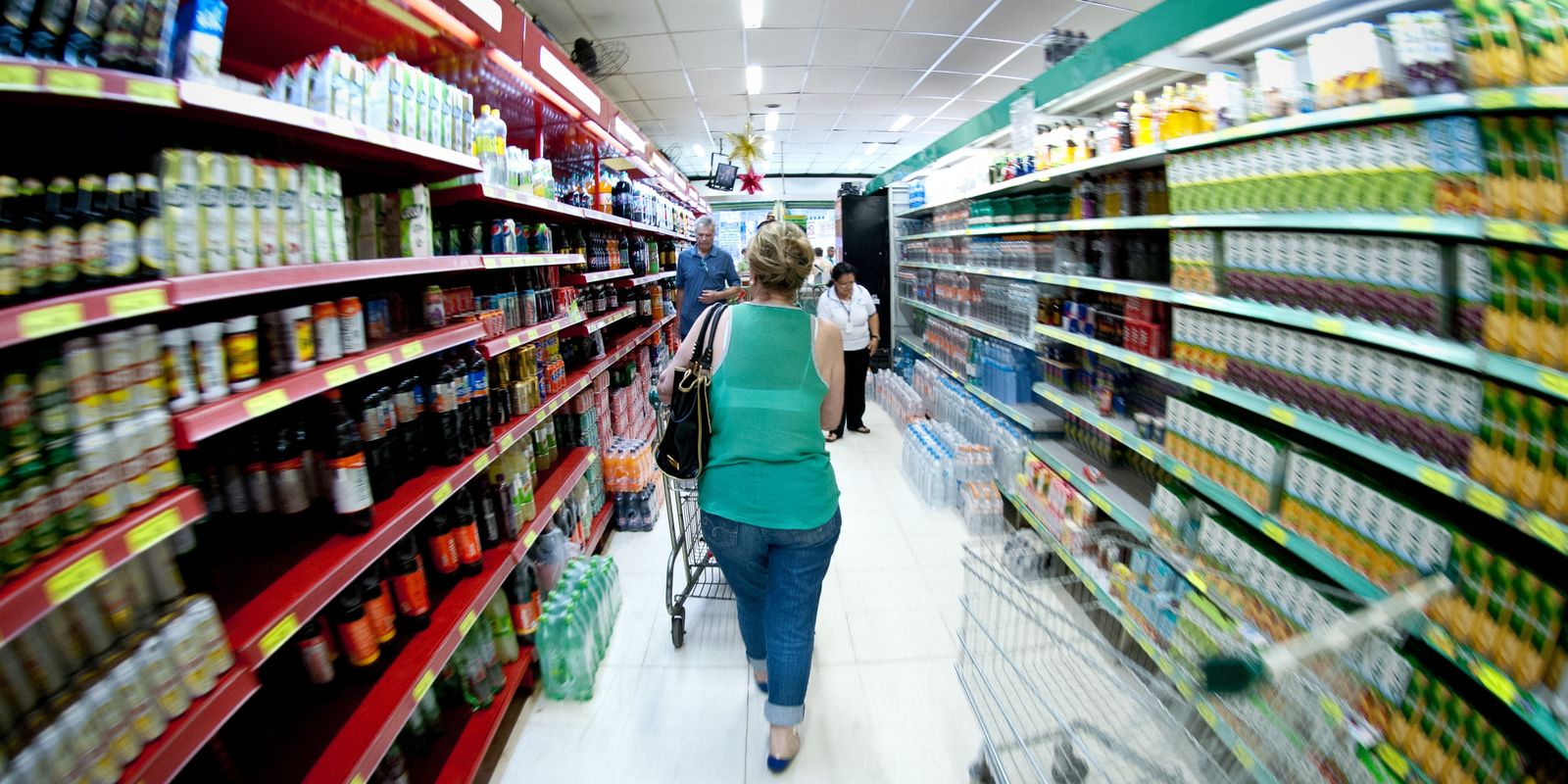
The price of the set of basic foods decreased in July 15 capitals and increased by 12, according to the National Food Basket Survey, released on Wednesday (20) by the Intersindical Department of Statistics and Socioeconomic Studies (Dieese) and the National Supply Company (Conab). This is the first time research encompasses all 26 capitals and the Federal District. Until then, the survey was made only in 17 capitals. 
The most important falls in the price of the basic basket occurred in Florianópolis (2.6%), Curitiba (2.4%), Rio de Janeiro (2.3%) and Campo Grande (2.1%). The highest highs occurred in the Northeast: Recife (2.8%), Maceió (2%), Aracaju (2%), João Pessoa (1.8%), Salvador (1.8%), Natal (1.4%) and São Luís (1.4%).
São Paulo was the capital where the basic food set the highest price (R $ 865.90), followed by Florianópolis (R $ 844.89), Porto Alegre (R $ 830.41), Rio de Janeiro (R $ 823.59) and Cuiabá (R $ 813.48).
In the cities of the North and Northeast, where the composition of the basket is different, the lowest values of the basic food set were recorded: Aracaju (R $ 568.52), Maceió (R $ 621.74), Salvador (R $ 635.08) and Porto Velho (R $ 636.69).
The comparison of July 2024 basket values with July 2025 showed that in the 17 capitals where the survey was conducted during this period, there was a high price in all, with variations between 2%in Belém, and 19.5%in Recife.
From the year until July, in the 17 capitals surveyed, there was also an increase in all, with rates that oscillated between 0.3%in Goiânia, and 11.4%in Recife.
Based on the most expensive basket that, in July, was that of São Paulo, and taking into account the constitutional determination that the minimum wage should be sufficient to supply the expenses of a family of four, with food, housing, health, education, clothing, hygiene, transportation, leisure and pension, the amount of the minimum wage required, the seventh month of the year, should have been $ 7,274.43 times The current minimum of R $ 1,518.
According to the survey, when the cost of the basket and the net minimum wage is compared, after the 7.5% discount on Social Security, the worker paid by the national floor committed, on average, in the 27 capitals surveyed in July, 50.9% of the income to purchase basic food products and, in June, 51.1% of net income.
Products
The price of the pound of rice fell in July compared to June in almost all the capitals surveyed, except in Recife (up 0.65%). The variations recorded in Porto Velho, a 7.1%drop; Palms, less 5.2%; and Florianópolis, less 5%.
The price of beans decreased in 24 capitals in July, compared to June. Grain Black, researched in the municipalities of the South, Rio de Janeiro and Vitória, dropped in the five capitals, the most expressive verified in Vitória (-6.9%) and Florianópolis (-5.2%). For Grão Carioca, collected in the other capitals, were observed high in three locations: Porto Velho (0.6%), Maceió (0.4%) and São Luís (0.3%). The decreases ranged from -4.3%in Fortaleza and -0.2%in Aracaju.
The value of the kilo of coffee powder fell on 21 of the 27 cities surveyed in July 2025, compared to the previous month. The most significant falls were recorded in Belo Horizonte (-8.1%) and Teresina (-3.9%). Only six capitals showed an increase in value, especially Macapá (7%), Cuiabá (1.3%) and Boa Vista (1.1%).
“Despite the leaning national and world inventories, the harvest advance and the consequent increase in coffee availability in Brazil have been pressing downwards. And domestic prices have followed Commodity oscillations in New York and London bags, in the face of 50% shrinkage in US imports, which generated speculation about the possible flow of Brazilian crop,” said Dieese, Dieese, Dieese, said, in note.
The price of first beef was behavior varied in the 27 cities analyzed: there was an increase in 11 capitals, especially Boa Vista (2%) and Salvador (1.8%). Falls were recorded in 16 other capitals, the most important in Belém (- 2.9%).
“Throughout 2025, the external demand for beef has been intense. Animal slaughter was slower and meat prices fell in Brazil after the announcement of 50% fare for Brazilian exports to the United States,” said the Dieese.