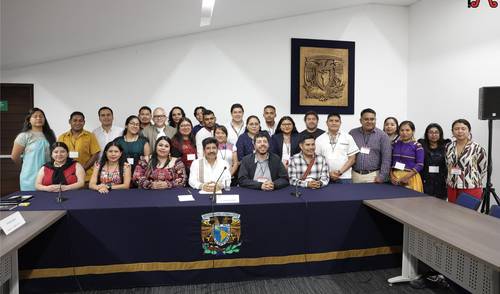
Minister Hugo Aguilar Ortiz reaffirmed his commitment to public universities.Photo @Hugoaguilarorti
Gustavo Castillo
La Jornada newspaper
Saturday, September 13, 2025, p. 8
The president of the Supreme Court of Justice of the Nation (SCJN), Hugo Aguilar Ortiz, and Alejandro Gertz Manero, Attorney General of the Republic, held their first institutional meeting at the headquarters of the highest court in the country.
Ministerial and judicial officials confirmed the meeting, which was from 9 to 10 in the morning and the agenda of the topics discussed was considered confidential.
During the government of Andrés Manuel López Obrador and the management of Arturo Zaldívar at the head of the Court, a high -level working group that allowed to address the matters of interest for the police and ministerial authorities, which expedited the processing of hearings and the speeding up of applications for communication intervention with judicial authorization.
However, under the management of Minister Norma Lucía Piña Hernández, it was suspended and there are cases in which the hearings requested by the Prosecutor’s Office have been delayed for more than a year.
Likewise, by leading the closure of the First Specialization course of Elected Judgers 2025, in the company of the members of the Judicial Administration Body, Aguilar announced that from the highest court it will launch a call for a National Justice Plan to be developed “that confirms or forces us to modify the design, the procedure of what we have as a judiciary” and pointed out that “it has been a success to take it to the streets, but we must strengthen it.
In the facilities of what was the Federal Judiciary Council, he indicated that in the previous SCJN “it was established that the president (of the Court) had his project (…) that the one who is president also knows everything, but I believe that the judicial reform if something raised with success, is that we cannot resolve it alone, we need from society”.
The more than 850 newly elected judges and magistrates told them that “they have much to contribute, much to say towards how to build a more Mexican, more authentic justice, an instrument and a mechanism for Mexican reality, nourished by the experiences of comparative law, as we say lawyers, but with authentically Mexican roots.”
He urged them that as of Wednesday “put one hundred percent of their capacity, their talent, their conviction, their passion, to give the people of Mexico better justice.”