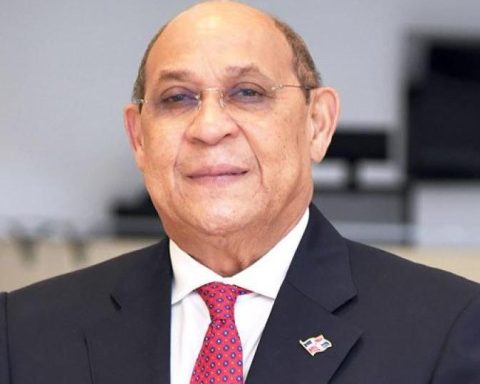
Santo Domingo.- He President of the Central Electoral Board, Román Andrés Jáquez Liranzoparticipated on Wednesday in the conversation “Electoral processes: the experience of the countries of the community of Independent states (CEI) and Latin America“With his conference entitled” Important aspects of electoral observation “, where he called to take care of these aspects for the present and future generations, as well as a key element of democracy.
“Electoral observation must be careful, deepened and professionalized, so that it remains one of the most effective tools to defend democracy, under the conviction that it is the only system that guarantees human development in an environment of full freedom,” He reflected.
Jáquez Liranzo received the invitation as a representative of the Inter -American Union of Electoral organizations (UNIORE), together with Alfredo Juncá Wendehake, President of UNIORE and Judge of the Electoral Tribunal of Panama, who was also in charge of rendering his conference “Technology and Democracy: Innovations in electoral processes”, a space that brought together speakers from different electoral institutions of other nations.
During the Jáquez Liranzo conversation, he presented about the experience, historical development, characteristics of the missions, challenges of contemporary electoral observation, the attacks on the electoral organs, the false observation and observation as mediation in political crises.
On electoral observation, he stressed that it is understood as an international mechanism for accompaniment and verification of electoral processes, and that it has distant background.
“The doctrine usually plays its first vestiges in Moldova, in 1857, when representatives of Austria, France, England, Prussia, Russia and Turkey supervised the electoral process in the fulfillment of international treaties,” said the president of the JCE and former president of UNIORE.
He said that over time the Observation reports Electoral ceased to be simple narratives to become integral diagnoses.
Likewise, the missions deployed by international and regional organizations such as those promoted by observation networks and civil society organizations, began to produce technical analysis that not only describe whatbut also guide states in the adoption of reforms.
He considered that in several Latin American countries, including the Dominican Republic, the recommendations of these missions have been incorporated into legislative and administrative practices, to the point of being considered an indirect source of electoral law.
Other conferences addressed during the event
After the intervention of the president of the JCE, each participant presented on young people in the electoral system, digital technologies in the electoral process, ethnopolitical divisions in the electoral geography of space postsoviet, electoral observation experiences with the application of the unique electronic ballot in Argentina and in the region. The reactivation of the open vote was also touched as a means of promoting confidence in elections, technology and democracy: innovations in electoral processes, among other topics.
At the end of the president of the JCE, in the name of the Plenary of the electoral body, he thanked the invitation to a space where electoral observation has become an inseparable component of democracy in Latin America.
CEI speakers and
In addition to Jáquez Liranzo, the speakers who completed this conversation are made up of Alina Balseiro Gutiérrez, president of the National Electoral Council of Cuba; Sadykovna Zupúyeva Aidán, vice president of the Central Commission of Elections and Eeferendums of the Kyrgyse Republic; Bajrom Tulkínovich Kuchkárov, vice president of the Central Electoral Commission of the Republic of Uzbekistan; Ilich Mushket Iván, Deputy Chief of the Secretariat of the AI CEI Council; Elena Víktorovna ErémenkoDeputy Director of the International Institute for the Monitoring of Democratic Development.
Also Nikolái Vladimirovich Grift, principal researcher of the Institute of International Relations and Political Sciences of the State University of Humanities of Russia; Nicanor Moscoso Peso, president of the Latin American Expert Council; Sergéevich Boyashov Anatoly, analyst at the Belaruso Institute of Strategic Studies, Doctor of Political Science; Olga Valentínovna Popova, Professor of the Department of Political Institutions and Applications of Political Studies of the Faculty of Political Science of the State University of St. Petersburg.
Okunev Igor Yurevich, the principal investigator of the Institute of International Studies of the State Institute of International Relations of Moscow; Sebastián Omar López Calendino, deputy director of the Electoral Observatory of the National University of La Plata; Ilyin Andrei Vitálievich, attached dean of the Law Faculty of the Pedagogical State University of Russia.
The event was held virtually, under the moderation of Erémenko Elena Víktorovna, deputy director of the International Institute for the Monitoring of Democratic Development, Parliamentarism and the Protection of the Suffrage of the citizens of the member nations of the AI CEI; and Barýshnikov Dmitri Nikoláevich, Deputy Dean of the Faculty of International Relations of the State University of St. Petersburg.