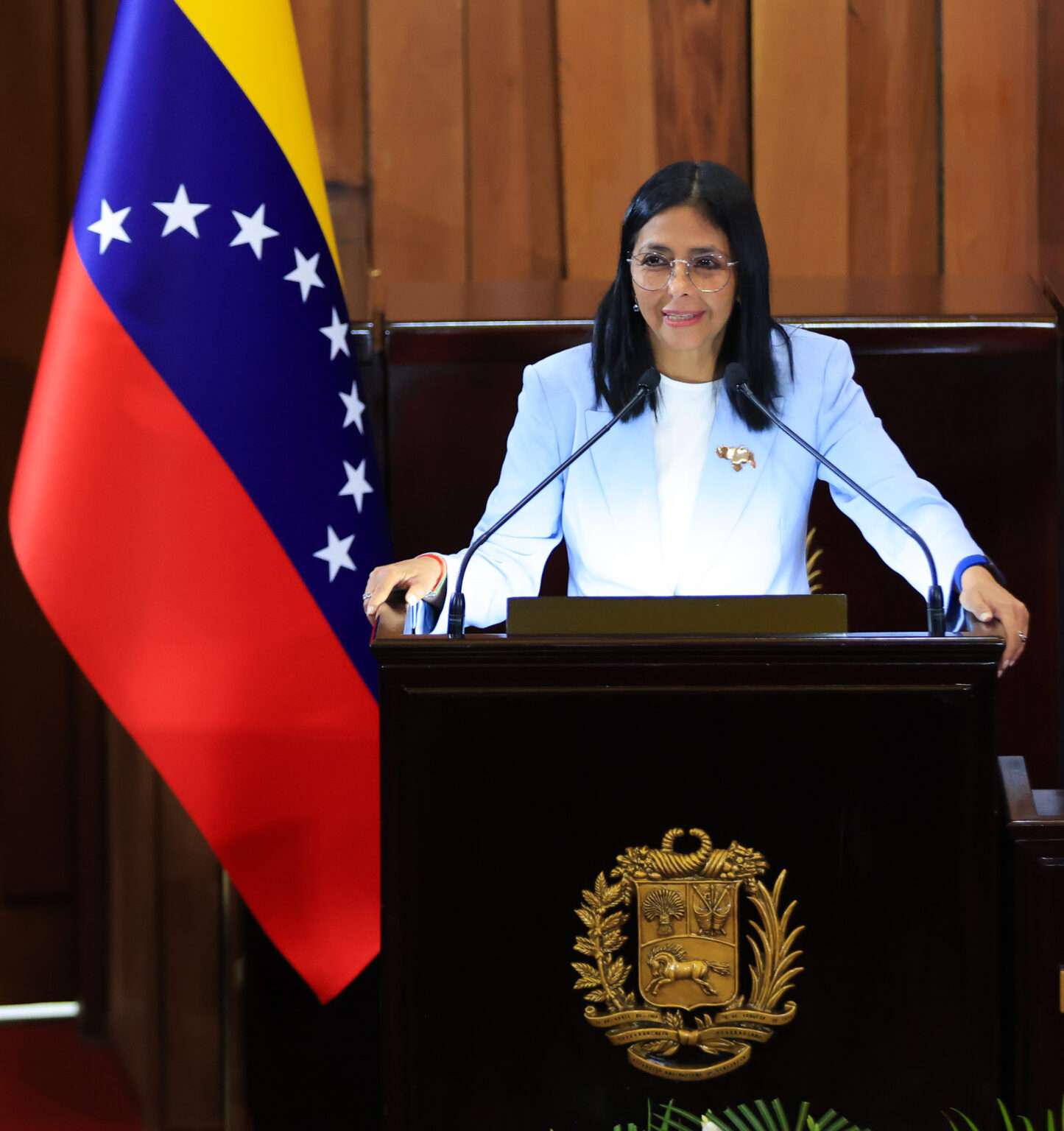
The president in charge of the republic, Delcy Rodríguez, announced this Friday before the Supreme Court of Justice (TSJ), that she will promote a General Amnesty Law that will cover the period of extremist political violence from 1999 to the present, as a way to open spaces for healthy political coexistence in the country.
The announcement was made within the framework of the Opening of Judicial Activities for the Year 2026, and highlighted that the bill has its antecedents in the two Amnesty laws of Commander Chávez and one of President Maduro. “Here is the spirit of Chávez and Maduro,” said the president in charge.
In order to present this legal text, Rodríguez commissioned the Commission for the Judicial Revolution and the Program for Coexistence and Peace to present the General Amnesty Law before the National Assembly, in order to give legal body to the norm.
“Let it be a Law that serves to repair the wounds left by political confrontation from violence, from extremism, that serves to reimplant justice in our country and that serves to rescue coexistence among Venezuelans,” said the president in charge when presenting the initiative.
Rodríguez Gómez considered that this measure is an opportunity to live in peace and tranquility in Venezuela. «With differences that there are. From the diversity and plurality that exists, we can coexist with respect and above all things, with respect for the law and justice in Venezuela,” he expressed firmly.
However, he stressed that this law will not benefit those who have committed serious crimes, hiding behind political motivations. “Those prosecuted, convicted of homicide, drug trafficking, corruption and serious human rights violations will be excepted,” he said.
Background of the amnesty in revolution
Regarding the General Amnesty Law that the acting president Delcy Rodríguez promoted this Friday, it is worth remembering that during the Bolivarian revolution, this power has already been used for the benefit of people who have violated constitutional principles, always in the interest of seeking national peace.
During the period of Commander Hugo Chávez Frías (1999–2013), the most notable was the one issued in 2007, published in Official Gazette No. 5,870 extraordinary, dated December 31, 2007, which left the people involved in the events of April 11, 2002 (signers of the Carmona Decree) fully free.
It also benefited citizens prosecuted for the seizure of governorships and mayoralties during the same period and participants in events related to the oil strike of 2002 and 2003. The objective was to pave a path towards social peace and political coexistence, trying to close the gaps generated by the instability of previous years.
Those responsible for human rights violations, war crimes and crimes against humanity were excluded from this benefit.
During the period of President Nicolás Maduro (2013 – present), a presidential pardon was approved to facilitate dialogue processes with various sectors of society. In that sense, 110 citizens were granted forgiveness of their sentences or termination of criminal action.
That decision, published in Official Gazette No. 6,569, dated August 31, 2020, included deputies with lifted immunity and leaders who were under precautionary measures or in diplomatic headquarters. There were names like Freddy Guevara, Mariela Magallanes, Roberto Marrero and Henry Ramos Allup, among other leaders of opposition parties.
Also in the current Maduro government, different Dialogue and Release processes were promoted (2023–2024)
El Helicoide will be a sports center
The president in charge highlighted that, as has been customary in the consultative processes of the Bolivarian revolution, the legal text will be submitted to public consultation from the moment its discussion begins in the Venezuelan Parliament.
To take a step forward in overcoming the times of political violence promoted by extremist sectors, the president in charge said that the Helicoide will become a Social Sports Cultural Center for the police family and the surrounding communities, as a symbol of national peace.
“May justice become the queen of republican virtues and may we guarantee peace and the future of Venezuela as an independent, free, sovereign and peaceful nation,” the president said on Cadena Nacional.
Additionally, Rodríguez called for a Grand National Consultation for a new Justice System in Venezuela, with the objective of “transforming the criminal and social approach in the country.”
Treasury Department Leave Statement
The president in charge also asked the Constitutional Chamber of the country’s highest court for a ruling on the general license issued this Thursday, January 29, by the United States Department of the Treasury on Venezuela’s resources.
Rodríguez requested this ruling “in order to preserve the jurisdiction of Venezuela and in order to preserve Venezuela’s right to international relations of diversity and relations of economic cooperation with all countries in the world.”
The Department of the Treasury issued General License (LG) No. 46, on the regulatory ground of the Venezuela Sanctions Regulations, which involves a carefully calibrated administrative review, which adjusts the current regulatory framework and redefines the conditions under which US participation in Venezuelan oil operations is permitted.