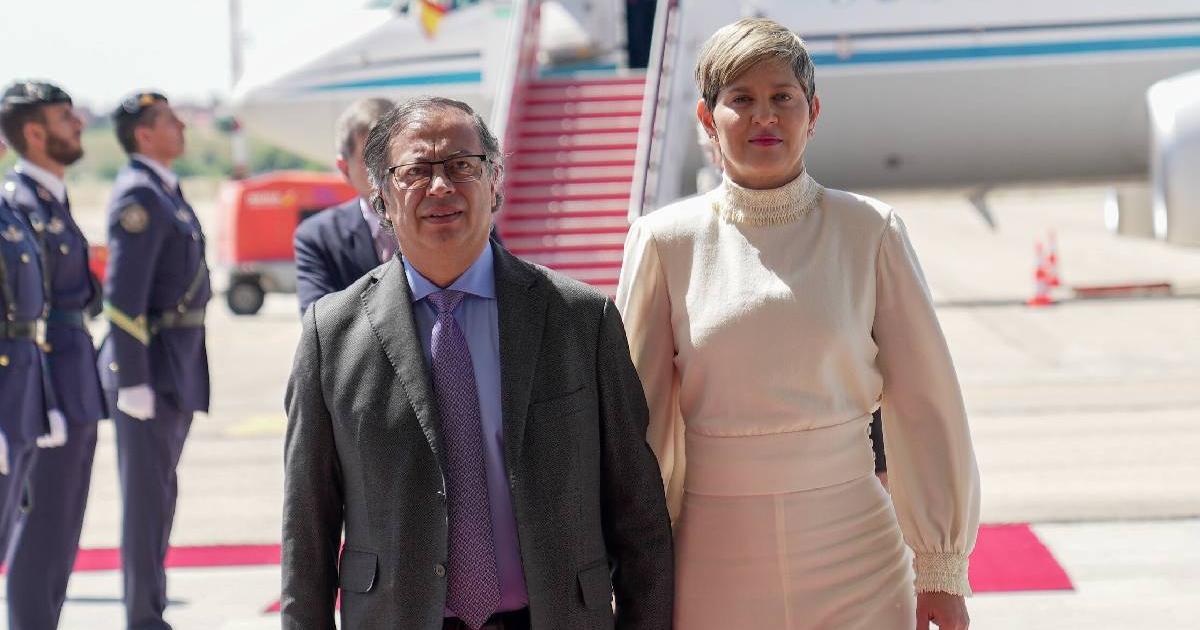
Verónica Alcocer does not serve as First Lady due to her stay in Sweden and the Presidency confirms that she has no official replacement.
The Presidency of the Republic confirmed that Veronica Alcocer is not currently performing functions as First Lady, because she remains in Swedena country from which she has not been able to leave after being included in the Clinton Listaccording to an official response delivered to La FM.
The Government specified that, although Alcocer is traditionally recognized as a social manager because she is the spouse of President Gustavo Petro, she does not have the status of public official, does not have administrative functions nor does she exercise state authority.
According to the Presidency, its role is limited to protocol, social and representative activities, but it currently does not carry out any due to its permanence in Europe.
“He is currently not carrying out activities, due to his stay in Sweden,” states the response issued by the DAPRE Legal Support Group.
There is no replacement in the figure of First Lady
There is no person designated, formally or informally, to assume the tasks that first ladies traditionally perform in Colombia.
“There is no other person who fulfills these functions,” stated the Presidency, also clarifying that the figure of First Lady is not a public position and does not require replacements or appointments.
More news:The release of 89 Colombians imprisoned in Venezuela is halted due to the regime’s annoyance
Government admits use of public resources in protocol activities
The Presidency recognizes that the protocol activities in which Alcocer participates—including travel, logistics and security—are financed with state resources, although under usual institutional criteria and by tradition.
This occurs despite the fact that President Gustavo Petro has acknowledged that he has not had a relationship with Alcocer for several years, although they maintain the marriage bond.
“Logistics (…) are carried out under criteria of security and protocol representation, as it is an act of tradition regarding the first lady,” the document states.
A figure without a legal framework, but with institutional tradition
The figure of First Lady does not have legal support as a position, but it does have a historical tradition linked to protocol and social assistance tasks.
Despite this, Alcocer has represented the country in international missions as an ambassador without being a public official.
You may also be interested in:Several homes flooded by heavy rains in Medellín
Alcocer’s expenses
A report from the Foreign Ministry and the DAPRE details Alcocer’s trips during the first two years of the current Government, with expenses on travel expenses, tickets and transportation corresponding to 2022 and 2023.
1. September 17-30, 2022 (London, New York and Tokyo)
He attended the UN General Assembly and the funeral of former Japanese Prime Minister Abe Shinzo.
Travel expenses: $33,080,918
Tickets: $40,996,818
Total: $74,677,736
2. January 13 and 14, 2023 (Rome)
Audience with Pope Francis.
Travel expenses: $4,789,995
3. May 5 and 6, 2023 (London)
Attendance at the coronation of King Charles III.
Travel expenses: $3,933,437
Ticket: $2,250,276
Total: $6,183,713
4. September 15 and 16, 2023 (New York)
Meeting with Yazmín Colón Cortizo, first lady of Panama.
Travel expenses: $3,413,594
Ticket: $2,451,585
Total: $5,865,179
5. September 25 to October 1, 2023 (Rome and Turin)
Assistance to the Vatican Consistory, visits to the Ferrero Group and meetings with Scholas Occurrentes.
Tickets: $14,951,776
Travel expenses: $3,933,437
Ground transportation: $2,148,000
Total: $21,033,214
In total, during five international outings, Alcocer spent $112,548,841more than double that of her predecessors María Juliana Ruiz and María Clemencia Rodríguez.
Most recent trips
Although Alcocer stayed away from public events, he accompanied Petro in Paris during the opening of the Olympic Games in July 2024 and represented the country at the funeral of Pope Francis on April 26, 2025.
On September 4, he returned to Colombia and visited La Picota prison, where he held a day of “active listening” to learn about resocialization processes and productive projects of the inmates.
Source: Integrated Information System