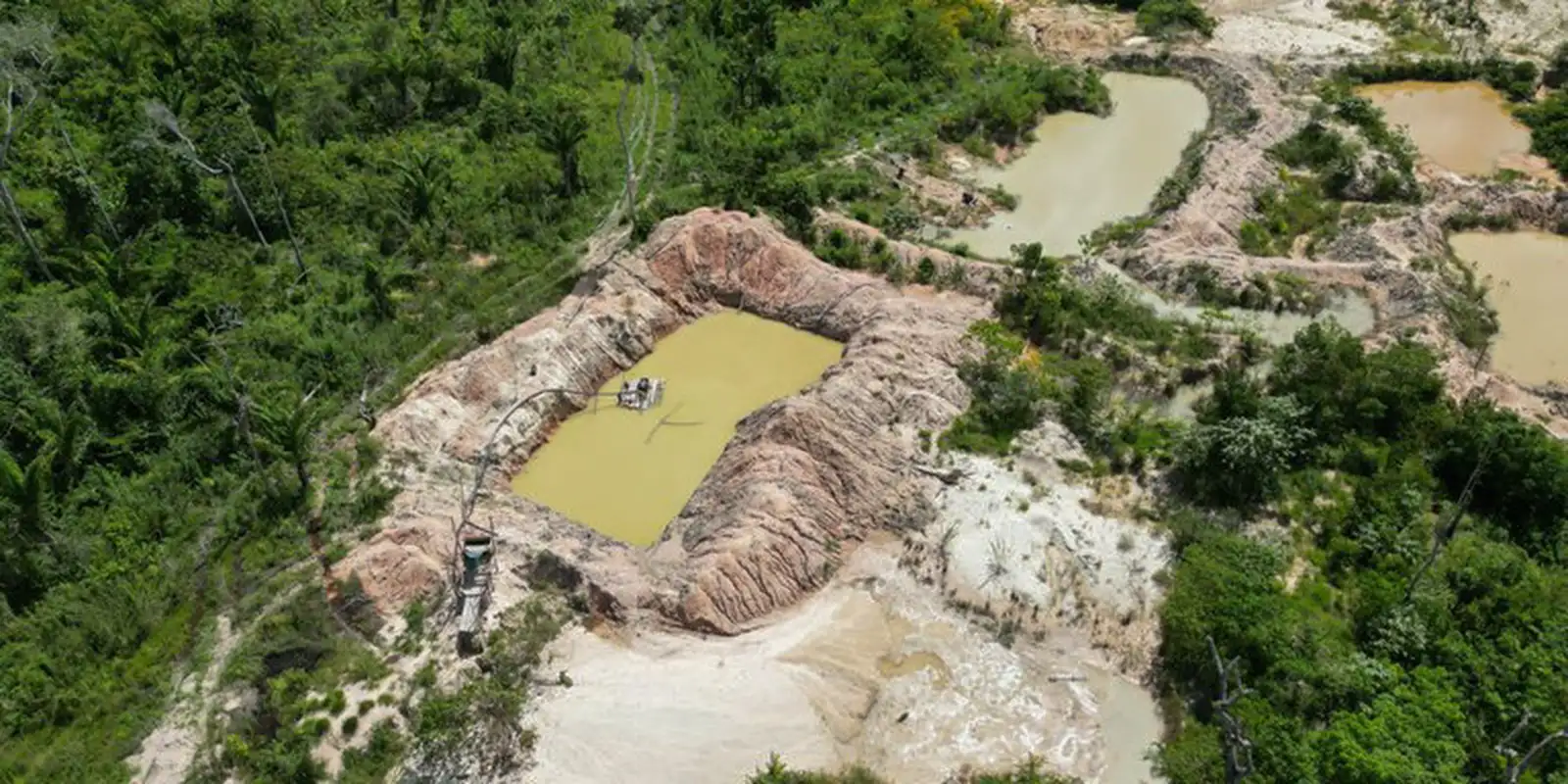
The “information” from the criminal faction Comando Vermelho (CV) reaches people involved in illegal mining in Alta Floresta, Amazon region of Mato Grosso, via WhatsApp groups. Since mid-October this year, registration and payment of monthly fees has become “mandatory” for everyone who works with ferries and scarios (large-scale mineral extraction equipment).
The report from Brazil Agency had access to full messages.
The criminals say that “all illegal work within the state of Mato Grosso is a priority and aimed at the organization”, says the text.
The payment date established by the faction is between the 1st and 8th of each month, with a table of values according to the equipment used.
Follow EBC’s complete coverage at COP30
The faction highlights the consequences for those who do not follow the rules.
“Remembering that those who are not closing with us will be allowed to be robbed and also be stopped from working. If they insist, their machine will be burned and they could even lose their own lives because they are attacking each other”, says one of the excerpts.
Study released this Wednesday (19) by the Brazilian Public Security Forum (FBSP) in an event held in the official space of the 30th United Nations Conference on Climate Change (COP30), in Belém, demonstrates the advance of criminal factions in the Legal Amazon.
The 4th edition of Cartografias da Violência na Amazônia shows that organized crime has grown and reached 45% of the municipalities that make up the Legal Amazon. Of the 772 cities, criminal organizations are present in 344 of them, which represents an increase of 32% compared to 2024, when they were in 260 municipalities. The Legal Amazon is made up of the states of Acre, Amapá, Amazonas, Maranhão, Mato Grosso, Pará, Rondônia, Roraima and Tocantins.
“The study shows that these factions, mostly linked to drug trafficking, see the Amazon and environmental crimes as new ways of making money and laundering money”, explains Samira Bueno, executive director of the Brazilian Public Security Forum.
She assesses that the Brazilian State will have to seek solutions for this intersection between organized crime and the environment.
“If this was already just a problem of environmental crime, when drug trafficking arrives, it takes on another aspect. We are in a space of climate justice and energy transition, but none of these solutions can be well thought out in Brazil without citizenship and security in the territories”, he adds.
Active factions
The study shows that there are 17 criminal factions active in the Amazon. In addition to CV and Primeiro Comando da Capital (PCC), regional groups such as Amigos do Estado (ADE), Bonde dos 40 (B40), Primeiro Comando do Maranhão (PCM), Família Terror do Amapá (FTA), União Criminosa do Amapá (UCA), Comando Classe A (CCA), Bonde dos 13 (B13), Bonde dos 777 (dissent from CV), Tropa do Castelar, Piratas do Solimões, Bonde stand out. do Maluco (BDM) and Guardians of the State (GDE).
There are also foreign organizations, such as the Venezuelan Tren de Aragua and the Colombian Estado Maior Central (EMC).
The CV and the PCC are the most powerful groups in the region. The CV is present in 286 cities in the Brazilian Amazon, being dominant in 202 municipalities and competing in 84. The faction maintains greater control of river routes, especially on the Solimões river axis, linked to Peruvian production and Colombian cartels.
Products flow through the ports of Manaus, Santarém, Barcarena, Belém and Macapá. Regional vessels, speedboats, submersibles and human “mules” are used. In addition to trafficking, it disputes territories for drug retail and operates in gold mines.
The PCC has direct influence in 90 cities, acting hegemonically in 31 and competing in 59 municipalities. The faction focuses on the internationalization of markets, intensifying the use of clandestine air routes, using runways in illegal mining sites and conservation units; and the oceanic route via Suriname, important for maritime traffic, connecting Amapá and Pará to international markets.
Murders
The number of victims of intentional violent deaths in the 772 municipalities of the Legal Amazon was 8,047 in 2024. The rate of 27.3 murders per 100,000 inhabitants is 31% higher than the national average. The most violent state in the region — and in the country — was Amapá, with a rate of 45.1 intentional violent deaths per 100,000 inhabitants.
Maranhão also stood out negatively as it was the only one that showed an increase in homicide rates between 2023 and 2024 (11.5%). The state is experiencing a territorial dispute over control of drug trafficking between Bonde dos 40, Comando Vermelho and the PCC.
Among the most violent cities with up to 20 thousand inhabitants, one of the negative highlights is Vila Bela da Santíssima Trindade, in Mato Grosso. The number of murders went from 12 in 2022 to 42 in 2024, a phenomenon related to the advance of the CV. The city has a strategic position for international drug trafficking due to its proximity to Bolivia. It also houses part of the Sararé Indigenous Land, which has seen exponential growth in mining.
“The situation in Sararé is very impressive. The Comando Vermelho arrived and began to control the entire mineral extraction chain, mainly gold. It is no longer just the prospector, who was already a problem. It is the prospector who pays fees to the Comando Vermelho to explore the territory. The logic of armed territorial control that we see in Rio de Janeiro is happening in the Amazonian territories”, points out Samira.
Among the most violent cities with more than 100,000 inhabitants is Sorriso, also in Mato Grosso, which recorded 72 violent homicides in 2024. It is known as the “national capital of agribusiness”, for leading global soy production. For two consecutive years, it was among the cities with the highest rates of rape of vulnerable people in the country.
The numbers warn that the public safety problem has intensified in Mato Grosso. The state, which has an extensive border with Bolivia, one of the world’s largest cocaine producers, has become strategic for drug trafficking. Since 2023, there has been an intensification of disputes between Comando Vermelho and Tropa do Castelar, dissent from the CV allied with the PCC.
The Pan-Amazon has become a priority corridor for supplying cocaine to markets in Europe, North America, Africa and Oceania.
Murders of women
The document indicates that 586 women were murdered in the Legal Amazon in 2024, a rate of 4.1 per 100,000 women — 21.8% higher than the national average. Mato Grosso is the deadliest state for women (5.3 per 100,000). And Maranhão was the only one to record an increase in female homicides (19.8%).
“Looking at these women in the Amazon, who live in territories further away from urban centers and are more vulnerable, we need to be able to offer policies of reception, economic empowerment and combating violence that reflect their reality”, argues Samira Bueno.
Samira argues that it is necessary to adapt models for coping with domestic violence to local realities.
“What do we have in Brazil today in domestic violence treatment models? How do you deal with domestic violence in an indigenous village? How do you deal with domestic violence in a border municipality, where you don’t have any specialized state equipment? We have this challenge of looking at the specificities”, he adds.