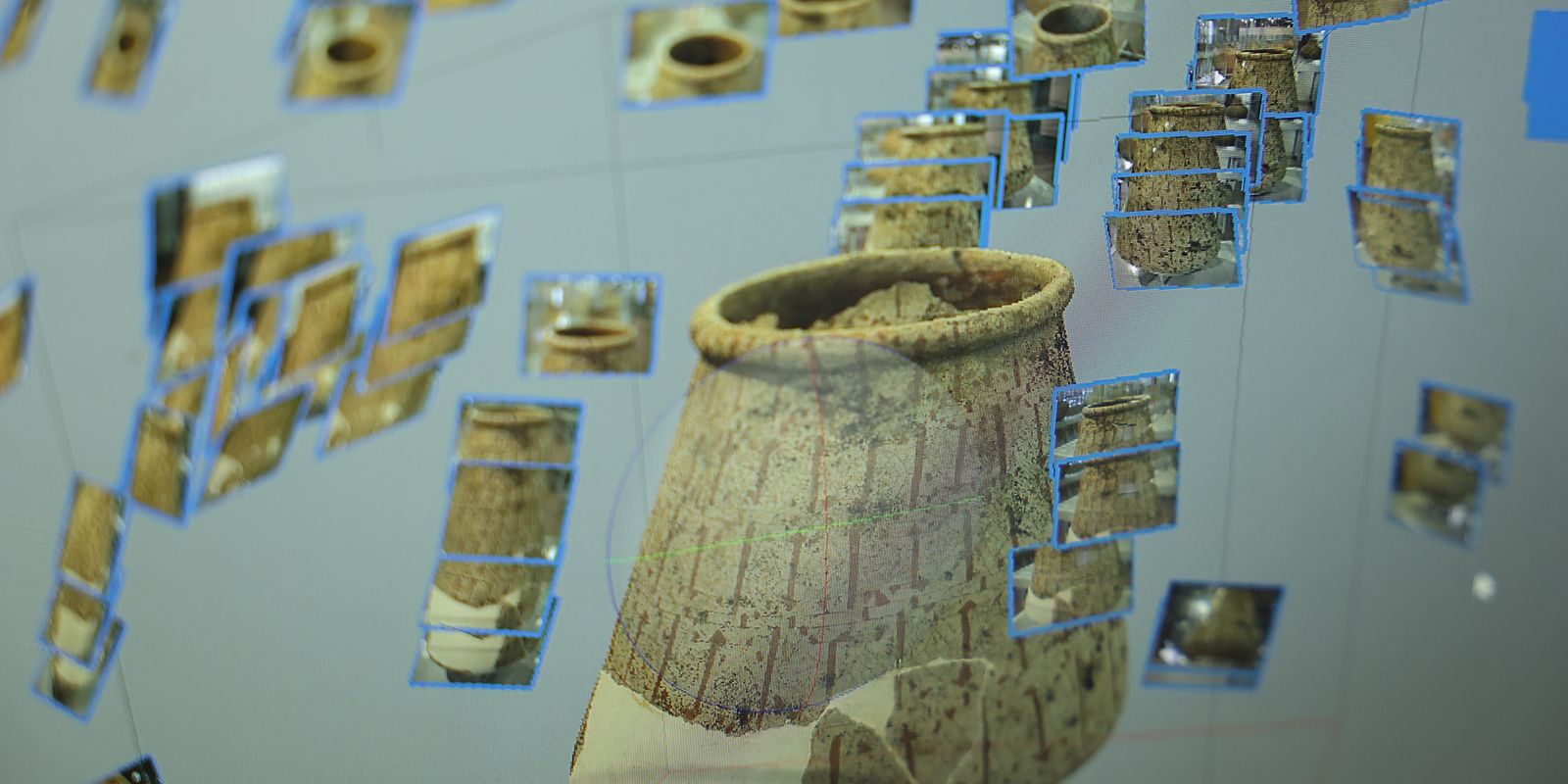
A project developed at the Pontifical Catholic University of Rio de Janeiro (PUC-RJ) digitized pieces of Marajoara culture that are part of the Marajó Museum’s collection and date back to before the arrival of Europeans on the American continent. At least 47 vases, urns and other rare artifacts were cataloged in 3D models, and broken items were reconstructed with the help of technology. 
For professor Jorge Lopes, responsible for the Biodesign Lab laboratory at PUC-RJ, digital files make it possible to recreate the pieces if necessary and help ensure that future generations have access to Marajoara culture.
“Some vases are already in augmented reality. You can reassemble them digitally. And several others, we have mathematical files, which we can even print in 3D if you want. You can do it in either augmented reality or virtual reality”, he says.
Jorge Lopes is a reference on the subject, and for around 20 years, he has been working on digitizing pieces from the National Museum of the Federal University of Rio de Janeiro. This ensured the digital cataloging of several artifacts lost in the 2018 fire and experience to replicate the work in Cachoeira de Arari, on Ilha do Marajó.
The Marajó archipelago is located in the state of Pará, in the north of the country, and is considered the largest fluvial-maritime archipelago on the planet. Research states that the Marajoara culture was one of the most developed among pre-Columbian Brazilian societies, recognized for the complexity of the production of utilitarian and ritualistic ceramic artifacts.
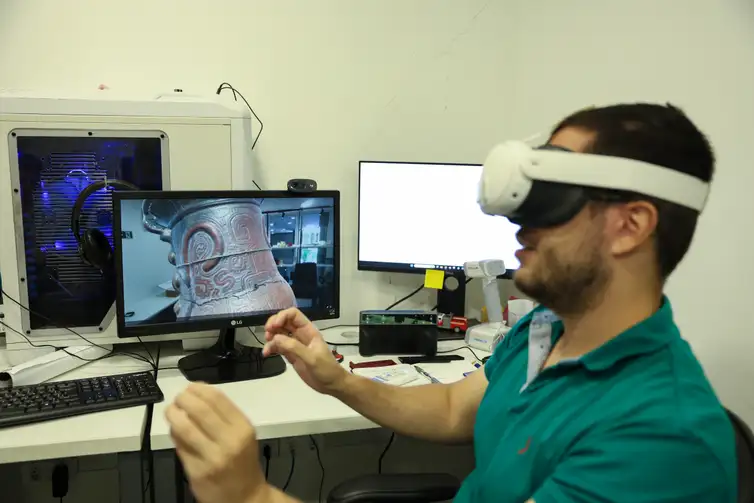
Student interacts with Marajoara vase in 3D augmented reality, at the Biodesign Lab PUC-Rio in the south zone of Rio de Janeiro. Photo: Tomaz Silva/Agência Brasil
Digitization of Parts
The project works with high-resolution 3D scanning and augmented reality. Each piece was scanned separately from different angles by the PUC-RJ team, who were in person at the museum. Then, software transforms these processes into raw, manipulable digital files, which need to be “polished” until they are identical to the original pieces.
According to Gerson Ribeiro, specialist in 3D scanning at Biodesign Lab, the biggest challenge was being able to capture the pieces well and ensure that details such as texture, color and volume were translated into the digital model.
“Scanning works very close to what our eyes are. So, what we see, the scanner can also see. If there is an object blocking the view, it won’t be able to see either”, he explains.
Ribeiro says that one of the challenges was that the largest items in the collection, such as some vases and funerary urns, could not be moved by the team, which made the work of the scanner and photogrammetry equipment difficult.
“Photogrammetry is a technique in which you take photos from various angles, and then software analyzes the images, crosses the reference points and, using the difference, calculates the depth,” says Ribeiro.
“The second technology was a smaller infrared light scanner, which we used to scan very small objects. And we also took the most accurate one, which is the white light scanner, which made most of the pieces. It also stores the texture, that is, it stores the colors of the object”, he adds.
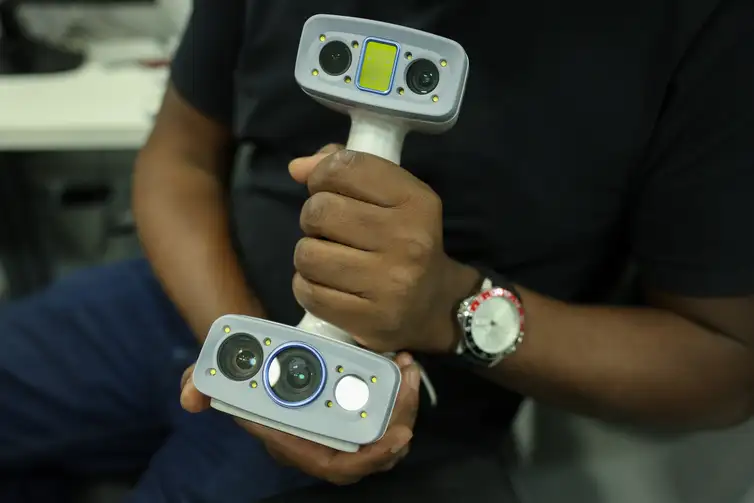
White light scanner used in the 3D reconstruction of a marajoara vase, at the Biodesign Lab PUC-Rio in the south zone of Rio de Janeiro. Photo: Tomaz Silva/Agência Brasil
Amazonize
The digitalization of the Marajó Museum is one of the parts of the Amazonizar project developed at PUC-RJ, which encompasses all of the university’s actions aimed at the environment.
In partnership with the municipality of Cachoeira do Arari, the university developed research to conserve Marajoara culture, as well as professional and social development initiatives. Entrepreneurship workshops were given to the municipality’s embroidery artisans, as well as technology classes for young people from nearby areas.
“The Amazonizar meta-project seeks both to bring the Amazon to the center of discussions at PUC-Rio and to take the university to the region, raising awareness among the academic community and generating knowledge to be shared”, states Professor Jackeline Lima Farbiarz, Vice-Rector of Extension and Pedagogical Strategy.
*Intern under the supervision of journalist Mariana Tokarnia