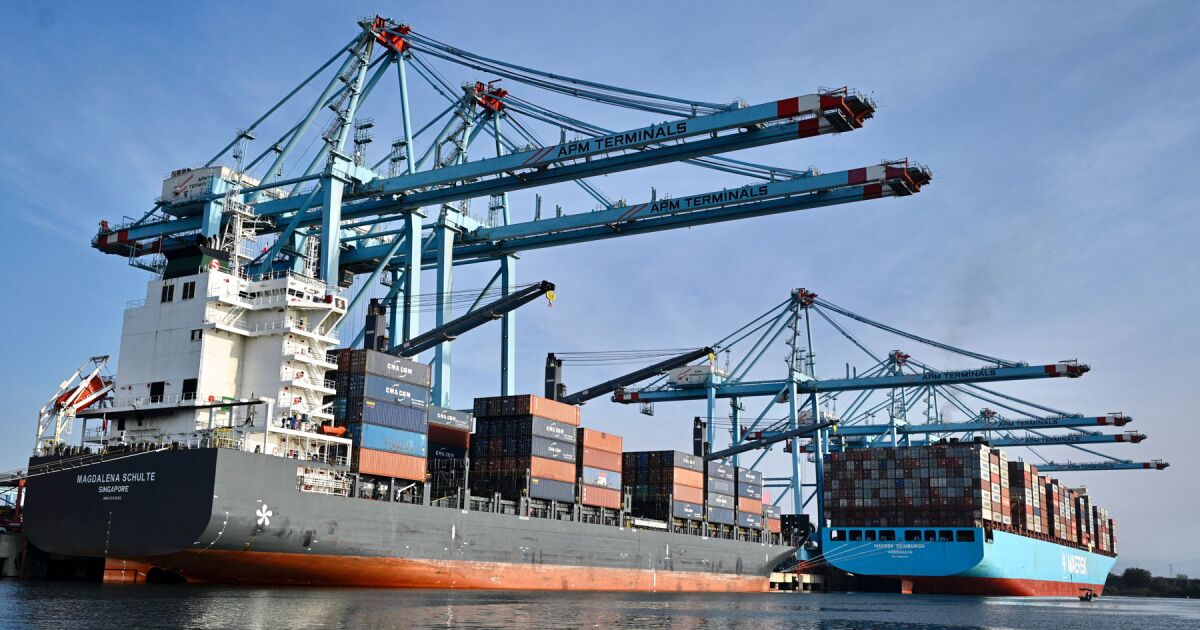
Last year the commercial ports From the country they moved 135.8 million tons in export and import goods. However, 73% corresponded to imports, confirming that in Exports participation remains marginal. International activity is concentrated in four terminals: Manzanillo, Lázaro Cárdenas, Veracruz and Altamira. Together they represent 76% of the tonnage that crosses by sea, according to data from the General Coordination of Ports and Merchant Marine.
Francisco Cervantes, president of the Business Coordinating Council, notes that while the North desert concentrates growth, areas with water and exit to two oceans remain lagging behind. Mexico, he says, has a privileged position: connects with Europe by the Atlantic, with Asia for the Pacific, with the United States in the north and with Central and South America through the southeast. But the lag of the port infrastructure limits that advantage.
The contrast is reflected in the costs. Sending a container to China is cheaper for the abundance of routes, while towards Brazil or Argentina there is no solid network of connections.
Imagine what size this market is, especially with important countries such as Argentina, Chile, Brazil, Panama, Costa Rica, Peru, Ecuador. We could develop this whole part, this opportunity that this regional agreement brings. Therefore, in the midst of what we face in tariff matters, it is a challenge, but also an opportunity to rethink things
Francisco Cervantes, president of the Business Coordinating Council.
For Cervantes, talking about integration of the Americas is meaningless if Mexico does not first develop its ports. “We have wasted the ports,” he says, and stresses that the south-southeast offers the largest potential.
The entrepreneur also dimensions the magnitude of the northern border. If that strip were a country, it would reach the size of the third world economy. Mexico, he maintains, should take advantage of the situation to link the ports of the South with the east coast of the United States, where the greatest economic force is concentrated. Ships and intermodal trains, which allow to transfer merchandise without additional maneuvers, already offer lower cost and greater efficiency alternatives. The key is to guide those routes not only to the northern neighbor, but also to South America and Europe.
Óscar del Leather, president of Canadian Pacific Kansas City, describes Coatzacoalcos as a point with potential to serve both the United States and Asian countries. He explains that the connection between Salina Cruz and Coatzacoalcos is already in operation and links with the CPKC roads to Canada and the United States. From its perspective, the federal administration seeks that this port not only receive ships, but also has an integrated system that makes it part of the interoceanic corridor.
The expectation that Mexican ports acquire prominence also grows in the north. Enrique Morán, president of Index Nuevo Laredo, acknowledges that his city will continue as the main land port in the country, but admits that maritime begin to win a different role. In Tamaulipas, Altamira maintains her weight and Matamoros reactivated her operations. Before, that burden had to cross through the United States and leave from Galveston. Today is dispatched directly from Mexico, which reduces costs and eliminates rates for American traffic.
The most visible symbol of this new stage is precisely Matamoros. After 24 years of inactivity, in August he received his first ship with vehicles. Its opening makes it the first large port inaugurated in more than two decades and places it as a new entrance door to foreign trade. Its proximity with Monterrey reduces up to five hours of transfer in front of other gulf terminals and outlines it as an intermodal node for key industries such as steel, autopartments and energy. In addition, its proximity to Texas aligns it with the tendency of Nearshoring and integrates it into the most dynamic industrial corridor in the country.
The relaunch of Matamoros also opens opportunities for Nuevo León, San Luis Potosí and Coahuila, who find in him a more competitive exit for their exports. The recently enabled infrastructure not only expands Mexico’s capacity within the T-MEC, it also responds to the need for diversified supply chains in the midst of tariff tensions.
The impulse is not limited to the Gulf. In the Pacific, Manzanillo advances in an expansion that will double its capacity. For customs and business agents, that project will mark the pattern in trade to South America and Europe. Several companies already think about modifying their import routes from Europe, formerly channeled by Houston, to move their products through Mexican ports and avoid tariffs in the United States.
President Claudia Sheinbaum places the ports in the center of her strategy. “We set out to make Mexico a port power,” he says. Within the Mexico Plan, its government will invest in 12 projects. They include the extension of Guaymas, Manzanillo, Lázaro Cárdenas and Acapulco; the modernization of Salina Cruz, Puerto Chiapas, Coatzacoalcos and Dos Bocas; and the expansion of progress, Seybaplaya, Veracruz, Altamira and Matamoros.
This year public investment amounts to 18,000 million pesos, complemented with 5,600 million private capital. For all the six -year period, the Government estimates 142,000 million pesos of public investment and 264,000 million private capital.
The challenge is great. But ports appear as the piece capable of opening a new logistics era and consolidating Mexico as an industrial and commercial power in the world.