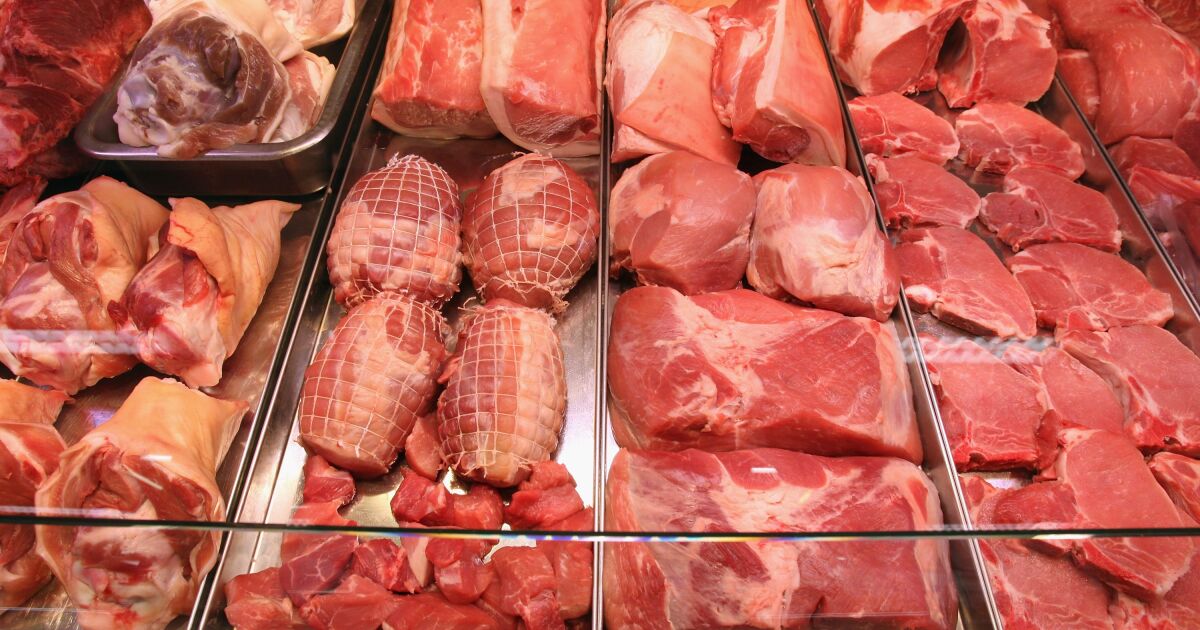
The pig of the United States, in the crosshairs
In December of last year, Mexico’s trade authority initiated an anti-dumping and anti-subsidy investigation into imports of pork leg and shoulder originating in the United States. The application was presented by five Mexican companies in the pork sector, including Productos Kowi, Productos Soles, Comercializadora Porcícola Mexicana, Proteína Animal and Sonora Agropecuaria.
Producers pointed out a constant increase in imports accompanied by falling prices, with direct effects on the profitability, income and financial indicators of national production. The procedure considers the year 2024 as the investigated period and the period from 2022 to 2024 as the period of damage analysis.
The cuts under investigation include pork leg and shoulder, boneless or boneless, fresh, chilled or frozen, key products for both direct consumption and the meat processing industry.
Mexican imports of pork from the United States represent 83% of the total. Pork and its products constitute the second main sale in that country. For American producers, Mexico is a crucial market, so its position regarding the T-MEC reviewwhose destiny will be defined on July 1 this year, is that the agreement be preserved.
Mexico buys 9% of all pork and 50% of ham produced in the United States. The Mexican market serves as a backup when China reduces its purchases of American pork, as it did in 2025, according to the National Pork Producers Council.
The Agricultural Markets Consulting Group considers that the antidumping investigation occurs in a context of high dependence on imports, but trade policy decisions must consider the magnitude of the impact on domestic supply and consumer prices. And that Mexico’s challenge is to reduce external dependence by strengthening national production, without causing disruptions in a highly integrated market with the United States.
The Secretary of Agriculture and Rural Development, Julio Berdegué Sacristán, pointed out that the country imports 47% of the total consumption of pork, but with coordinated work, Mexico can produce more and generate the 1.4 million tons necessary to achieve full self-sufficiency in this meat.
The apple of discord
In the case of apples, the request was presented by the Regional Agricultural Union of Fruit Growers of Chihuahua. The producers argued that US imports registered a growing trend accompanied by a sustained drop in prices, levels that do not cover the production costs of Mexican apples and put pressure on the domestic market.
The investigation covers the period from April 1, 2024 to March 31, 2025, while the damage will be evaluated with information dating back to April 2022. The product investigated includes all varieties of fresh apple, without distinction of color, size or flavor.
In fresh apples, the tension is concentrated in the organic ones. In 2022, the United States sold 69.3 million dollars of these to Mexico. By 2024, the figure rose to 126.7 million dollars, according to data from the United States Department of Agriculture.
The Ministry of Economy reviewed customs databases, trade balance statistics and price references in the United States. With this information, it calculated average export prices and compared them with references of production costs and internal prices, in order to determine if there were margins of discrimination higher than the minimum level allowed.
This is not the first time that Mexico has initiated an antidumping investigation into apples. In 2014, the Ministry of Economy opened a procedure also at the request of the Regional Agricultural Union of Fruit Growers, but in 2016 it closed the case after determining the non-existence of unfair practices.
On this occasion, both in pork and apples, the Ministry of Economy indicated that these products benefited from tariff exemptions linked to measures to support basic consumption, valid until the end of 2025 and possible extensions conditional on previous contracts.
In both cases, the agency concluded that there are sufficient elements to open administrative procedures. Although immediate measures are not imposed, the processes can lead to compensatory fees if unfair practices and damage to national production are confirmed.
Mexico arrives at the prelude to the review of the T-MEC with two files open against the United States on the agri-food front. The investigations into pork and apples bring sensitive issues to the table for both countries, at a time when the treaty faces its first formal examination.