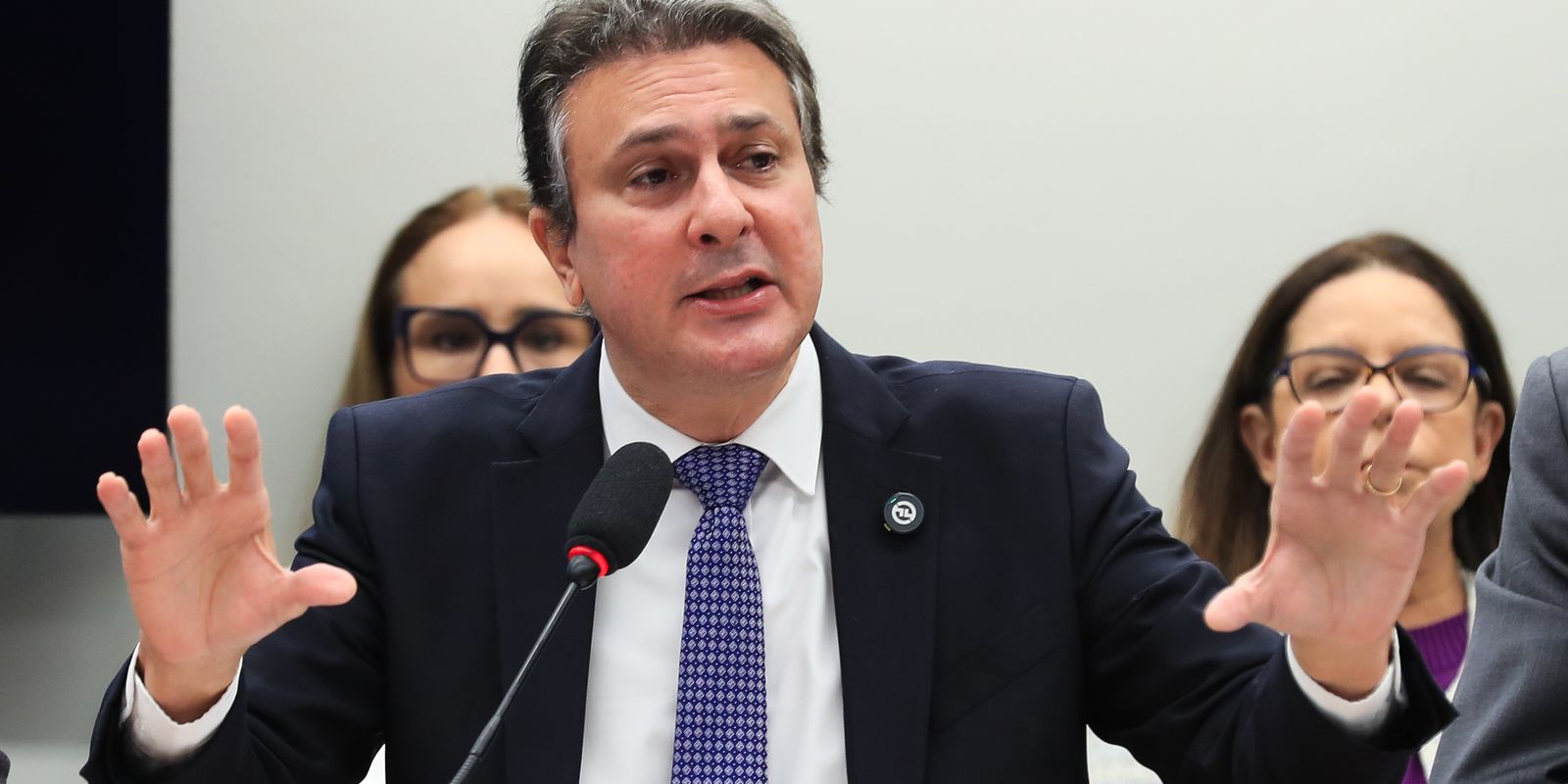
The Minister of Education, Camilo Santana, said this Thursday (18) that the federal government cannot interfere with the other powers, but that the Brazilian population needs to charge the House of Representatives for the approval of the amendment proposal to the Constitution that will make it difficult to investigate crimes committed by deputies and senatorscalled PEC of Armage.
“They are autonomous, independent powers, it is in the role of legislators. But the population can also charge if it is fair for a Brazilian citizen to answer for their attitudes and the National Congress has shielding,” he said.
The minister participates in the 2nd Global Summit of the School Feeding Coalition, held in Fortaleza, which brings together representatives from over 80 countries.
Asked if the approval of the Armage PEC may disrupt the supervision of resources for school lunch, Camilo Santana said the program already has the inspection instances.
“We have the control bodies to follow. We have the courts of states of states and municipalities, we have the Federal Account Court, we have the school councils, including PNAE itself has their advice that are responsible for accompanying.”
Brazil is named as a reference for having the largest school feeding program in the world. The National School Feeding Program (PNAE) serves 40 million students across the country. By 2025, the budget was $ 5.5 billion.
Oversight
Between 2017 and 2018, TCU auditors went to 130 schools in the 26 states and the Federal District and evaluated the responses of questionnaires sent to another 3,000 schools across the country. The result is that irregularities were found in the management of resources passed on to the feeding of students in ten states. In April this year, in a plenary session, the TCU concluded that the internal control of PNAE resources must be improved.
For Renata Carvalho, chief auditor of the Specialized Audit Unit in Education, Sport, Culture and Human Rights of TCU, the inspection methods need to be updated according to the legislation.
She does not believe that the armor PEC will interfere with the inspection of resources from parliamentary amendments:
“The execution of amendments may not necessarily reach the parliamentarian himself, sometimes it goes through direct execution by the entity that received the appeal, which is derived from the amendment [parlamentar]. “
For Renata Carvalho, the differential is in transparency. “The delivery of the service to the population talks a lot with the level of transparency we have, so that we can oversee the execution of these resources. This is generally. Not only in relation to TCU. We have worked for transparency. If we have transparency in the amendments, then I think the shield is a different subject.”
Another path pointed out by the auditor also involves social control.
During the event in Fortaleza, the TCU launched a new edition of the booklet to help the performance of the School Feeding Councils (Caes). The councils are formed by different actors in the school community, professional education, students of students, civil society and were created to accompany the execution of the PNAE.