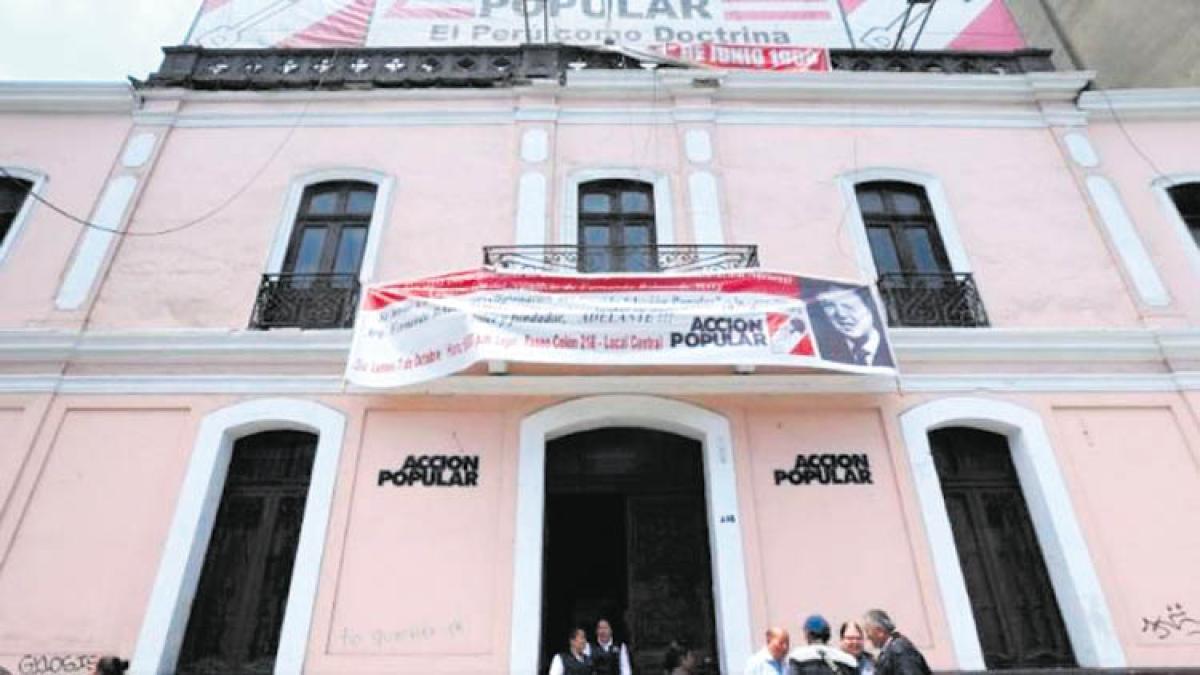
After the National Elections Jury (JNE) made official its exclusion from the next electoral process, after annulling its internal elections due to “substantial defects”, Popular Action presented this Monday an appeal to annul this resolution already published in the official newspaper El Peruano.
The historic party of the lampa refuses to be left out of the elections on April 12 and through a document justifies its request alleging “serious violations of the constitutional rights of defense, due procedure, due motivation, presumption of innocence, to elect and be elected and others” of Acción Popular and the “flagrant non-compliance with the principle of legality” by the electoral body.
In the letter, AP requests that the JNE declare the challenges made to the party’s internal elections inadmissible and proclaim the results of the primary election, in accordance with the electoral schedule; orders that require prompt attention.
The acciopopulist group points out that the JNE resolved the challenges without calling a public hearing or allowing the party to present its defenses. It adds that the JNE admitted and evaluated several appeals that were submitted after the deadline, which is why it acted arbitrarily.
After the JNE’s annulment resolution, Alfredo Barnechea, one of the primary candidates, attacked that electoral body and denounced that due process was violated. The former presidential candidate indicated that neither the representative nor the general secretary of the party was notified and previous instances were omitted. At first he even said: “They don’t know who they are dealing with.” Last night, in an interview on channel N, he apologized to the members of the JNE.
THE EXPERTS SPEAK
Contrary to what Barnechea claims, José Manuel Villalobos, a specialist in electoral law, pointed out that according to the norm the challenge had to be presented directly to the full jury and that in this case the JNE could dispense with holding a public hearing.
“If Mr. Barnechea reads the resolution, he will know that the JNE, according to its public hearing regulations, can dispense with holding a public hearing when due to preclusive acts and the electoral schedule and when it already has all the sufficient elements to resolve, it can do so directly without a hearing, as it acted in this part,” he explained to Perú21.
For Villalobos, the decision of the JNE is the last instance and there is no appeal against it, since this body does not resolve these types of requests.
Constitutionalist Aníbal Quiroga agreed that the JNE acted in accordance with the law. “The procedure in this case begins by determining that what is done in the ONPE goes to the JNE for a nullity review in a single instance. The plural instance is not always fulfilled. This is also the case in the Constitutional Court,” he explained to Perú21. He added that due process in this case is adapted to the electoral process and the peremptory deadlines that exist.