Activist Tamara Suju, director of the Casla Institute, warned about the situation through her social networks. He indicated that the majority of the strikers are military, although there are also civilians and foreigners detained in the facility.
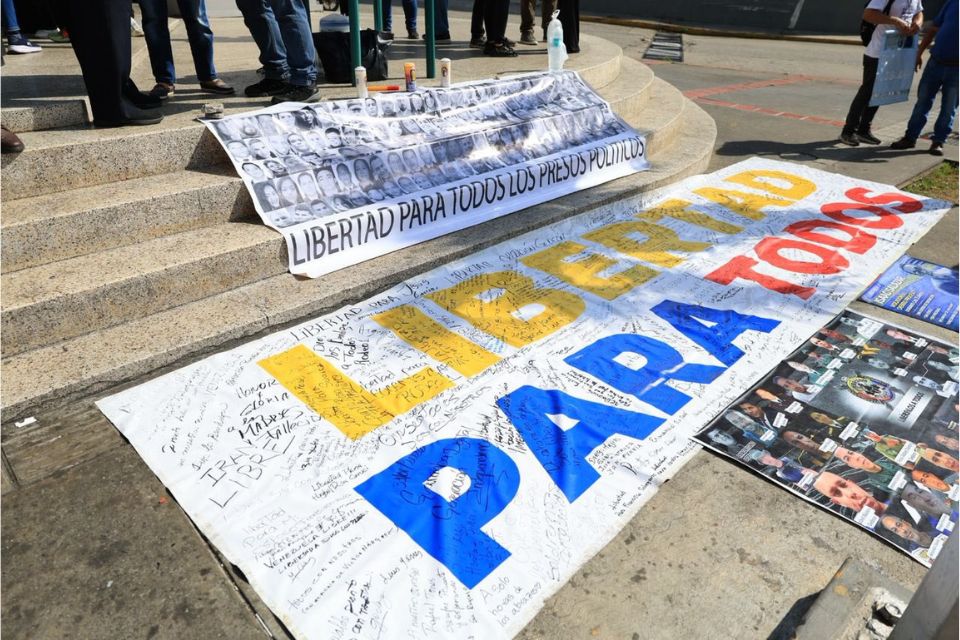
A group of political prisoners held in the El Rodeo I prison, in Guatire, Miranda state, began a hunger strike to demand their prompt release, in the midst of the application process of the recently promulgated Amnesty Law for Democratic Coexistence, from whose coverage they fear they will be excluded.
Activist Tamara Suju, director of the Casla Institute, warned about the situation through her social networks. He indicated that the majority of the strikers are military, although there are also civilians and foreigners detained at the facility.
Among them is the Argentine police officer Nahuel Agustín Gallo, detained for more than a year in Caracas. His wife, the Venezuelan María Alexandra Gómez, confirmed the protest and held the prison authorities responsible for any consequences that may arise from fasting.
«Today I received the information that Nahuel Agustín Gallo and more than 200 people held in El Rodeo 1 have started a hunger strike. “What they are doing crossed the limit of inhumanity,” she wrote on February 22 on her X account. In her message, she blamed the director of the facility, identified as Martínez Rangel, for what may happen to her husband and the rest of the detainees.
#URGENT Today I received information that Nahuel Agustín Gallo and more than 200 people held in El Rodeo 1 have started a hunger strike.
What they are doing crosses the line of INHUMAN.
I hold Martinez Rangel responsible, who is the director of the facility, for what… pic.twitter.com/ATi1BmHj5w
— Maria alexandra Gomez (@gg_alexand95764) February 22, 2026
Gómez also called on the acting president Delcy Rodríguez and the president of the National Assembly, Jorge Rodríguez, not to play “with the hopes and expectations” of the relatives. Likewise, he questioned the role of international bodies in the face of what he described as continuous violations of human rights.
The case of General Hernández Da Costa
Among the strikers is also General Héctor Hernández Da Costa, detained since August 13, 2018, when officials from the General Directorate of Military Counterintelligence (Dgcim) broke into his residence in Chacao.
Hernández Da Costa was accused of participating in the alleged drone attack against Nicolás Maduro in 2018. Although he is a military man, he was tried in a civilian court and sentenced to 16 years in prison. His relatives have denounced procedural irregularities, including the presentation of an arrest warrant dated after his arrest.
His daughter, Loredana Hernández, demanded proof of life, urgent medical attention and his immediate release, while warning about the deterioration of his health and non-compliance with international measures that order his release.
#VENEZUELA. My father, Gen. Héctor Hernández Da Costa, political prisoner in El Rodeo I, is on hunger strike. We demand faith of life, urgent medical attention and your freedom NOW #urgent day #2 pic.twitter.com/iKEjABTBmY
— Loredana (@loresblog) February 22, 2026
Exclusions in the Amnesty Law
The Amnesty Law was approved on February 19 unanimously in the National Assembly and presented by the ruling party as a step towards political reconciliation. However, non-governmental organizations have expressed reservations about its scope.
Article 9 of the instrument excludes crimes related to serious violations of human rights, crimes against humanity, intentional homicide, very serious injuries, drug trafficking, corruption and promotion of military actions against the country.
*Read also: Penal Forum warns that the imprisonment of Blanca Suárez seeks to intimidate lawyers
The NGO Penal Forum estimates that around 400 political prisoners would be excluded from the amnesty, because the law limits its application to 13 specific political moments between 1999 and 2026.
The president of the organization, Alfredo Romero, explained that a good part of those excluded are linked to alleged military operations, although there are also civilians within that group.
For his part, the vice president of Foro Penal, Gonzalo Himiob, criticized that the law leaves “15 years completely out,” which — in his opinion — ignores the continuity of political persecution in the country. He also pointed out that the text establishes an “arbitrary” selection of specific years and situations, including 2002, 2003, 2004, 2007, 2009, 2013, 2014, 2016, 2017, 2019, 2023, 2024 and 2025.
*Journalism in Venezuela is carried out in a hostile environment for the press with dozens of legal instruments in place to punish the word, especially the laws “against hate”, “against fascism” and “against the blockade.” This content was written taking into consideration the threats and limits that, consequently, have been imposed on the dissemination of information from within the country.
Post Views: 78