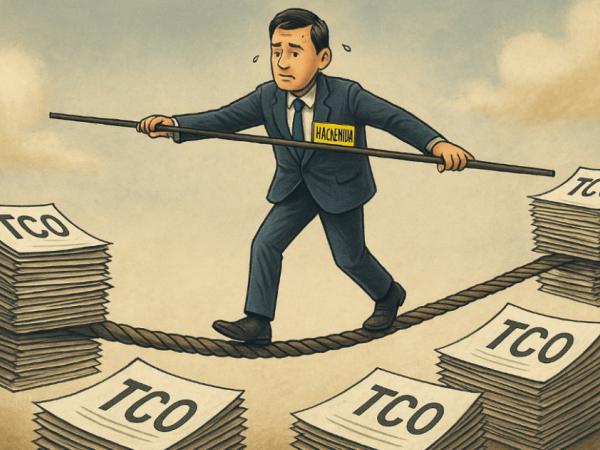
The management of public debt in Colombia is going through a decisive moment in which, with a fiscal deficit that continues to press the finance of the State and the urgency of attending immediate commitments, the Ministry of Finance has opted for a strategy that analysts define as “play in short” to prevent debt overflowing.
Basically, the movements of the portfolio directed by Germán Ávila, focus on privileging the placement of debt in short deadlines, especially through the short -term treasury titles (TCO), in front of the traditional long breath. For experts, although this helps, it should not be taken lightly.
Also read: Comptroller found alleged patrimonial detriment in aerocivil for $ 5,670 million
According to a recent report by Banco de Bogotá, this maneuver has allowed Overcome liquidity troubles and ensure that the government can meet the most immediate payments. However, they warn that the strategy is not exempt from risks and that, if maintained without adjustments, it could become a source of vulnerability towards the near future.
A Breathing Strategy
To better explain their postulate, these analysts said that so far this year, Hacienda has resorted more actively to TCO broadcast and explained that these papers, due to their short -term nature, become a useful tool to face moments of narrowness in the public box.
One of Bogotá’s recommendations is not to forget that accumulating these debts can aggravate the fiscal crisis.
“The Government, when going to them, obtains resources more quickly and with relatively close maturities, allowing him seithern more expensive for the financial environment and doubts about fiscal sustainability, ”they said.
In this way, the report indicates that this pattern is clear, since the TCOs have won a greater prominence in the internal debt structure, in order to cover the short -term deficit and ensure that the obligations, both with creditors and with providers and state programs, can be fulfilled in agreed times.
It may interest you: Lower economic growth, the price of leaving the fiscal crisis
However, they are clear in saying that this change translates into an additional load For the coming months, since each TCO issued is an obligation that will soon be to refinance or pay, which accumulates pressures on future finances and could also be understood as a way to kick the deficit.
“As for the TCO, from the announcement of the highest broadcasting quota in history, it was made clear that this would be one of the most important instruments in the Nation’s financing strategy. In addition to paying its credit to Ecopetrol for the FEPC with TCO, the nation expanded the emission quota of at $ 67 billion, it issued $ 6.3 billion to serve as a collateral SWAP) with the global banking and enabled the option to make direct tCO placements to public entities, ”they said.

One of Bogotá’s recommendations is not to forget that accumulating these debts can aggravate the fiscal crisis.
The mirror of the tes
On the other hand, economic investigations of Banco de Bogotá tells that although traditional tes have lost weight in the last auctions and that the market seems to have appetite for its new form of play, since its lower participation reflects not only the government’s preference to cover Immediate needs, but also a less favorable environment for long -term emissions.
“While this has given (and would give) resources to the nation, it has also increased the risks of refinancing by 2026 to the extent that the payment for the expiration of the TCO for March and June 2026 is around $ 15.4 B and $ 16.7 B, respectively. To attend this, the Public Credit Directorate seeks to completely change the structure of this market,” says the report.
Other news: Ani opens the old variant while unlocking the Bogotá – Villavicencio road
They also indicated that the market has shown caution against the purchase of more extensive tesbecause it perceives risks associated with the fiscal rule, tax uncertainty and political tensions and this sense, investors demand greater rates to lend for long terms, more expensive and withdrawing attractiveness to that source of resources.
This is why Bogotá Bank warns that the commitment to the TCO is helping to overcome the present, but at the expense of weakening the long -term front, which is essential for the sustainability of public debt.

One of Bogotá’s recommendations is not to forget that accumulating these debts can aggravate the fiscal crisis.
Risks in refinancing
The report is clear in pointing out that this strategy increases the so -called “risk of refinancing”, which is nothing more than the more emissions in short maturities are concentrated, the greater the need to constantly go to the market to renew those obligations.
Likewise, they stressed that this phenomenon has several consequences, beginning with an increase in government exposure to changes in financial conditions, since if interest rates rise or if investors’ trust deteriorates, each renewal becomes more expensive and difficult.
See here: Fashion of San Victorino and El Restrepo arrives in Vitrina de Times Square in New York
The second, an effect on the country’s risk perception, taking into account That an excessively concentrated debt in short deadlines can generate doubts about the ability to pay and raise the premium required by the creditors.
And the third, a permanent pressure on cash management, since instead of concentrating on designing a long -term strategy, the Ministry of Finance is forced to attend the day to day, reducing its maneuver.

One of Bogotá’s recommendations is not to forget that accumulating these debts can aggravate the fiscal crisis.
A delicate balance
With all of the above, the central idea of this report revolves around the challenge to find a balance and warns that a TCO -based scheme cannot be sustained indefinitely, because sooner or later the accounts expire and that short -term indebtedness can be useful as a transitory tool, but if it becomes the normthe risk of refinancing can be triggered and compromise the country’s financial stability.
In this sense, the Bagotá Bank recommends that, in parallel to the issuance of TCO, the path of longer installments is resumed, even if this implies paying a greater cost in the short term and closes saying that the idea is to distribute the loads and ensure that the debt profile is more balanced, with diversified maturities that reduce vulnerability.
Daniel Hernández Naranjo
Portfolio journalist