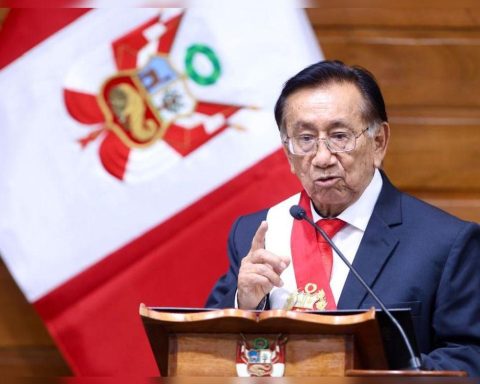
He Judicial Branch and the Prosecutor of the Nation They warned of the negative impact that the Domain Extinction Law would have. According to the leaders of each institution, the modifications raised by the CongressThey would harm the fight against crime and give impunity to illegal assets.
The Prosecutor Delia Espinoza He considered that illicit money or badly had badly borne by organized crime, either through illegal mining, people trafficking, etc., generate great damage to society.
You can see: Frigoinca denounces the robbery of the Qali Warma case, Noemí Alvarado
Delia Espinoza on the reform of the domain extinction law: “It would be a decline for the fight against crime”
“We cannot allow this law to demand a final sentence in criminal issue, we cannot accept this legislative change because it would definitely be a decline for the fight against crime and allow impunity regarding these illegal assets and financing,” he said.
He also stressed that there are “concrete actions to deal with the alleged reformulation of this law that implies a destruction to what is the fight against crime organized in all its forms.”
In that sense, he informed that in five years, the National Domain Extinction Subsystem managed .
With this, the Judicial Branch He issued 1685 sentences in the first instance and 815 in Second, which makes a total of 2500 sentences in the period referred to, however, with the Congress Law, only illicit property may be seized when there is a firm criminal sentence. In addition, the rule states that the imprescriptibility on this matter drops from 20 years to five.
For his part, the Supreme Judicial Judge of the Judicial Subsystem, Manuel Luján Tunpez mentioned: “On the contrary, it is the absolute guarantee that only the well given property will be the one that must prevail in a constitutional state.”
Chamber of Commerce of Lima also spoke against the reform
The application of the Domain Extinction Law, approved by Legislative Decree No. 1373 of August 2018, would be affecting the property right, the presumption of innocence and the principle of good faith, agreed to point out various specialists during a round table Organized by the Chamber of Commerce of Lima.
This rule establishes that the owner of a certain property loses property if the good comes or was used in illegal activities, without the need for the offender to have been sentenced.
In daily practice, it is sufficient that the authority suspects the probable illegal origin of the good, so that it can go to the power of the State and be finished almost immediately.