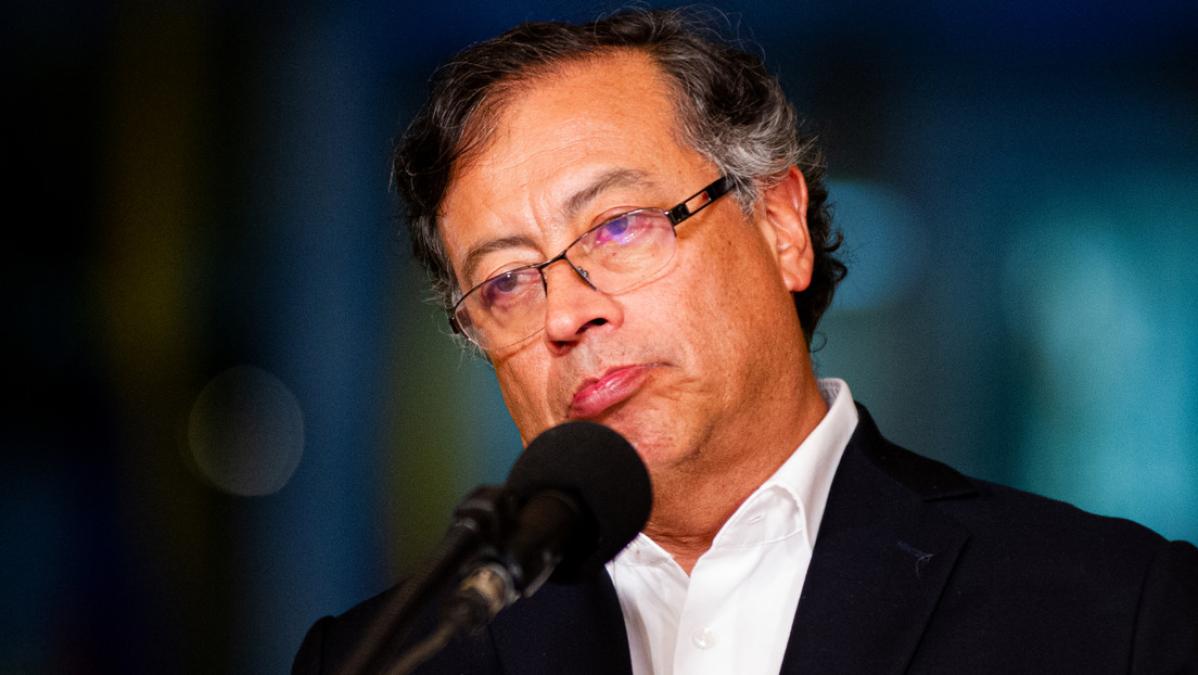
At a time when he is a lonely island in his country, Gustavo Petro came up yesterday inventing a smoke curtain in an attempt desperately by strengthening his worn image. The president of Colombia has accused Peru of having “copied” part of his territory in the Amazon and violating the Rio de Janeiro protocol, which ended the conflict between the two countries.
In an irresponsibly, the former M-19-Raffle points out that our country has appropriated the islands that have appeared in the deepest line of the Amazon River.
“That unilateral and violation of the Treaty of Rio de Janeiro can make Leticia disappear as a Amazon Port by removing her commercial life. The government will use, first of the triple border between Peru, Brazil and Colombia, on the Amazon river.
The Peruvian government was not long in responding through a statement from the Foreign Ministry expressed its strongest and most energetic protest regarding Petro’s statements, remembering that the territory in question legitimately belongs to Peru for more than a century.
Torre Tagle stressed that Congress approved on June 12 the creation of the new district of Santa Rosa de Loreto, in a rule that was officially promulgated on July 3, so “such territorial constituency is under the sovereignty and jurisdiction of our country”.
“The territorial delimitation is protected by the treaty of limits and free river navigation signed in 1922 and in the works of the Mixed Demarcador Commission of Limits of 1929, which assigned to Peru the island of Chinería, where Santa Rosa is located,” said the Ministry of Foreign Affairs.
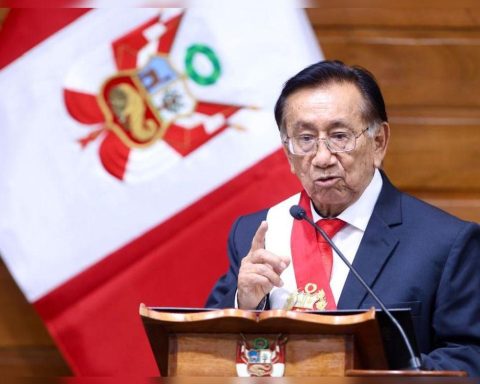
“A millimeter of Colombian territory has not been touched. Santa Rosa is Peruvian,” said Chancellor Elmer Schialer, who regretted Petro’s expressions pointing out that Petro “has not been properly informed.”
Schialer recalled that, through the Solomon Treaty Lozano (1922) and subsequent delimitation agreements, Chinería Island was assigned to Peru, from which Santa Rosa Island came at some time and, years later, it was united again.
The regional governor of Loreto, René Chávez Silvano, also protested before Petro’s irresponsibility: “He is very wrong, we have never invaded Colombian territory, Santa Rosa always belonged to Peru.”
For the mayor of Maynas, Vladimir Chong, this impasse is just a “cantaleta” of Petro.
The Colombian Foreign Ministry, far from affirming that the island belongs to them, said that it has not yet been assigned to Peruvian territory and proposed to reactivate the Permanent Mixed Commission for the Inspection of the Colombo-Peruvian border (Comperif).
SMOKESCREEN
The truth is that the Colombian president launched his bomb just when one seems to have exploded in his face. The journalist Vicky Dávila disseminated a series of chats attributed to Nicolás Petro, son of the president, and his ex -wife Day Vásquez, and who according to the communicator would reveal disorderly behaviors of the president in a party during his 2022 campaign, in which he was allegedly women and financiers of his campaign. Petro has denied everything.
For Dávila the president’s accusations against our country intend to cover these chats: “Now Camorra looks for Peru … He is a specialist in putting on scandalous smoke curtains,” he wrote in his X account.
It is not the first time that Colombia protests this Peruvian island. In July last year, during a technical security table at the borders, held in Amazonas, Diego Cadena, then director of territorial sovereignty of the Ministry of Foreign Affairs of that country, rejected that the island belongs to Peru and accused us of occupying it irregularly. The Peruvian government presented a protest note and reaffirmed its sovereignty over Santa Rosa. Even the Colombian Foreign Ministry lamented the incident.
THE DIFFEREND WITH COLOMBIA
The conflict was reactivated in July 2024, when the Colombian director of territorial sovereignty, Diego Cadena, declared that the island “would not belong to Peru” and that it would be “irregularly occupied.”
Given this, the Peruvian government presented a diplomatic protest note and reaffirmed its rights of sovereignty and jurisdiction over Santa Rosa.
Although the then Peruvian Chancellor Javier González -Olaechea turned the issue on July 15, 2024, after receiving the official response of Colombia.
Historical context
The treaties
Solomon -Lozano Treaty (1922): He set the Colombian -Peruvian border, granting Peru Amazon territories and assuring Colombia direct access to the Amazon.
Rio de Janeiro protocol (1934): He ended the Colombo -Peruana War (1932-1933) and ratified the criterion of the deepest line of the Amazon as a border.
Santa Rosa is located precisely in an area where this criterion generates different interpretations, which explains diplomatic sensitivity.