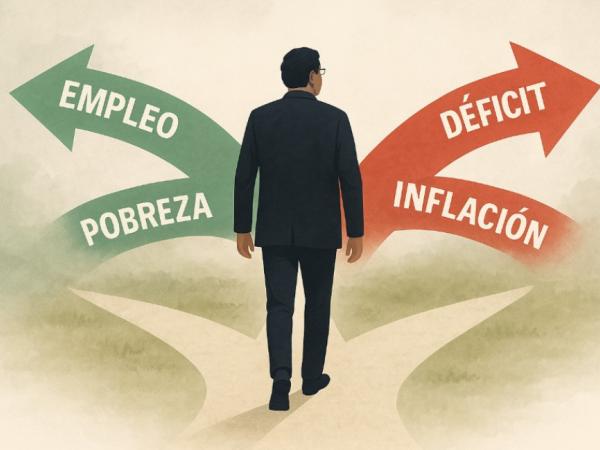
A few days after turning three years in power, Gustavo Petro’s government faces an economic balance with lights and shadows, according to the most recent report of the Anif Economic Studies Center, which warns that although there are advances in social matters, management presents important lags against comparable countries of the region, especially in growth, investment, inflation, exports and fiscal discipline.
The document, entitled ‘Economic Balance of the Petro Administration: regular notes and a great lunar in fiscal matters’, Compare the main indicators of Colombia with those of Chile, Peru and Mexico between August 2022 and mid -2025 and conclude that the local market shows lower performance on several key fronts, and its fiscal situation represents a particularly critical point.
More information: Special: Development Plan, in 58% to one year after the end of the government
First, Anif points out that Colombia had a low growth profile in 2023 and 2024, with a partial recovery in recent months; But it makes it clear that when comparing the current level of activity with that of Chile, Peru and Mexico, the country is still lagging behind, since “the growing gap is closing, but with a cut in the third year, the balance is not particularly good.”
“The contrast is even more evident if it is considered that the reference countries managed to maintain greater stability in their economic activity during The same period, while Colombia faced consecutive decelerations, ”they added.
While this administration has had advances, tax management has been a great mole.
Mixed signals in investment and consumption
Regarding the gross fixed capital formation, the report says that Colombia registered a 2.7% growth in the first quarter of 2025, above the regional average of 1.4%. However, it is the only country in the sample with investment levels lower than those of prepaandemics and also, as a proportion of GDP, the national investment rate is the lowest among comparative countries.
This lag contrasts with the behavior of consumption, where ColombiA has had the highest level in the region in the postpania period, since for ANIF, this imbalance between consumption and investment questions the sustainability of long -term growth.
It may interest you: Demands, blocking points and other aspects that you should know again in Colombia
Likewise, the export dynamics also reflects a weakness in which Colombia had an accumulated 5.6% drop in the value of its annual exports between 2022 and 2025, compared to an average growth of 9.9% in Peru, Chile and Mexico. Although a 36.9% growth in agricultural products, food and drinks, fuel exports, fuel exports, 14.7% stand out.
In terms of prices, Colombia shows the highest inflation in the sample. As of June 2025, the annual variation of the CPI was 4.8%, compared to a regional average of 3.4%. Although the gap has been reduced and Colombia closed 2023 with 9.3% and 2024 with 5.2%, the country continues to disadvantage its peers. This without leaving A side that faced significantly higher rates for a good part of the analyzed period.

While this administration has had advances, tax management has been a great mole.
The work front offers a more favorable panorama. Colombia was the second country of the sample in employment creation, with a 7.1% increase in the number of employed between August 2022 and June 2025, only behind Peru. However, the unemployment rate remains structurally high: in June it was 8.9%, as in Chile, but superior to Mexico (2.6%) and Peru (6.4%).
Prosecutor: The Great Lunar of the Government
The most critical aspect of the economic balance, according to Anif, is fiscal managementSince by 2025, Colombia projects a 7.1%deficit of GDP, well above Chile (1.8%), Peru (2.2%) and Mexico (3.9%) and the report does not hesitate to qualify this result as “the Great Lunar” of the Petro administration.
Other news: Budget of 2026 would have stressed that the Bank of the Republic did not lower the rate
The imbalance has triggered the public debt, which would reach 62.2% of GDP this year, 6 points above the level of 2024. In parallel, the Risk premium (EMBI) of Colombia rose to 309 basic points, the highest of the four countries analyzed.
Finally, socially, the balance is more positive if one takes into account that monetary poverty is
reduced from 36.6% in 2022 to 31.8% in 2024, and the Gini index went from 55.6% to 55.1%. However, Anif points out that These improvements do not seem to support economic policy measures, but on exogenous factors.

While this administration has had advances, tax management has been a great mole.
With all of the above, Anif concludes that the economic balance of the Petro government is unequal and that despite some advances, especially in employment and poverty, Colombia is still behind in key areas and faces a worrying fiscal landscape and closely warning that with a year of remaining management, it is urgent to adjust the course, starting with a reduction of the general budget of the Nation by 2026.
Daniel Hernández Naranjo
Portfolio journalist