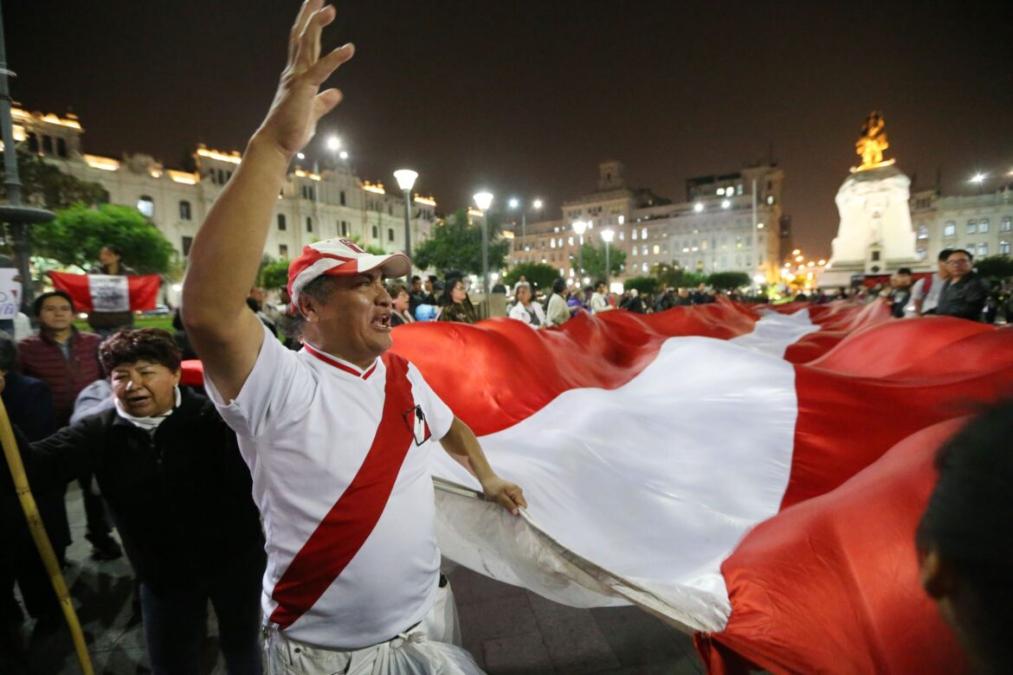
A strong leader, willing to act with a strong hand to establish order and fight against crime, corruption and generate employment, is the type of presidential candidate that the majority of Peruvians prefer to occupy the Government Palace since July 28 of this year.
This is revealed by the Ipsos survey published today Peru21. 44% want a leader with that profile. The trend towards this type of candidate has been growing since February 2023, when only 24% requested that type of government leadership for the next five years.
Secondly, “a leader who promotes the market economy and economic development” is preferred by voters. On the other hand, the predilection for “a leader who promotes a gender approach in education and intercultural non-discrimination” has been losing strength.
Political analyst Luis Benavente said that “the issue of a strong hand goes back a long way, since the re-election of Alberto Fujimori,” and that there is an “institutional framework that is complex and that does not give the president as much power to impose a strong hand.”
“The strong hand has very short limits due to this unbalanced, asymmetrical framework that exists. There is a demand for a strong hand because the soft hand does not work in ordering things and the wave of crimes exacerbates citizens,” he told this newspaper.
In his opinion, Keiko Fujimori (Fuerza Popular) and Rafael López Aliaga (Renovación Popular) are the candidates who are trying to capitalize more on the demand for a strong hand in these elections. “They have a more radical position and several points in common,” he stated.
Meanwhile, Guillermo Loli, director of Opinion Studies at Ipsos, told Peru21 that “throughout all these months that we are doing the evaluations, the profile that citizens are looking for is clearly someone who resolves citizen insecurity and fights crime. People are once and for all asking for firmness with a strong hand.”
“This is not a surprise; it is what the country is asking for. The levels of crime and, above all, extortion, are worrying. The population is asking for solutions, not more diagnoses,” he said.
DECISIVE FACTORS
And what criteria does the Peruvian take into account to decide his vote? The Ipsos survey concludes that 49% look for an honest and upright candidate, a value that, unfortunately, has been rare in the political class.
This is in line with the main problems detected by citizens in the country, since it places corruption in first place, leaving crime in second place with a narrow margin of distance.
In this regard, Benavente said that the indicators show the “ideal candidate” that people are looking for, but that in the end there are “real candidates” who are going to reveal their defects.
“Corruption continues to be a fundamental issue and is as important as citizen security in this time of so many crimes and homicides,” he explained.
For his part, Loli said that “it has been seen that in recent years there has been more than one president imprisoned for corruption cases, as well as mayors and governors; therefore, people are looking for someone who has the qualities of integrity and honesty.”
The executive director of Proética, José Luis Gargurevich, pointed out to Peru21 that “in this climate of disaffection, of much discouragement, of much pessimism” around the elections, it is important to “pull the thread of the skein by which citizens continue to believe that the honest and upright leader is the one who can move us forward.”
When people think about corruption, what worries them most is that which exists in the justice system, according to the Ipsos survey. Regarding this, Benavente pointed out that “there is a deep crisis” in the Judiciary and the Prosecutor’s Office.
“There is contempt between jurisdictional bodies, between the Public Ministry and the National Board of Justice. In addition, the laws of Congress are not followed, the Constitutional Court has to intervene… So, it is a mess and that confuses the citizen,” he declared.
Likewise, voters are divided between electing a person “with extensive political experience” and a person “who has not participated in politics before.”
Experience “is important,” said Benavente, but sometimes it can be read as “experience in corruption.” He added that “there is a demand for change” and that, in this context, “inexperience has value.”
Loli, in turn, pointed out that “there is a sector of the population that is looking for someone new,” but that “before that percentage was higher; now it has dropped.”
“Before, being the novelty had more relevance, but now people highlight the trajectory, because the great risk of novelty is that sometimes it is not accompanied by capacity,” he pointed out.
Gargurevich indicated that “people over 40 years of age are clear that it should not be the current politicians” who govern the next five years, but that it is also imperative to analyze who are the outsiders that a sector of the population is looking for; if they are part of the private sector, academia or other worlds that are not usually understood as politicians.
Important reading less than three months before the elections.
RECOMMENDED VIDEO