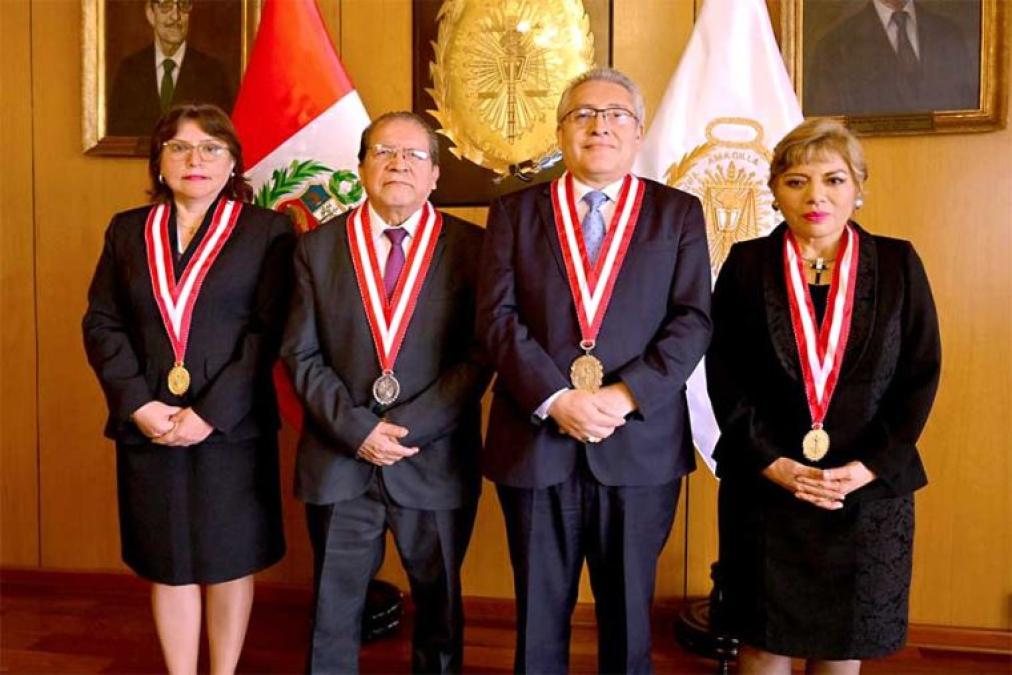
The Permanent Commission Congress approved to disqualify the suspended supreme prosecutor Delia Espinoza from exercising public office for ten years. The session also approved denouncing her for the crimes of usurpation of functions, abuse of authority, prevarication and generic falsehood, as well as lifting her jurisdiction so that the Attorney General can proceed with the complaint.
Espinoza was the only supreme prosecutor sanctioned by the Permanent Commission that evaluated and voted on the final report approved by the Subcommittee on Constitutional Accusations. In the case of the other three prosecutors, Juan Carlos Villena, Zoraida Ávalos and Pablo Sánchez, the votes were not reached to be disqualified and denounced because the abstentions were the majority.
The document recommended disqualifying prosecutors Espinoza, Villena, Sánchez and Ávalos for 10 years, for violation of articles 38, 103, 109, 159 and 166 of the Constitution.
The prosecutors are accused of the issuance of Resolution 2246-2024, on October 14, 2024, which approved a regulation considered contrary to Law 32130, a rule that strengthens the investigative function of the National Police of Peru.
The report considers that the supreme prosecutors would have disregarded Law 32130, by keeping the material investigation of crimes in the hands of the Public Ministry, which is interpreted as an invasion of the powers of the PNP.
Prosecutors’ defense begins
Lawyer Samuel Abad defends prosecutors Juan Carlos Villena, Pablo Sánchez and Delia Espinoza before Parliament.
The lawyer assured that the report “claims that by not sharing the criteria of a regulation approved by the nation’s prosecutor, by not sharing an interpretative criterion, it intends to dismiss four supreme prosecutors.”
Abad assured that the current situation reminds him of the year 1997, when Congress dismissed three judges from the Constitutional Court “for not sharing the interpretation” in the case of the re-election of former President Alberto Fujimori.
“Political control by Congress exists and must be respected, but it must not be abused to use the figure of political control as a mechanism of institutional attack on an autonomous body such as the Public Ministry,” he said.
“For the Public Ministry and for the Constitution, the person responsible for directing the investigation of the crime is the Public Ministry,” he added.
The lawyer points out that it cannot be disqualified for 10 years due to an interpretative discrepancy. Furthermore, it rules out that Article 159 of the Constitution has been violated, which establishes that the conduct of the investigation corresponds to the Public Ministry.
Likewise, the lawyer ruled out that article 38 of the Constitution had been violated and assured that compliance with the law had been respected.
“Issuing, by the Attorney General’s Office, a regulation that develops the functions of the Prosecutor’s Office is not a crime,” he emphasized.
The lawyer considers that the report prepared by the Subcommittee on Constitutional Accusations is “harmful to the Constitution.”
“To try to disqualify four senior officials, I must at least indicate which rule of the regulation is being harmful. It does not even mention it,” he added.
Abad also questions that congressmen with investigations intend to dismiss supreme prosecutors. “How can congressmen, who are the subject of complaints by the Attorney General’s Office, attempt to disqualify the supreme prosecutors who denounce them?” he stated.
Juan Carlos Villena defends himself
The former acting prosecutor of the nation Juan Carlos Villena indicated that, when the unconstitutionality of a law is presumed, the Constitutional Court is appealed. “When there are infralegalities, which are presumed to be contradictory to a law, there is a regular way to question the violation of the normative hierarchy,” he said.
The former nation’s attorney pointed out that the Constitution allows “popular action” to question the contradiction of the law with other laws of higher hierarchy. In that sense, he indicated that it is the Judiciary that must evaluate the dispute.
Villena also considered that it should be specified which articles of the regulation violate the law and in what way, something that – he said – has not been done.
“The resolution of the Attorney General’s Office that approves the regulation, nor the regulation itself, contains express words or phrases that order non-compliance with the law,” he said.
Zoraida Ávalos begins her defense
The former prosecutor of the nation Zoraida Ávalos, who is connected virtually, began her defense before the Permanent Commission of Congress.
The official points out that the issuance of the regulations took place in the office of the Attorney General’s Office. “The issuance of administrative regulations are the exclusive and exclusive competence of the Attorney General’s Office. That is, they cannot be issued by a board of supreme prosecutors,” he said.
Likewise, the supreme prosecutor assured that in the report approved by the Subcommittee on Constitutional Accusations there is no mention of the jurisdictional issue.
The official points out that the Board of Supreme Prosecutors (JFS) did not approve the resolution approving the regulation in question. “It is not the responsibility of the JFS to approve directives, regulations, or instructions,” he said.
“Where in the resolution does it indicate that I approved the regulation? The answer is: none,” he emphasized.
“I didn’t decide anything, I didn’t participate in the drafting of this regulation. (…) How could I have falsified or adulterated something?” he added and asked to file the accusation against him.
Voting starts
Parliament began voting to decide individually whether to accuse the supreme prosecutors of violating the Constitution and disqualify them for 10 years.
Vote to disqualify Juan Carlos Villena
- In favor: 6
- Against: 5
- Abstention: 8
The vice president of Congress, Waldemar Cerrón, reported that, because the number of abstentions exceeds the votes for and against, the accusation for violation of the Constitution and disqualification of the supreme prosecutor will be voted on another time.
Vote to disqualify Pablo Sánchez for 10 years
- In favor: 2
- Against: 6
- Abstention: 11
Parliamentarian Waldemar Cerrón reported that, in this case, the necessary votes were not obtained to make a decision on the accusation for violation of the Constitution and disqualification of the supreme prosecutor Pablo Sánchez.
Vote to disqualify Zoraida Ávalos for 10 years
- In favor: 2
- Against: 6
- Abstention: 11
The vice president of Parliament announced that the necessary votes were not reached to make a decision on the accusation for violation of the Constitution and disqualification of the supreme prosecutor Zoraida Ávalos.
Vote to disqualify Delia Espinoza for 10 years
- In favor: 16
- Against: 4
- Abstention: 2
The vice president of Congress reported that the votes were obtained to approve the report that recommends charging the suspended prosecutor of the nation, Delia Espinoza, for violation of the Constitution and disqualifying him.
The report must be submitted to the Plenary Session of Congress, where it will be voted on to make a final decision.
Voting for crimes
The Permanent Commission begins voting on alleged crimes attributed to the supreme prosecutors in the exercise of their functions.
Juan Carlos Villena
- In favor: 2
- Against: 7
- Abstention: 12
The vice president of Congress reports that no decision has been made to accuse the supreme prosecutor Juan Carlos Villena of alleged crimes in the exercise of his functions.
Pablo Sanchez
- In favor: 2
- Against: 13
- Abstention: 6
The vice president of the Legislature announced that it was rejected to accuse the supreme prosecutor Pablo Sánchez of the alleged crimes in the exercise of his functions.
Zoraida Avalos
- In favor: 2
- Against: 14
- Abstention: 6
The vice president of the Legislature announced that it was also rejected to accuse the supreme prosecutor Zoraida Ávalos of the alleged crimes in the exercise of her functions.
Delia Espinoza
- In favor: 15
- Against: 5
- Abstention: 2
The vice president of Congress announced that the votes were obtained to approve the report that recommends charging the suspended national prosecutor, Delia Espinoza, for alleged crimes in the exercise of her duties. The crimes charged are usurpation of functions, abuse of authority, prevarication and generic falsehood.
NEWS IN DEVELOPMENT