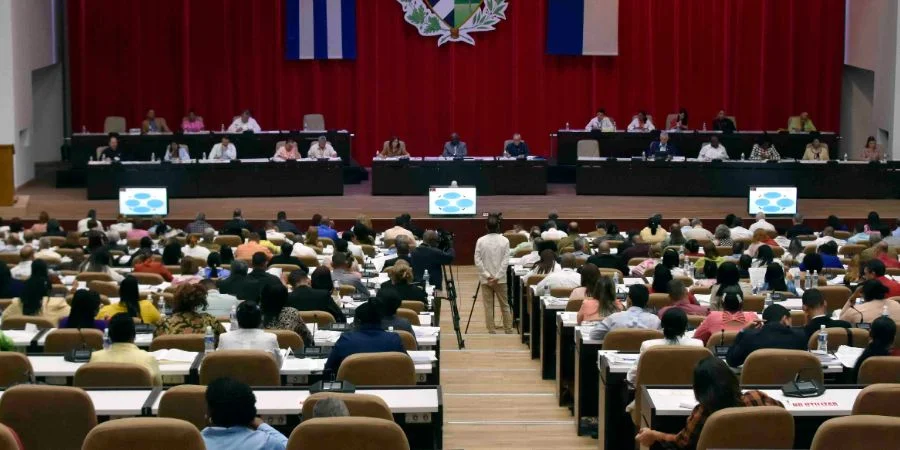
HAVANA, Cuba. – These days various events are being held in Cuba to remember the 50 years since the creation of the organs of Popular Power. And these bodies, and the activities related to them, are part of the mythology that Castroism has developed in order to improve its image. The Cuban rulers try to show that the people rule on the Island, that there are real elections, that the National Assembly of People’s Power carries out authentic legislative work, and that it constitutes the highest authority of the Cuban State.
Particular mention should be made of the elections that take place in Cuba, especially those that take place at the constituency level, that is, at the neighborhood level. Regarding them, the machinery of power boasts that the Party does not propose or nominate candidates, and that the voting boxes are guarded by pioneers. Of course, there is nothing important at stake. Here it makes no difference whether Juan is chosen as Peter. Overall, nothing changes above. Always the same characters for 50 or 60 years in power. But we also have examples of the maneuvers carried out at the grassroots level to prevent a candidate from being elected who does not have the sponsorship of the authorities.
In 2015, the opponent Hildebrando Chaviano He was nominated in his block. Immediately afterwards, when the photos and biographies of the candidates were posted in public places, Hildebrando was the subject of offenses to degrade her image: that she had attended events abroad organized by the enemies of the nation and other things of that nature. And in the end, on the day of the vote, a “rapid response brigade” appeared and offered a rally to repudiate the opposition candidate, with the deliberate purpose of frightening voters.
On the other hand, the regulations for elections at the constituency level allow us to see the formal nature of these elections. It does not matter that in all the meetings of a constituency the same candidate is nominated. In any case, in the last meeting of that constituency another candidate must be nominated, with the sole objective of having an election, even if it is known in advance who is going to win it. This is how the Castro election circus works.
Next comes the work of the famous “Candidacy Commissions”. They are made up of figures belonging to the various associations related to the Party, such as the Central Workers of Cuba (CTC), the Committees for the Defense of the Revolution (CDR), the Federation of Cuban Women (FMC) and the University Student Federation (FEU). Its mission is to nominate future deputies to the National Assembly. Approximately half of those chosen are leaders at the national level (ministers, senior Party officials, high-ranking military personnel and internal security forces), who, in opposition to the democratic principle of separation of powers, will govern and legislate at the same time. Here it is not important to elect figures who will spend legislatures and more legislatures without opening their mouths in the Assembly sessions, as were the cases of Juan Almeida and Abelardo Colomé Ibarra. The important thing is to occupy the positions with figures of the high nomenclature.
The Castro regime boasts of the number of young people and women who make up the Cuban Parliament. However, they do not mention that this parliament holds the world record for unanimity. When a proposal comes from the highest levels of power, there is neither a vote against nor any abstention. What would those brave parliamentarians like Manuel Sanguily, Juan Gualberto Gómez and so many others who fought tough oral battles during the discussion of the 1901 Constitution say!
But the rulers know that every day fewer Cubans agree to become delegates of Popular Power. People are aware that this mechanism does not solve anything, and that everything is a lie to feed another myth of Castroism.