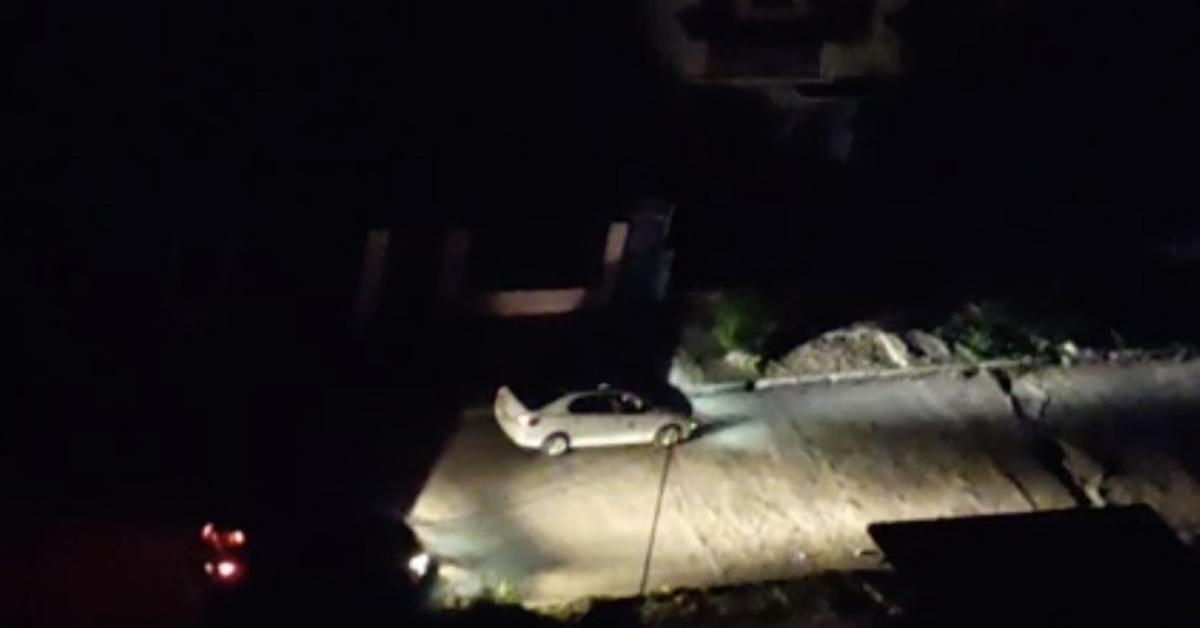
Madrid/The protests of October 20, 2024 in Manicaragua, Villa Clara, due to the lack of light has resulted in severe sentences of five and six years in prison for six of the protesters. The sentence was issued just one year after the protest act, in which 23 people were arrested and has had access to it the Cuban Observatory for Human Rights (OCDH), which has denounced the “Orwellian narrative” of the document.
Those sentenced to six years are José Águila Ruiz, for a crime of propaganda against the constitutional order, and Raymond Martínez Colina and Carlos Hurtado Rodríguez, both for public disorder. Meanwhile, Osvaldo Agüero Gutiérrez, Narbiel Torres López and Yoan Pérez Gómez all received a five-year prison sentence for public disorder as well.
The Provincial Court of Villa Clara considers that all of them were part of the hundred people who on October 20 went to the headquarters of the Municipal Assembly of People’s Power in the town asking for an end to the blackouts. During the act, the sentence indicates, they resorted to “touching cauldrons and other metal objects” that “affected citizen tranquility” and interrupted traffic while shouting “we want current.”
During the act, the sentence indicates, they resorted to “touching cauldrons and other metal objects” that “affected citizen tranquility” and interrupted traffic while shouting “we want electricity.”
The text details that “the accused Narbiel activated a type of horn that incited noise; for his part, the accused Raymond had a metallic object placed on his waist that he hit and the accused Carlos emitted similar noises”, while two others claimed “with shouts and gestures”, making it difficult, argues the document, to which the OCDH had access, for the authorities to communicate verbally with citizens to explain the situation. The objective was, the court determines, “to overwhelm the officials.”
José Águila Ruiz, the man convicted of “propaganda against the constitutional order,” was accused of this crime for having filmed and disseminated the demonstration on social media in real time “with the aim of discrediting the Cuban social system.”
In the protests of those dates, which, as the sentence recognizes, dissolved peacefully when the light returned, 23 people were detained, the largest group being those arrested in the neighboring Encrucijada, among them the independent journalist José Gabriel Barrenechea, for whom seven years in prison were requested in a trial held at the end of September against the defendants from that town.
The OCDH considers that the Manicaragua sentence follows the usual path and constitutes “a fraud whose sole purpose is to criminalize civic protest, serving as an instrument of repression and annulment of human rights” in addition to being issued “in a context of intensifying repression as the only response to serious social problems.”
The organization insists that there are no guarantees in the judicial processes of the Island and the principle of legality is nullified, by condemning actions that are not classified crimes, although it does not specify which of all the acts it refers to. “The absence of a duly proven crime should have resulted in the acquittal of the accused and their immediate freedom, given that they have been illegally deprived of liberty since October 2024,” he adds.
Among the many details that the organization questions is the fact that – in its opinion – there is no reliability in the witnesses, who “indistinctly” identified the accused among a group of at least one hundred people. “As is customary, the court automatically gives full weight to the testimonies of Ministry of the Interior and local government officials, which is incompatible with judicial impartiality,” he argues.
Nor was there, he argues, a lack of logical reasoning, since “the causal link between individual actions and the impact on public order is not explained, nor is the threshold that distinguishes a legitimate protest from a criminal act defined.” In addition, there is the use of “politically sectarian language, such as ‘people disaffected to the revolution’ or ‘enemy media’. [lo que] “It seriously compromises the objectivity of the court and blurs the legal analysis.”
The decision was announced on the same day that the Cuban Prison Documentation Center (CDPC) has publicly denounced the situation of people deprived of liberty in Cuba, 60 of whom died in state custody according to its calculations.
The events are collected in a report that goes from March 2024 to the same month of 2025, a period in which “1,858 events related to people deprived of liberty in Cuba” were recorded.
The facts are collected in a report that goes from March 2024 to the same month of 2025a period in which “1,858 events related to people deprived of liberty in Cuba were counted. Of these, 1,330 constituted human rights violations, which shows a pattern of institutional violence and a critical deterioration of penitentiary conditions.”
The document, titled What the numbers tell, specifies that of the 60 deaths, 47 were related to the physical and mental health of the victims, as well as lack of care. Another seven were due to direct physical violence, while the remaining six were not specified.
The most common acts of violence in prisons are repression and harassment, followed by inadequate medical care, poor living conditions, and nutritional deficiencies. There is also a “persistent” use of actions that violate human rights and that range from isolation and transfers as punishment to practices that border on torture, such as the Turkish bed – immobilization of the prisoner – or the bicycle – which consists of throwing handcuffed inmates from the top of stairs.
Common and political prisoners are subjected to these practices, which add to overcrowding and unhealthiness, the latter being 329 of the 545 identified as affected. The CDPC urges the international community to monitor and promote oversight mechanisms for these practices, which also end with total impunity for officials. “Today, the Cuban prison system is a space of human degradation and political repression. These are not isolated failures, but rather a structural policy of punishment and silence that requires a firm international response,” they warn.