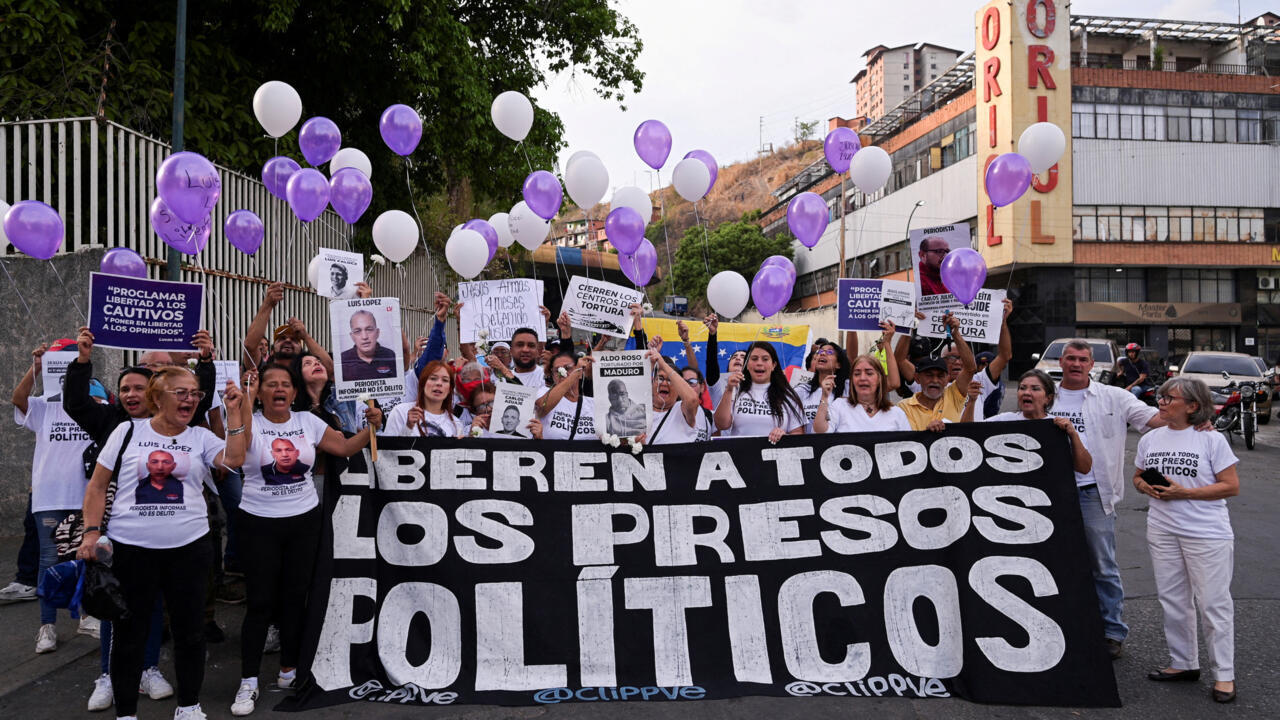
The NGO Foro Penal updated this Thursday the number of political prisoners in Venezuela, which amounted to 887 peopleof which 85 have foreign nationality. The balance, corresponding to December 1, 2025, deepens the concern about the increase in arrests for political reasons in the country.
He report details that among those detained there are 770 men and 117 women, as well as 713 civilians and 174 soldiers. The organization also registers 883 adults and 4 adolescents, in a pattern that shows the transversal scope of the repression.
One of the most alarming data is that of the 60 detainees whose whereabouts remain unknowna situation that human rights organizations describe as short-term forced disappearances, a practice documented in reports from international bodies.
Increase in political prisoners after presidential elections
Penal Forum explained that most arrests occurred after the July 2024 presidential electionselections in which the National Electoral Council proclaimed the re-election of Nicolás Maduro, despite complaints of fraud made by the opposition grouped in the Democratic Unitary Platform (PUD).
The protests and social mobilization that followed election day were accompanied by a wave of mass arrests. According to independent organizations, the pattern includes warrantless arrests, temporary disappearances, prolonged incommunicado detention, and, in many cases, denial of access to legal defense.
The Maduro government believes that there are no political prisoners in Venezuela. The president and the attorney general, Tarek William Saab, assure that all those detained “committed crimes,” a statement that is rejected by the Penal Forum, other NGOs and opposition leaders, who point out that these are fabricated processes to punish dissent.
Growing opacity and violations of due process
On November 3, the organization Justicia, Encuentro y Perdón (JEP) warned about increase in arrests without sufficient public informationa scenario that he describes as “legal insecurity and prolonged anguish.”
JEP denounces that the authorities hide key information about the arrests, delay the presentation of detainees to court and hinder the work of lawyers and family members. The NGO maintains that this “generalized opacity” has strengthened a climate of structural arbitrariness.
Simultaneously, the Committee for the Freedom of Political Prisoners in Venezuela (Clippve) denounced precarious conditions in detention centers, including poor food, limited access to water, restricted visits and lack of timely medical care.
The committee warns that four teenagers and at least 10 older adults with chronic illnesses remain detained, none of whom have been included in the recent releases ordered by the government as part of political gestures.