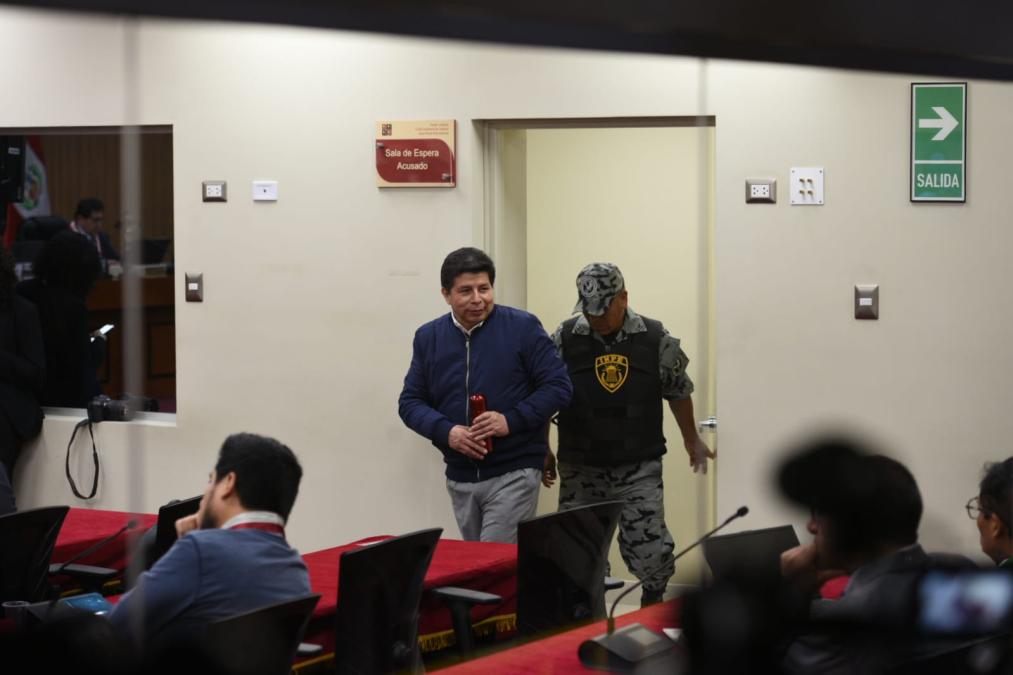
Today’s judicial agenda has a decisive point: starting at 9:00 am The Special Criminal Chamber of the Supreme Court will read the sentence of the process followed against Pedro Castillo Terrones for the failed coup attempt that occurred on December 7, 2022. The former president will follow the hearing remotely from the Barbadillo prison, where he is serving preventive detention.
Today the sentence against former President Pedro Castillo for the attempted coup d’état of December 7, 2022 will be announced.
Office: Natalia Lizama pic.twitter.com/bmpCR4p6g2
— Perú21 (@peru21noticias) November 27, 2025
At the beginning of the session, Pedro Castillo’s defense requested the annulment of the trial. However, the request was rejected by the court. Subsequently, Judge Norma Carbajal announced that an advance sentence would be given.
According to Pedro Castillo’s defense, the annulment of the trial is justified due to the “poor appointment” of the members of the courtroom, in addition to the fact that it had to be signed by the prosecutor of the Nation, something that did not happen in the case of the former president. The judge indicated that the signature of the Attorney General “is not a requirement”, on the other hand she indicated that the case is about the coup d’état and this shows that “the defense could not prepare against the attributed rights”, so the annulment of the case cannot be processed.
In the responsibility of Castillo Terrones, it was attributed to him that on December 6, 2022, he met with Torres Vásquez and Chávez Chino to draft the coup d’état letter and this is verified with the videos recorded in the Palace camera. As indicated by the court based on a testimonial statement, Chávez Chino requested that the transmission had to occur through the IRTP signal, so that night he called the secretary general of the Ministry of Culture to find the head of the IRTP and the message be transmitted the next day. Another piece of evidence is a document located on a Palace computer.
The testimony of former Minister of the Interior Willy Huertas indicated that Betssy Chávez tried to have the National Police allow pro-government protesters to enter the parade ground; this coordination was also done through the Ministry of Defense with the phrase “it is by order of the president.”
The court determined that former President Pedro Castillo committed the crime of rebellion and described this as a proven fact. In addition, it was proven with documents obtained from the former head of state’s home that he was going to comply with the specifications mentioned in his speech. After the message he hugged Betssy Chávez and Aníbal Torres. Chávez told him “good president.” This moment was accredited by the room.
According to a member of the presidential escort, “when leaving the Government Palace I asked the president where we were going and he told me the Mexican embassy.”
It was proven that Chávez called the ministers for an extraordinary meeting and that he sought to get the holders of the different portfolios to endorse the state of exception that Pedro Castillo was going to dictate. “Dear ministers, go to the PCM, today is a historic day,” he wrote in the WhatsApp group he had with the rest of the authorities. On the other hand, it has been confirmed that Chávez had the press enter the Palace irregularly so that the message could be transmitted. Due to these and other facts, the former premier has been classified as a co-author of the crime of rebellion.
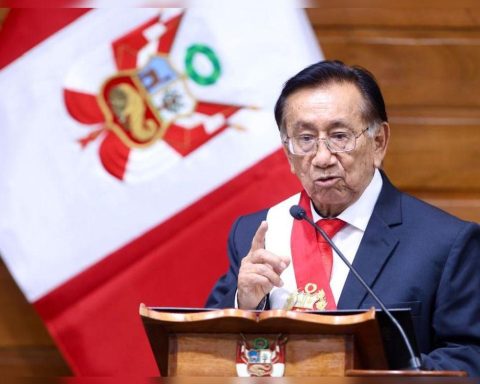
The panel is chaired by Supreme Judge José Neyra Flores, and is made up of judges Iván Guerrero López and Norma Carbajal Chávez.
Charges and tax position
The Second Transitory Supreme Prosecutor’s Office accuses Castillo of rebellion, abuse of authority and serious disturbance of public tranquility. Altogether, it has raised a condemnation of 34 years in prison:
The Public Ministry maintains that Castillo not only announced the unconstitutional dissolution of Congress and the reorganization of the justice system, but also took actions aimed at materializing that decision. The fiscal thesis indicates that the then president’s televised message sought to establish a government of exception.
THE TRANSCENDENCE OF THE FAILURE
Constitutional lawyer Aníbal Quiroga highlighted the historical significance of the ruling and said that, if a conviction is carried out against the Chotano professor, it would be the first time in the history of Peru that a president is criminally sanctioned for carrying out a coup d’état.
Quiroga used the case of Alberto Fujimori and the 1992 self-coup as the main contrast, indicating that this act went unpunished and the former president “got off cheap” by not being convicted.
“When Fujimori’s coup occurred, the issue was validated in some way politically by the popular acceptance, due to what happened later, of calling elections for a new Congress. There was never a criminal accusation. Even when he was extradited, none of the five crimes included the coup. Yes, there was a political sanction because Congress disqualified him for 10 years,” he recalled.