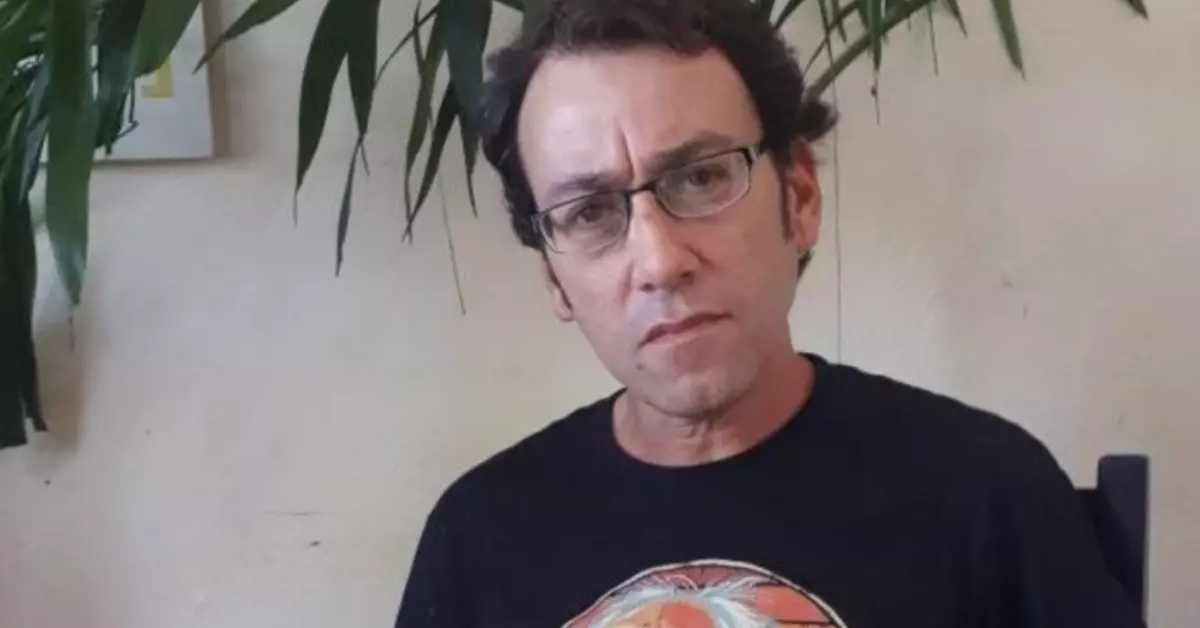
Havana/The independent journalist José Gabriel Barrenecheacollaborator of 14ymediois the winner of the prize given annually by the Patmos Instituteas reported by the organization this Friday. The award, granted unanimously “for his testimonies of genuine faith and visions of hope,” is also offered to the memory of the communicator’s mother, Zoila Esther Chávez, who died while he was in prison, where he remains. awaiting sentencing for demonstrating last year in Encrucijada, Villa Clara.
“The prize has once again been awarded to a Catholic (Physics) professor, currently a political prisoner, since November 8, 2024 and without, on the verge of completing a year of arbitrary confinement, a sentence having been handed down,” says the Patmos Institute in a statement, in which it recalls that the first winner, in 2014, Amador Blanco Hernández, was also a professor, in his case of History.
With this award, a statement indicates, the Patmos Institute “closes a cycle of 12 consecutive years in which an imaginary pendulum began its oscillation with the award in 2014 to Amador Blanco Hernández, a professor (of History), Catholic, former political prisoner, who was active in the Patmos Institute since its founding. [en 2013]until his departure from this world on April 9, 2020.”
The statement recalls that the first winner, in 2014, Amador Blanco Hernández, was also a professor, in his case of History
Barrenechea, the text continues, “has been active in the Patmos Institute since its foundation and until the present, and in all these years he has lived a process in which, from defining himself as a cultural Catholic, he has transitioned to deeper and existential experiences of faith, especially with the hard times of tribulation in prison.” As an example, the organization cites the communicator’s gratitude to the Catholic Church and the bishop of Santa Clara, Arturo González Amador, for “his visit on July 7 to me, here in prison, bringing me spiritual comfort and the word of Our Lord.”
Likewise, the statement includes the journalist’s words sent in a personal message to the evangelical pastor Mario Félix Lleonart, also with a religious meaning: “I will carry the Cross like my Lord, that of my elders, that of us Hispanics. There are values that give meaning to our days, and although it is terrible for us to face their defense, it is an honor to do so.”
With this, indicates the Institute – which in previous years also awarded political prisoners, such as Sissi Abascal, Félix Navarro, Sayli Navarro, María Cristina and Angélica Garrido or Jorge and Nadir Martín Perdomo – “it shows that beyond the suffering of the prisoner is the family, and especially if they are elderly mothers, who depend on only children who have been deprived of caring for them and even burying them.”
Zoila “departed this world, at the age of 84, in the afternoon of Sunday, May 4, without saying goodbye to her son, because the system that keeps her son imprisoned did not listen to her cry.”
In the case of Zoila, Barrenechea’s mother, the organization recalls, “she left this world, at the age of 84, in the afternoon of Sunday, May 4, without saying goodbye to her son, because the system that keeps her son imprisoned did not listen to her cry.” In her last days, the text denounces, “Zoila stopped eating, consumed by the pain and sadness of not being able to see her son. Despite her delicate state of health, aggravated by terminal cancer, the authorities of the La Pendiente prison, under the command of the repressor Yurianis Speck Rosillo (by superior orders), denied Barrenechea permission to say goodbye to her mother. ‘The son will see his mother when she dies,’ was the official response that the family received and “That’s how they accomplished it.”
The statement also cites the article that Barrenechea himself sent from prison and published by this newspaper last October 14.
Regarding his biography, Patmos highlights that the journalist has a degree in Physics from the University of Pedagogical Sciences of Villa Clara and describes him as a “very prolific intellectual”, his texts have been published in several magazines such as Coexistence, Stained glass either Hypermediaas well as in newspapers such as 14ymedio and Cuban Diary.
“Prison has been the most recent phase in the system’s cruelty against Barrenechea,” the statement continues, recalling the censorship he suffers both when publishing in state media and when practicing as a professor. “In 2019, after receiving a visa from the United States to participate in a Vista Literature Festival in Miami, he was prevented from leaving and his visa expired without him being able to use it, remaining regulated by political interest,” they detail, adding that “prior to the current imprisonment, on numerous occasions he received police summons or was the victim of shorter detentions.”
“In 2019, after receiving a visa from the United States to participate in a Vista Literature Festival in Miami, they prevented him from leaving and his visa expired.”
Barrenechea was arrested a few days after participating in the cacerolazo in Encrucijada that took place on November 7, 2024. His request to be released pending trial was rejected and he was only allowed to leave prison to attend his mother’s funeral (but not visit her when she was already seriously ill).
The trial took place last septemberand in it the Prosecutor’s Office requested six years in prison for Barrenechea, and up to nine for one of the other two of the five defendants. According to the prosecutor’s letterthe accused – with three cauldrons “that could not be occupied” – led a cacerolazo in the town of Encrucijada taking advantage of “the absence of electricity caused by the electro-energy crisis in the country.”
The action, with “incessant knocking” and “high decibels,” was accompanied by repeated shouts of “Turn on the power, we want power.” This, the Prosecutor’s Office argued, meant “disturbing citizen tranquility” and “obstructing vehicle traffic on public roads.”