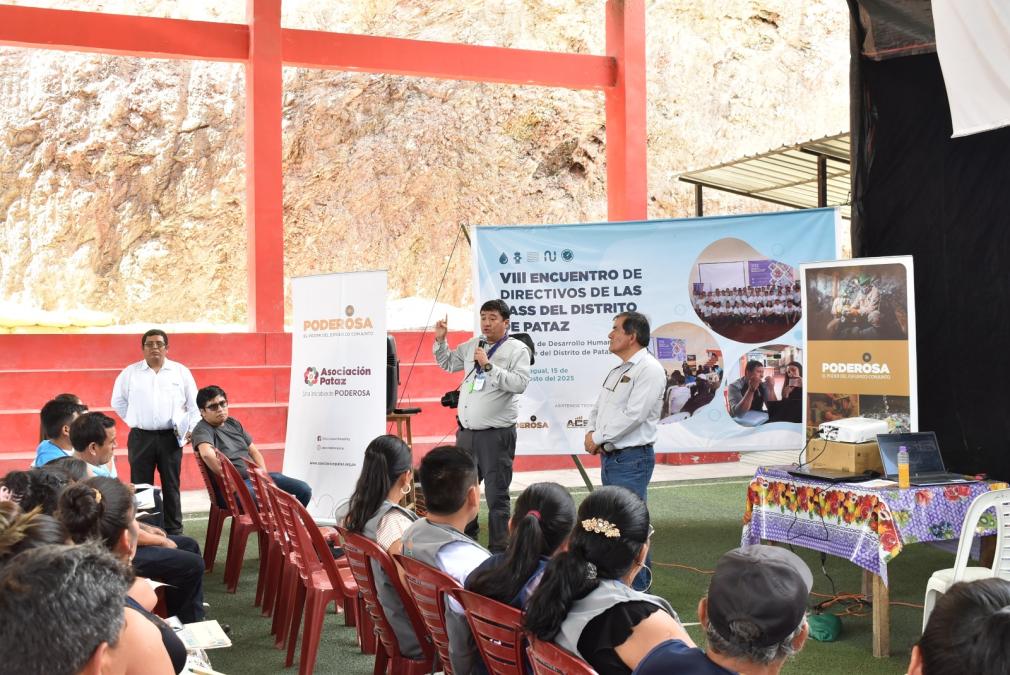
With the aim of strengthening their management capabilities and promoting the Sustainable developmentleaders and residents of the Districts of Pataz and Pías participated in a series of key meetings for Community Development Committees (CODECO) and the Sanitation Services Management Boards (JASS).
These events, organized in collaboration with Minera Poderosa, Pataz Association, and local governments, marked a milestone in the participatory governance of the area.
In Pataz, on August 15, the XXVIII Encuentro de Codeco and the VIII of Jass was held, gathering 11 development committees and 14 sanitation joints. The next day, in Pías, the second meeting of Codeco and the third of Jass was held, with the participation of 4 committees and 11 joints.
María Paz, assistant to the head of community relations of Minera Poderosa, inaugurated the meeting in Pataz, highlighting the company’s commitment to support the Codeco and Jass to become managers of their own future.
For their part, the inhabitants valued these spaces as an opportunity to exchange successful experiences and highlight the importance of sustainable water management, a vital resource for the community.
During the meetings, José Luis Calderón, coordinator of Pataz Association Projects, presented the details of the XIV Concursable Fund for Community Development Projects for Pataz and the II Fund for PIAS. This program seeks that the CODECO acquire the necessary tools to formulate, co -finance and execute projects that improve the quality of life of their neighbors.
“All of us here want the people to progress”Calderón said. “We work to strengthen commitments through the Codeco and Jass”.
In this edition, the competitive fund will finance the three winning projects in Pataz and the winning project in Pías with 130,000 soles each, a significant amount to promote productive and social initiatives.
Sustainable sanitation training and ecological solutions
One of the pillars of these meetings was technical training, focused on improving the management of water and sanitation systems. The participants attended two key presentations:
-
Sustainable management of sanitation systems: The consultant Ney Díaz emphasized the need for efficient economic-financial management, including rates that cover the operating and maintenance costs, to ensure the sustainability of the service.
- Biological wastewater treatment: Hugo Cotrina, a specialist in sanitation, explained natural and ecological methods to treat wastewater, controlling bad odors and protecting the environment.
These training are crucial for communities to manage their water resources efficiently, which translates into a direct improvement in public health and environmental protection.
The commitment demonstrated by the leaders and residents of Pataz and Pías underlines the importance of collaboration between communities, the private sector and local authorities to build a more prosperous and sustainable future.
Recommended video