
The Mixed Parliamentary Front for Paternity License and the Women’s Bench in the National Congress articulate support for the regulation of paternity leave in Brazil to guarantee a period of 60 days for the parents, even if implemented gradually, from 30 days.
Last week, the House of Representatives approved an urgent request to vote on one of the various bills that are processed in the house. PL 3.935/2008, which has already passed the Federal Senate, stipulates the 15 -day paternity license, a period considered insufficient by specialists and civil society organizations that accompany the subject.
“We think it is possible to expand the paternity license in Brazil, [mas] It is not overnight. And that’s what we’re negotiating. So this older text, which is the first of the tree [de projetos de lei]who came from the Senate, speaks in 15 days. What we have brought in recent times is to reach 60 days. To do this, we have to negotiate how long we take to make this transition, how many days we start. So this is what is under discussion, “said federal deputy Tábata Amaral (PSB-SP), who is president of the Parliamentary Front.
The statement was given to journalists after Tabata participated, in the Planalto Palace, sanction of the law that establishes a 30% quota for women in state -owned boards.

The President of the Mixed Parliamentary Front for Paternity License, Deputy Tabata Amaral – ROVENA ROSA/FILE/AGENCY BRAZIL
“We got the approval of the urgency, being designated the rapporteur [deputado federal Pedro Campos]. Now it is this construction, in which our political articulation is mainly for ensuring that the text is approved in the House and exit directly to the sanction of the Presidency of the Republic, “said federal deputy Jack Rocha (PT-ES), coordinator of the women’s bench.
Jack Rocha predicts vote for the coming months, from the return of the parliamentary recess.
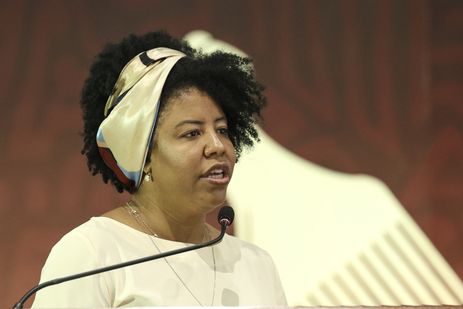
Deputy Jack Rocha, coordinator of the women’s bench – MARCELO CAMARGO/FILE/AGENCY BRAZIL
“It starts with 15 or 30 days – this would be the rhythm of progression. But we are consensual, from left to right, the camera and Senate, to walk along and that, at some point, will reach 60 days,” said Tábata Amaral.
According to the deputy, there is already an agreement under construction with different political groupings, such as the Parliamentary Front of Early Childhood, the evangelical bench and parties of different ideological spectra.
Tábata said that among the obstacles to the advancement of the project is the tax impact of the measure, estimated at 0.05% of the social security budget. “It’s a small impact, but it’s a complex context from the fiscal point of view. So we are worked with the government to find this compensation.”
How it works
Currently, the license for parents is five consecutive days in cases of child birth, adoption or shared custody. Law is foreseen in the Consolidation of Labor Laws (CLT) and was created with the promulgation of the 1988 Constitution.
By the act of transient constitutional provisions (ADCT), rules created with the promulgation of the Constitution, the five -day license should remain until Congress approves a complementary law for definitive implementation, a vote that until today, after 37 years, did not occur.
The theme re -gaining impetus after the deadline given by the Federal Supreme Court (STF) for Congress to regulate the license. The decision, issued by the Supreme Court in 2023, was the result of action filed in 2012 by the National Confederation of Health Workers (CNTs) in favor of the benefit.
At least 10 countries, including Spain, the Netherlands and Finland, grant paternity leave of 30 days or more. In most countries, the license is still less than 15 days.