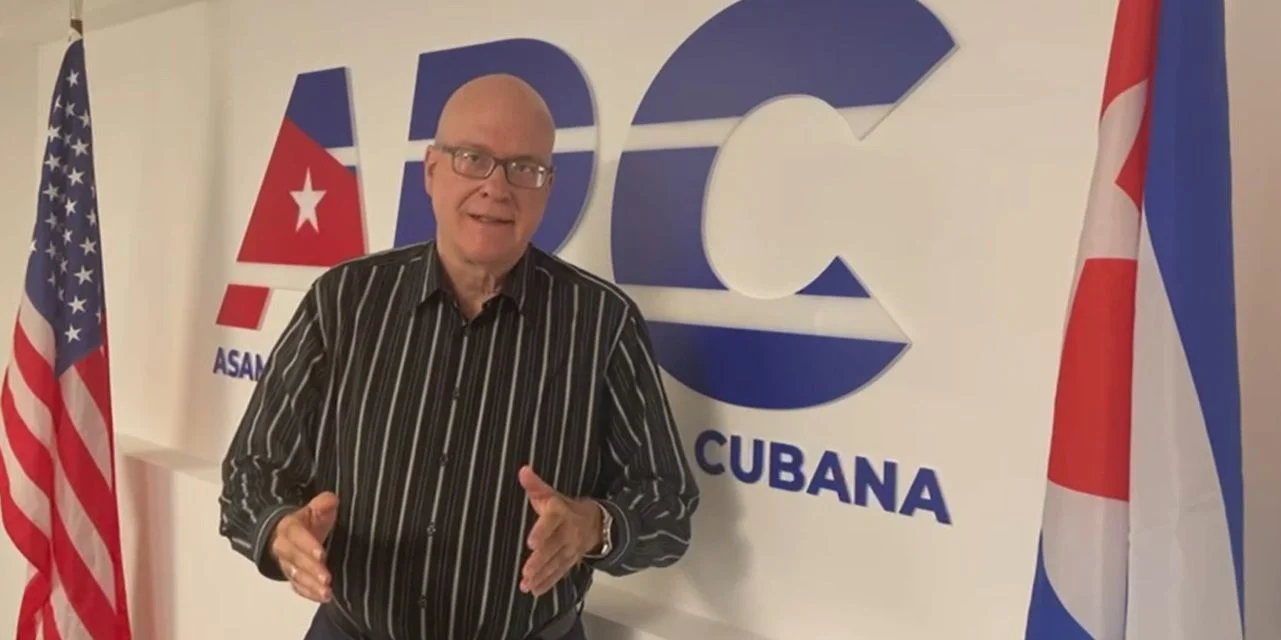
MIAMI, United States. – The secretary general of the Assembly of the Cuban Resistance (ARC), Orlando Gutiérrez-Boronat, qualified like a “hoax” Miguel Díaz-Canel’s speech this Thursdayassured that there were no substantive announcements and maintained that the Cuban regime is “isolated”, “confused” and without decisive international support.
In declarations granted to CubaNetthe opponent stressed that the broadcast “was not live” as the regime had announced and that Havana once again resorted to “anti-imperialist” rhetoric without offering solutions to the crisis.
“The nation has been waiting for decades for the regime to decree the end of the civil war in Cuba (…) and that did not come. What came was more nonsense of anti-imperialist discourse,” he said. According to the opposition leader, this speech “the only thing it has served for (…) is to cover up the serious defects of the system” and explain “the level of poverty and desperation that exists in Cuba.”
During the conversation, the secretary general of the ARC maintained that the way out of the crisis involves “national reconciliation”, the construction of an “open and free economy”, a “rule of law” and the guarantee of human rights. “That is the only way to get the country out of the quagmire in which it finds itself,” he stated, after emphasizing that none of that was present in Díaz-Canel’s message.
Gutiérrez-Boronat also questioned the president’s reference to alleged external support. “When he talked about international support it was laughable because the list of international support was a mockery. They don’t have anyone’s support (…) and that includes Russiaincludes China“Because they don’t have it,” he said. In his opinion, the intervention showed “a disconcerted Díaz-Canel, without a clear direction.”
In relation to the United States, he maintained that policy towards Cuba is conditioned by US legislation and significant electoral support, and affirmed that both President Trump’s national emergency decree and the State Department’s messages “point out that a political transformation of Cuba is essential” to normalize bilateral relations and so that Cubans “can live in a different way.”
Asked about the absence of foreign press in the official broadcast, Gutiérrez-Boronat considered that the regime remains in a “totalitarian bubble” that denies reality and avoids uncomfortable questions. “If they bring in foreign press, some foreign journalist is going to make them [a Díaz-Canel] the uncomfortable questions that it cannot answer,” he said, before describing the system as “a house of cards” in the process of collapsing.
Regarding the electro-energy crisis, the leader rejected official statements that the blackouts have not worsened and assured that the population reports more hours without electricity. In that context, he presented the general lines of a “national salvation plan” prepared by the Assembly of the Cuban Resistance, made up—as he said—of 52 organizations inside and outside the country.
The plan, he explained, prioritizes the restitution of rights and freedoms, the reconstruction of public powers with competitive elections, an elected Congress and president, and a Constitution that emanates from popular sovereignty.
“The Cuban is exceptional (…). Wherever the Cubans fall in the world, they push forward. They are successful, except in Cuba. Why? Because of communism, not because of the Cubans,” he stated, adding that the country needs “a government that is up to par and tailored, that is employed by the Cubans, not the other way around.”
Regarding the European Union, Gutiérrez-Boronat urged cutting off cooperation funds that, in his opinion, “only benefit the dictatorship,” and proposed a coordinated policy between Europe and the United States against a regime that he described as “pro-Russian.” “Once this aid is cut, the regime’s countdown will accelerate,” he said.
Finally, when asked about possible contacts between sectors of the regime and Washington, he clarified that it was a personal conjecture. “I think there are people within the Castro regime who are talking to the United States without other factions of the regime knowing. That is my speculation,” he said.
In his closing message, he stated that a Cuba without the Communist Party and the Castro family could quickly move toward recovery. “Change has to be real. Real change means out with the Castro family, out with the Communist Party, full restitution of the rights and freedoms of the people of Cuba,” he concluded.