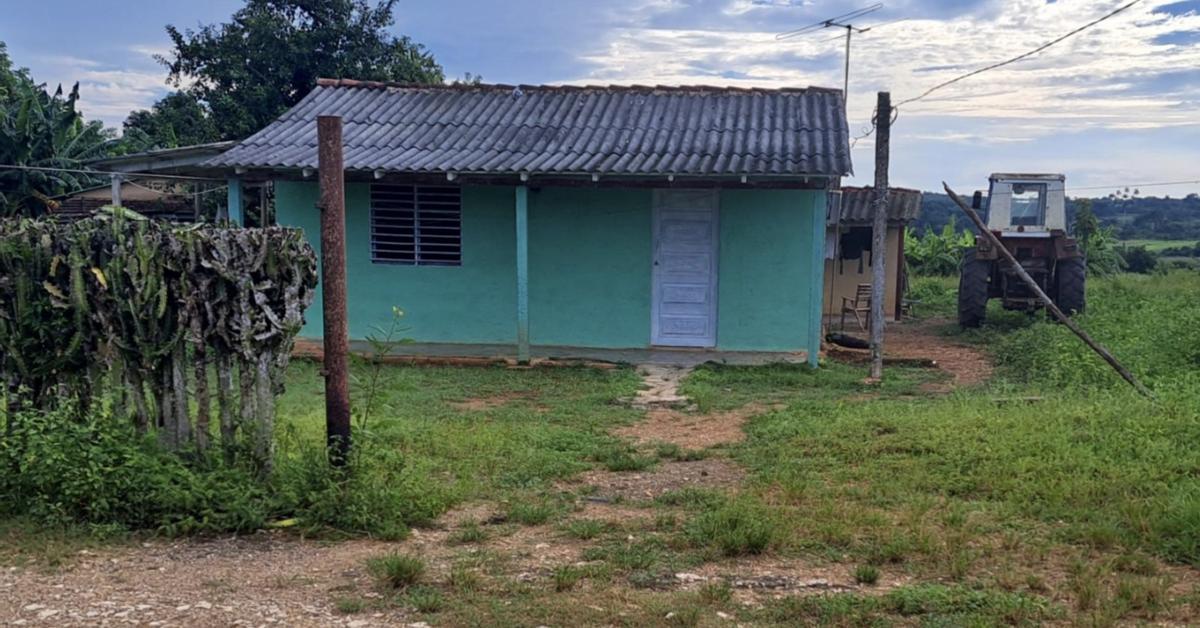
Havana/Since Hurricane Melisa, only 15,000 homes damaged by the cyclone, out of a total of 106,500, have been repaired. The data was offered by this monday the official newspaper Granma, who interviews Danislay Hechavarría Duvalón, coordinator of Programs and Objectives of the Provincial Government. Although it is presented as progress, the figure shows the slowness of the process. Tens of thousands of families are still waiting for a definitive solution months after the disaster.
The delivery of materials to repair roofs by the State is limited to 70 square meters per home, explains the Communist Party’s own newspaper. The technicians calculate the tiles based on the largest type, without adjusting to the actual dimensions of each house. In larger homes, only the roof is partially covered, and the rest must be repaired by the affected people themselves once minimum habitability is declared.
The Government admits that many families have not been able to rebuild their roofs quickly due to economic or mobility problems. At the same time, it denounces diversions of resources towards the informal market, which has led to police controls and calls to strengthen popular supervision.
The Government admits that many families have not been able to rebuild their roofs quickly
As an alternative to the housing crisisthe official media have been announcing for a couple of months the conversion of metal containers into homes. Initially it was intended as a one-time measure, but now it is applied in several provinces, using structures that were previously imported for equipment, especially for photovoltaic parks.
Although it tries to sell it as a good solution, given the high cost and lack of traditional materials, the Government itself recognizes that this model faces several challenges: the need for good thermal insulation to counteract heat and humidity, the resistance of the structures and the high costs. Although the State covers the development and some expenses, the beneficiaries must pay for the container, whose value is estimated at 900,000 pesos.
Furthermore, in recent months some MSMEs have begun to offer conditioned containers between 7,550 and 10,000 dollars, in a country where the average salary barely reaches 18 dollars per month, which makes it almost impossible to access these improvised homes, which do not guarantee basic comfort or durability of the structures.
Despite these limitations, authorities insist that containers be adapted with insulation systems such as glass wool, henequen fiber or bagasse cardboard, and with protective covers to reduce heat and humidity. However, many residents continue to point out that, although functional, these houses are not always practical in the face of local climatic conditions.