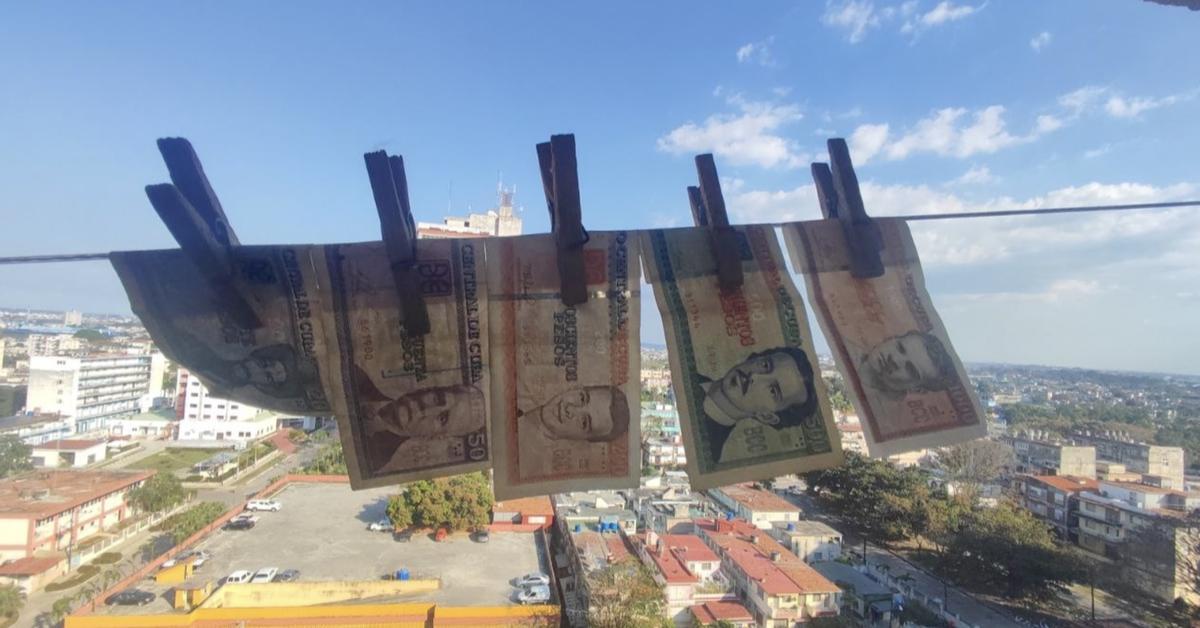
Havana/A thousand Cuban peso bill was a rare sight until a couple of years ago. We saw him rarely and the sellers put their hands on their heads if they had to give change for such a high sum. But on the Island of Inflation, extending Julio Antonio Mella’s face now to buy something no longer surprises, does not impress and much less is synonymous with high purchasing power. Papers are papers.
This Monday I enter the Calzada del Cerro. I have been told that a store that sells ornamental plants also has fertilizer that can be used for the garden that I am preparing on my terrace for the “zero option.” They are a row of still tiny plants that can give some flavor to our food if garlic and onion stop reaching the market, if life comes to a standstill so much in Havana that a little cilantro becomes an unattainable chimera or if people go to war over a bunch of lettuce.
I will have what I can grow. Which is little, given that except for the rural schools I attended and the high school I spent in a deteriorated building in the middle of the fields of Alquízar, current province of Artemisa, my agricultural knowledge is very limited. I know how to weed and uproot when the crop is ready to eat. All those trainings to be the new man, who could be self-sufficient, were nothing more than a teaching caricature. We played that we could survive with our own hands and we couldn’t even survive without the Soviet Union.
On the corner of Rancho Boyeros and Calzada del Cerro there is a broken electric tricycle. The fact that these vehicles do not need gasoline does not mean that they are impregnable to the constant gaps and unevenness of Havana streets. The man tells me his name is Roly, who is dedicated to moving packages for one of those agencies that brings merchandise from Miami, which has lost almost the entire fleet of cars it used for delivery due to lack of fuel. Where some have seen their livelihood disappear, others cannot cope with so many clients calling them to move a box or a suitcase. Roly was one of the latter, until a gap deflated his business.
There was a time when taking a Calixto García (50) out of your wallet was a sign of financial slack
“This arrangement does not go below 8,000 or 10,000,” he calculates as he tries to bring the vehicle closer to the sidewalk while waiting for a friend who comes to help him return home. Life is counted in thousands of pesos. That pound of pork costs 1,000, this package of adult diapers costs 3,000 and that dozen painkillers costs 5,000. We add in a big way, with zeros that grow to the right and bills that pass so quickly from our pocket to other hands that we barely have time to distinguish the face printed on them.
There was a time when taking a Calixto García (50) out of your wallet was a sign of financial slack. Then the turn passed, very quickly, that paying with a Frank País (200) marked the difference in social status. It quickly jumped to Ignacio Agramonte (500) making it clear that its owner was not an ordinary Cuban, to reach this moment in which we recount our existence with a piece of paper with the image of the founder of the Popular Socialist Party. One Mella, two Mella, three Mella… life measured by the speed with which we hand over a bill that bears the face of a communist leader.
I approach the small place where they sell postures, but it is closed. I check with my eyes to see if there are bags of that fertilizer that I need to feed the small plants that have begun to grow on my terrace. A man passes by on a bicycle and yells at me that the nursery is not going to open today, that the old woman who takes care of it is still suffering from one of those viruses that have become part of our daily lives. I take a deep breath and step onto the road.
The barracks follow one another, a polyclinic in darkness, due to the blackout, has patients and health personnel spilled out at the entrance and at the nearby fire station the truck has just left with sirens sounding. The rescuers have no life these days in Havana. They are called when the elevators in tall buildings get stuck when the electricity goes out. They get called when someone sets fire to a pile of trash on a corner. They are called when floodwaters fail to drain through sewers covered in plastic bags and other waste.
Almost all my neighbors are skinnier. There are people whose clothes and teeth dance
Firefighters have come to replace community services, missing medical personnel, electrical company technicians, and police officers who do not appear when they are most needed. Recently one of them reached the 13th floor of our building to rescue a neighbor locked in the elevator. He was small and petite. He had probably only had a piece of claria with rice for lunch that day, at best. The uniform was too big for him.
Almost all my neighbors are skinnier. There are people whose clothes and teeth dance. An elderly woman has lost so many pounds that she wears her blouse with a knot tied around her waist so it doesn’t blow up in the wind. There are people who are even thinner than when they lived through the Special Period. That time the hunger was different. It hurt, but everyone in the neighborhood had our stomachs stuck to our spines. Now there are empty plates and MSMEs with imported hams. In this crisis there are apartments that are completely turned off at night and others that have a power plant to overcome the lack of power. I have neighbors without soap to bathe and others who perfume themselves with expensive scents that stick to the elevator walls.
I’m near the old Maravillas cinema. Smoke spreads in the surroundings that makes the eyes and throat burn. A pile of waste burns under a nearby tree. Nearby there are several merchants offering their merchandise. One sells a package of 50 masks for 1,000 pesos. If they continue burning garbage everywhere, the residents of Havana are going to have to use face masks again. But this time it will not be because of covid-19, but because of toxic gases. I reach into my pocket and pull out a Mella. I do the rest of the way along the Calzada del Cerro with a piece of cloth over my nose, protecting myself from this city that attacks us from all sides.