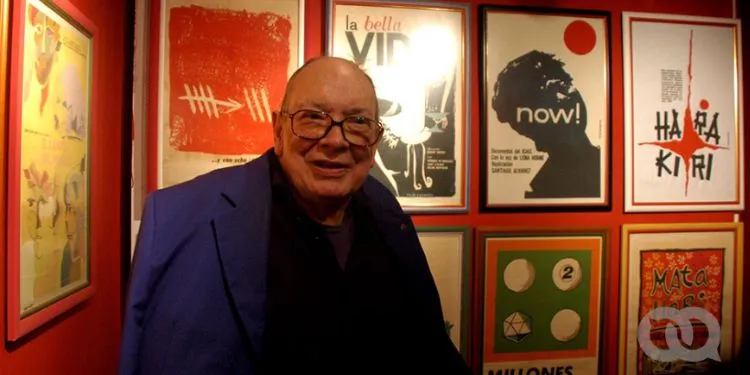
Guevara played a shadowy role in the most decisive moments of the suppression of cultural freedom in Cuba.
HAVANA, Cuba.- This year, the increasingly diminished Festival of New Latin American Cinema – which was held in the few cinemas that remain operating in Havana (less than eight) and using electric generators to avoid blackouts – was dedicated to the founder of the event, Alfredo Guevara, on the occasion of the hundredth anniversary of his birth, on December 31, 1925.
Alfredo Guevara was a man of cinema, undoubtedly, but he did not make films or documentaries, but as president of the ICAIC—a position he held from 1959 to 1983 and resumed in 1991—he was the chief curator of Cuban cinema.
As a result of his long-standing friendship with Fidel Castro—both were 19 years old when they met at the University of Havana and participated in the 1948 Bogotazo—Guevara, who introduced Fidel to socialism, felt authorized to dissent and hold critical positions.
In his last years, claiming to be original and iconoclastic, he declared himself a supporter of destatization and “a libertarian and Renaissance socialism.” He would probably regret having supplied Fidel Castro with those first Marxism-Leninism manuals from the Academy of Sciences of the Soviet Union, which were nothing more than the simplified and opportunistic Stalinist version of Marxism, which was what Fidel kept. Later, little given to theorizing, the leader was too busy to listen to his friend and mentor on issues of socialism and dedicate time to the study of Gramsci and Althusser.
Alfredo Guevara, as one of the main makers of the cultural policies of Castroism in its first decades, found himself facing the Stalinists of the old Popular Socialist Party. Thanks to Guevara, the Stalinists who banned us from Hollywood cinema did not manage to deprive us of the European cinema of the sixties nor were they able to impose socialist realism in the Soviet way. We only have to thank Alfredo Guevara for that because good cinema would have been made in Cuba with or without him. Rather, it was made in spite of him, as demonstrated by the films of Tomás Gutiérrez Alea that he objected to, or some of the films that were made between 1983 and 1991, when Julio García Espinosa directed the ICAIC.
Guevara, as commissioner, played a shadowy role in the most decisive moments of the suppression of cultural freedom in Cuba. There is the prohibition of documentary P.Mhis apology for Fidel Castro’s “Words to Intellectuals,” his attacks against Revolution Monday and the letters recriminating Tomás Gutiérrez Alea.
In his story “Crime for dancing the chachachá”, Guillermo Cabrera Infante masterfully reflected Guevara’s attitude, when thanks to his proximity to the Maximum Leader, he arrogantly decided what “revolutionary culture” should be.
In this story, Cabrera Infante narrates a meeting he had with Alfredo Guevara in 1961 at the El Carmelo cafeteria, where the ICAIC czar made it clear to Cabrera Infante that the closure would not stop only with the confiscation of the documentary. P.Mbecause “Revolution Monday It could not in any way be revolutionary culture,” and in the face of the writer’s ironies, he went from smiling to fury, and got into such a tantrum that he nearly knocked over the jacket that he usually wore thrown over his shoulders.
In his last years, Guevara, when trying to justify his actions at the time of P.M and Monday of Revolution, He did so with such an arrogant attitude that, far from calming grievances, he exacerbated them.
The ICAIC was not, as Guevara painted it, a libertarian lodge, but rather a purgatory for numerous creators who did not agree to submit to its whims. In the ICAIC there was debate, but in the end the criteria of the chief commissioner were always imposed, by hook or by crook.
Guevara used his powers to shelter in the ICAIC some strays that he welcomed as his protégés in the worst years of the Gray Quinquennium, such as Silvio Rodríguez, Pablo Milanés and Noel Nicola, for whom he created the Sonora Experimentation Group as a reformatory and musical academy.
Guevara boasted that the ICAIC, like Alicia Alonso’s National Ballet and Haydée Santamaría’s Casa de las Américas, did not receive the UMAP nor the parameterization. But the truth is that only homosexuals, ideological deviants and other misguided people who enjoyed Guevara’s sympathy could reach the ICAIC. For the others, who were the majority, he did not lift a finger or utter a word.
Alfredo Guevara’s arrogance and airs of superiority were reflected in an interview granted a few months before his death to journalists Nora Gámez and Abel Sierra, where he did not hide his disdain for the common Cuban. He said: “I am the bearer of an almost mystical vision of my country and my people, a people in which I do not believe, I do not believe that my people are worth it. I believe in their potential, but not in their quality. They have always wanted to put us in the mold of the Soviet Union. Talking with a French intellectual about the particularities of Cuba, on one occasion, I wanted to convince him that we were very different, and that day I convinced him because I told him: Go out into the street, do you think that with those asses and those lycras, can anyone understand Ludwig Feuerbach and the end of classical German philosophy? Do you think that is possible?”
Guevara, who confessed that he would have wanted to be simultaneously a revolutionary and a millionaire and almost achieved it, showed his disconnection with reality by denying the impoverishment of the living conditions of Cubans: “Now they call misery the people who live in microbrigade buildings, with clotheslines in the street and people half naked. You can’t tell me that this misery exists.”
However, there are those who prefer to evoke Guevara, who died in April 2013, as an erudite, sophisticated being, open to debate, who in his talks with the students – among whom he said he felt comfortable – recommended that they “have cushions and more cushions” to defend their own criteria, knowing that they would not have the licenses or sponsorship that he had.