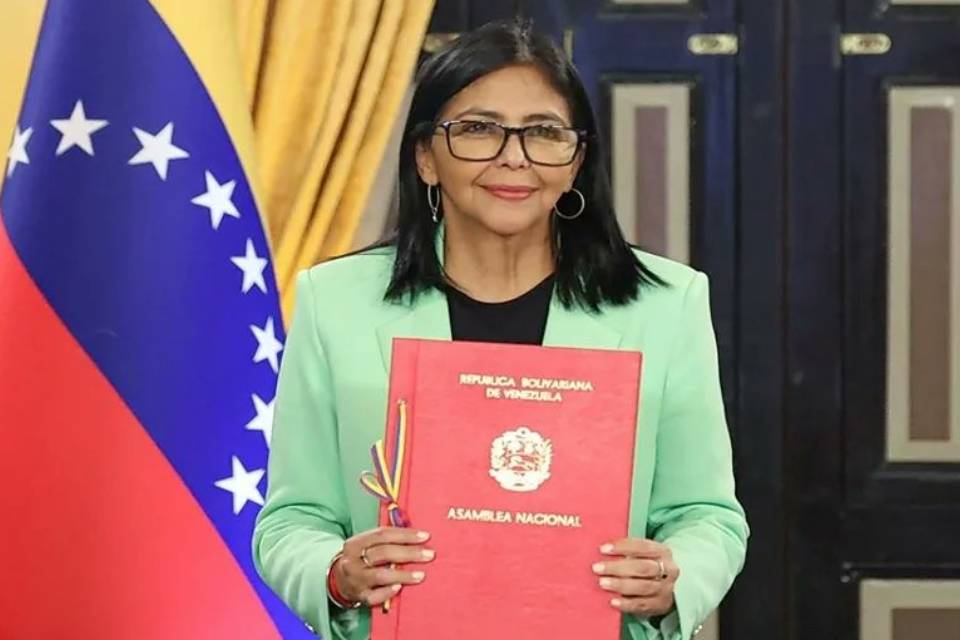
The reform presented to the National Assembly by Delcy Rodríguez allows private companies to produce and sell crude oil directly, even if they are minority partners of PDVSA. At the same time, it makes the tax regime more flexible – reducing the royalties that must be delivered to the State – and reduces parliamentary control over mixed companies.
The draft reform of the Organic Hydrocarbons Law proposes a redesign of the legal framework that governs the Venezuelan oil industry. Although it formally maintains principles such as sovereignty over the deposits and state ownership of the resource, the text introduces substantive changes that They expand private participation, make the tax regime more flexible and reduce political and administrative controls established in the law in force since 2006.
One of the first changes appears in the very object of the law. The reform expands its scope to incorporate principles such as “legal certainty”, “contractual transparency” and “energy transition”, which become an explicit part of the interpretation criteria of the sector. This twist is not minor: introduces concepts associated with investment attraction and contract stability in an article that, until now, focused mainly on the affirmation of state control.
The project also incorporates a new article eight that expressly enables the use of alternative dispute resolution mechanisms, such as mediation and independent arbitration. Although it does not eliminate the jurisdiction of the Venezuelan courts, it does open the door to arbitration instances that were not so directly contemplated in the current law, a historically sensitive point in the oil debate.
In terms of primary activities—exploration and production—the reform redefines who can execute them and under what modalities. In addition to the Executive and state companies, and mixed companies with majority control of the Republic, A third way is introduced: private companies domiciled in Venezuela that may operate through contracts with state companies or their subsidiaries. These private companies assume comprehensive management “at their own cost, expense and risk”, without the contracting state company being held accountable for their debts or financial obligations.
This design is developed in detail in the new Section of articles 40 to 45, dedicated exclusively to contracts for primary activities. As remuneration, the operator may receive a percentage of the volumes produced, which may be marketed directly once the fiscal and parafiscal obligations have been met. At the end of the contract, the incorporated or built assets pass to the state company without the right to compensation.
One of the most relevant political changes is the modification of the role of the National Assembly. While current law requires parliamentary authorization for the creation of joint ventures and their essential conditions, the project replaces that control with a notification mechanism. In practice, this reduces the AN’s ability to veto or condition the constitution of new associations in the oil sector. This reduces the margin of legislative control over the essential conditions of these strategic partnerships, that come to depend fundamentally on decisions of the Executive.
The reform also introduces a new article 36 that grants unprecedented powers to the minority private partner within mixed companies. Among them, the possibility of directly marketing part or all of the production if it demonstrates that it obtains better prices than state companies; open and manage bank accounts in any currency and jurisdiction; and assume the technical and operational management of the project, directly or through related companies, under the supervision of the governing body. The text also incorporates the notion of “economic-financial balance” of the project, aimed at guaranteeing the return on the private partner’s investment.
On a fiscal level, the reform maintains the base royalty of 30%, but introduces a more flexible structure. The modified article 44 allows the Executive to reduce it for reasons of “economicity”, with differentiated floors: up to 20% in contracts with private companies and up to 15% in the case of mixed companies. A similar scheme is introduced in article 45 for the extraction tax, which continues to be one third of the value of the hydrocarbons, but with possible reductions up to those same levels – the tax continues to be one third of the value of the hydrocarbons produced, but with equally reduced minimums depending on the type of operator.
The project also expands the concept of “special advantages” that the State can demand, explicitly incorporating economic compensation for access to reserves, as well as obligations regarding technology transfer, training of human talent and training programs.
Finally, the transitional and derogatory provisions of the project partially eliminate regulations that reserved activities and services related to hydrocarbons to the State, and ratify the full validity of the contracts signed under the Anti-Blockade Law. In addition, they order the review of existing joint ventures to adapt them to the new legal framework, consolidating a structural change in the Venezuelan oil model.
The portal Economic Log published this Wednesday, January 21, that “it will not be a total reform of the Organic Hydrocarbons Law but a partial one, and The articles that will be modified have already been discussed with the United States and approved by Donald Trump’s administration.
The note was published almost parallel to the statement of deputy Henrique Capriles in which he stated that Chavismo wants to give a “fast track” or rapid discussion to the reform of the Hydrocarbons Law, whose debate began this Thursday in the National Assembly.
Here you can read both documents, the reform proposal and the current Hydrocarbons Law in force since 2006:
*Read also: The US “approved” the changes to the Hydrocarbons Law first than the AN deputies
*Journalism in Venezuela is carried out in a hostile environment for the press with dozens of legal instruments in place to punish the word, especially the laws “against hate”, “against fascism” and “against the blockade.” This content was written taking into consideration the threats and limits that, consequently, have been imposed on the dissemination of information from within the country.
Post Views: 692