The mobilization for the Battle of Santa Inés was marked by the low attendance of the officials and apathy among those who were present. However, some members of the ruling party assured that they were willing to defend the country “with their lives” in the face of the possibility, from their perspective, that the United States would invade Venezuela.
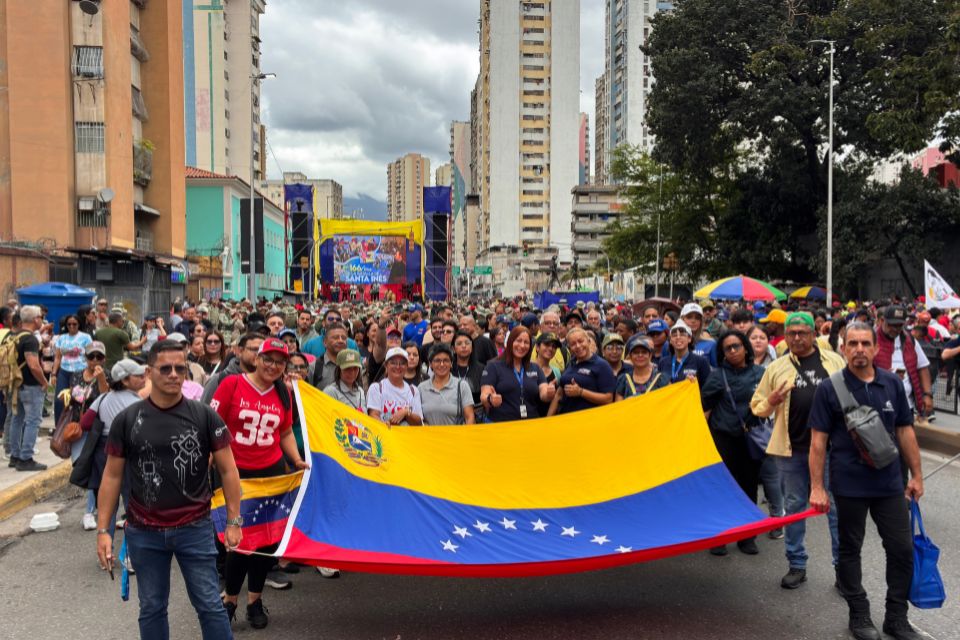
The official march called for this Wednesday, December 10 to commemorate the 166 years of the Battle of Santa Inés took place between music, instructions from the stage to those attending to smile at the camera or appear more cheerful, and an atmosphere that demonstrated apathy among those present.
Militias, students from the National Experimental University of Security (UNES) and groups of farmers from Portuguesa and Aragua gathered on San Martín Avenue, many of them wearing hats and reluctant to be photographed. The supporters of Chavismo who gathered outside the Concepción Palacios Maternity Hospital did not fill a block.
Between salsa rhythms, the participants ate combos with juice, sandwich and banana for lunch while from the platform they asked for “una noise” that was more timid than scandalous. The animators insisted that “peace cannot be violated by anyone,” but the attendees did not respond to that call; They remained indifferent, eating, talking among themselves and avoiding the cameras.
Not even the “Tarzaniao dance” invented by Nicolás Maduro managed to raise the spirits of the followers of the ruling party. Only a few, who were in the front row, after requests to make the peace symbol with their fingers, raised their hands. Meanwhile, the leaders of the activity assured that in the country “the battle is being waged with joy.”
“Defend the country with one’s life”
Despite the prevailing discouragement, the speech of several attendees revolved around the willingness to defend the nation before the United States and the alleged desire for invasion that government leaders denounce daily.
«We are willing to defend the homeland and take up arms because everything the US says are falsehoods. Our people are peace and harmony,” said militiaman Miguel Marín.
This young and shy young man also rejected the awarding of the Nobel Peace Prize to the leader of the opposition, María Corina Machado, and stated: “That should be cancelled. She talks about loving the country, but she’s not even here. “He hasn’t shown his face.”

For her part, Wendy Medina, 39 years old and resident of Macarao, paused before answering that she would also be willing to face a US invasion. Dudosa said she would do it “to help my people.” However, regarding the Nobel Prize, she was emphatic: “You cannot give him that prize because he is not supporting the country.”
For Juan Plaza, a Corpoelec worker and resident of El Marqués, “the US invasion of Venezuela is a question of logic,” he believes that it is only necessary to review history and understand, from his point of view, that Donald Trump’s administration wants to take over the country’s oil and other wealth.

“A person who calls for invasion and subjects the people to restrictions cannot be the subject of such an important award,” said Plaza, after asking for his opinion on the awarding of the 2025 Nobel Peace Prize to the representative of Vente Venezuela.
Daisy Mercedes Núñez, first sergeant of the Battle of Rodeo de Guatire, Miranda state, had the same position of readiness to defend the homeland: «I defend the country even if it is with my life. “That’s why we are here, in the Militia.”

On the right, militia member Daisy Núñez
Núñez rejected that the Nobel Prize had been awarded to María Corina Machado and added: “She is the one who is harming the country. “He doesn’t deserve any award.”
The mobilization from Bellas Artes, the point from which the Minister of the Interior, Justice and Peace, Diosdado Cabello, and the Vice President of the Republic, Delcy Rodríguez, left, was marked by the rain, which did not even allow them to speak on the stage and made them leave earlier than planned, while attendees were asked not to leave the march due to the heavy rain and to stay on the route.

*Journalism in Venezuela is carried out in a hostile environment for the press with dozens of legal instruments in place to punish the word, especially the laws “against hate”, “against fascism” and “against the blockade.” This content was written taking into consideration the threats and limits that, consequently, have been imposed on the dissemination of information from within the country.
Post Views: 21