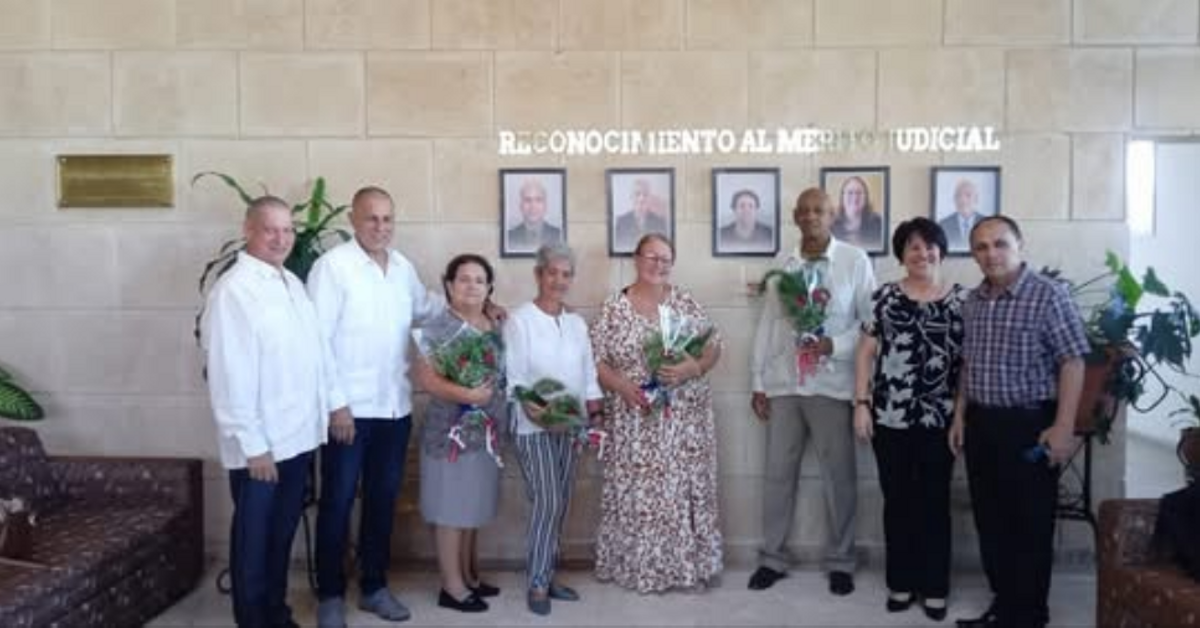
Madrid/When in 2023 Juana Orquídea Acanda Rodríguez received the order of judicial merit, he said: “It is the recognition of the work of a lifetime, to the realization of my dreams and is the best example of the work of the revolution.” Now, at 62, he will have to place himself on the other side of the stand after being arrested on March 20 when he tried to reach the US with a family reunification visa.
As reported by the journalist Mario J. Pentón in his social networks, agents of the Office of Customs and Border Protection (CBP) stopped Acanda at the Miami International Airport for hiding his militancy in the Communist Party of Cuba (PCC) and his links with the Cuban State. The former judge, who worked more than three decades in a criminal hall, lied in the consular interview, one of the most common causes for the revocation of visas.
For US authorities, any past or present affiliation with the PCC, the courts, the judicial system or the forces of the order can be considered a critical factor in the evaluation of visa, asylum or residence applications of citizens of the island. But deny those links, if it is verified that they existed, not only constitutes fraud, but that it can be perceived as a threat to the security of the migration system.
Acanda erased any detail that could account for its past in common with the regime before starting a new stage in the United States. There are no profiles with its name on social networks, but a simple internet search reveals everything that Achieve tried to hide in the eyes of consular officers.
It appears in various matterous media, in articles that cover galas, ceremonies, anniversaries and decorations. And it is not a simple retired worker, but a recognized figure on more than one occasion for his loyalty and commitment to the regime. In one of those reports where it is mentioned, it is read: “Perhaps the retirement keeps it apart, in quotes, from the courts, but in their mind and heart, orchid will always be a judge.”
Your case reminds of the Melody González Pedrazawho was also arrested at an air terminal in the United States after revealing his repressive history. The former judge had sentenced four 11J protesters in Cuba.
Now, Juana Orquídea Acanda, from the bench, faces a possible deportation and permanent inadmissibility to US territory. He must demonstrate his innocence in the face of accusations of deliberate fraud and misrepresentation, something unlikely, since – according to Mario J. Pentón an anonymous source of CBP – she herself admitted to having lied.
Just a few months ago, excited, she declared Yumurí TV: “I was totally made during those 36 years of justice, as the company demands.” Today, without toga or deck, he faces not only the US courts, but also to the moral judgment of an exiled community with which he intended to live together the possible reprisal of that regime that, after decades of loyalty, tried to abandon between silences and forgetfulness.