The bodies of the shot of cause 1 were buried in the necropolis of Columbus so that it was almost impossible to locate them.
Havana, Cuba. – An execrable and scandalous page in the history of the Castrocommunist regime was the shooting of the General of the Revolutionary Armed Forces and hero of the Republic of Cuba Arnaldo Ochoa Sánchez, the colonel of the Interior Ministry Antonio de la Guardia Font and two other officers.
The four were executed at dawn on July 13, 1989, in the Baracoa Special Troops Unit, east of Havana.
The accusations presented at the trial, the Cause 1 of 1989They involved these people in operations with drug traffickers from the Medellín poster and smuggling of diamonds and ivory.
The process, which was broadcast on television, left enough doubts. Above all, because it was quite unlikely that Fidel and Raúl Castro (then Minister of the FAR) did not know about the matter and had given their authorization for such operations. No operation of that magnitude could have been carried out without their knowledge and consent.
Recall that the night before the verdict of the military prosecutor, Raúl Castro appeared before the cameras in decomposed way, and gave a speech, which was not broadcast or published entirely in the press in which he implied the disagreements of him and his brother with Arnaldo Ochoa for the driving of the war in Angola.
Cause 1 occurred as a consequence of the complaints and evidence presented by the United States, which accused Cuba’s government of being involved in cocaine traffic. To clean themselves with guilt, Fidel and Raúl Castro made responsibility for Ochoa and the Brothers of the Guard, whom they used as scapegoats in the midst of a great staging.
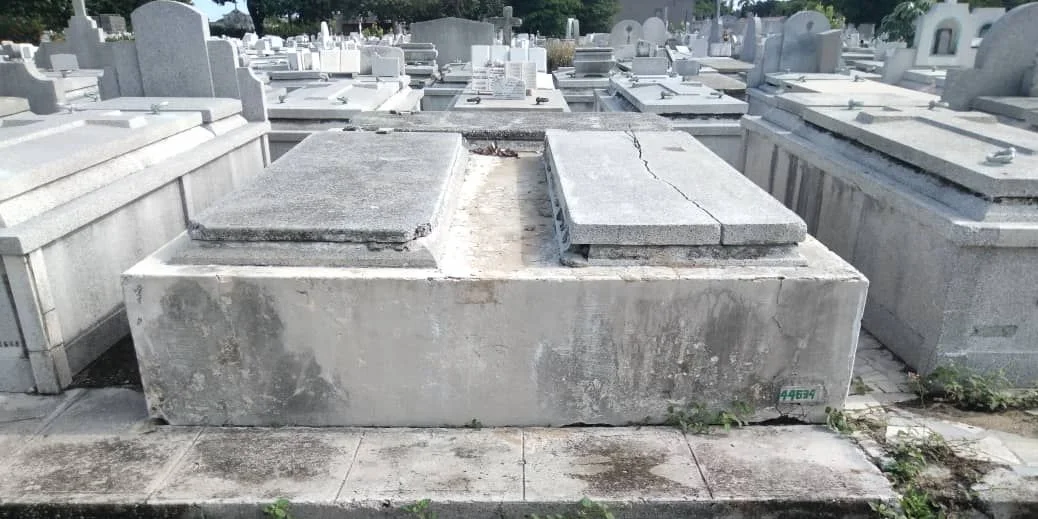
The bodies of the shot of cause 1 were buried in the necropolis of Columbus so that it was almost impossible to locate them.
A few years ago, a cemetery archivist, already deceased, gave me information about the exact location of the remains of the shot.
The archivist assured that the letter of the settlements of the deaths, in the corresponding book, was different from the writing of the remaining ones, something that allows to conjecture over the intentions of concealment by the authorities.
The documents on the burials are not available to any known person.


I recently toured the points indicated by the archivist. A friend, connoisseur of the cemetery, accompanied me. Without their help it would have been impossible for me to find them.
The state of the tombs, in general, is deplorable. Grown herbs make it difficult to identify the pantheons, which do not present indications with the name of the buried. They may no longer be there their remains.
We went to the cemetery tourist office to know if there was a general map of the field. There they told us that they only have one, but it is outdated and is only for foreign tourists and relevant personalities.
There is a plane dating from 1949 in a cemetery office, framed in a picture. It is the only guide for guidance in the field.
According to the data provided by the archivist, Arnaldo Ochoa was buried in the SE, Table 3, Vault 3, and with file 46,672 in a common field, and exhumed in the second ne area, in the ossuary of Ángel Navarro Estrada, with file 23,706.
Colonel Antonio de la Guardia Font was buried in the NE zone, Table 1, vault 2, in common field, with file 46,427. The exhumation was carried out in the NE 14 zone, common field, file 1,180, in an ossuary owned by Rosa Madán de la Guardia (burial book: Common field 347, folio 515).
The other officers involved, with the lowest military category, were Jorge Martínez Valdés, who was buried in the area 424, common field, vault, file 45,589, and exhumed in the Ne 12 area, common field, file 18,853, in an ossary owned by Rafael and Aurora Valdés Muñoz; and Amado Padrón Trujillo, who was buried in the area, 417, common field, vault 4, and with file 540-3431 [sic] (without data on your exhumation).
In the cases of Antonio de la Guardia and Jorge Martínez Valdés, the exhumation sites seem to belong to a relative, since the surnames coincide.
In the case of Ochoa, the sepulcher has another numbering (44,634). It gives the impression that the previous number was covered and changed (46,672).

It is striking that everyone was buried in common field, presumably to mask tombs, mislead and make it more difficult to know where the remains are.
It is possible that the bodies were buried in pantheons owned by people who do not reside in Cuba.
Another information obtained was that the relatives of the shot could never place even a gardener on the tomb. As the burials were without the presence of relatives, the relatives did not obtain the notification of the burial place until several weeks later.
Today, after 36 years of the fateful event, mysteries persist to clarify. Hopefully one day the whole truth comes to light.