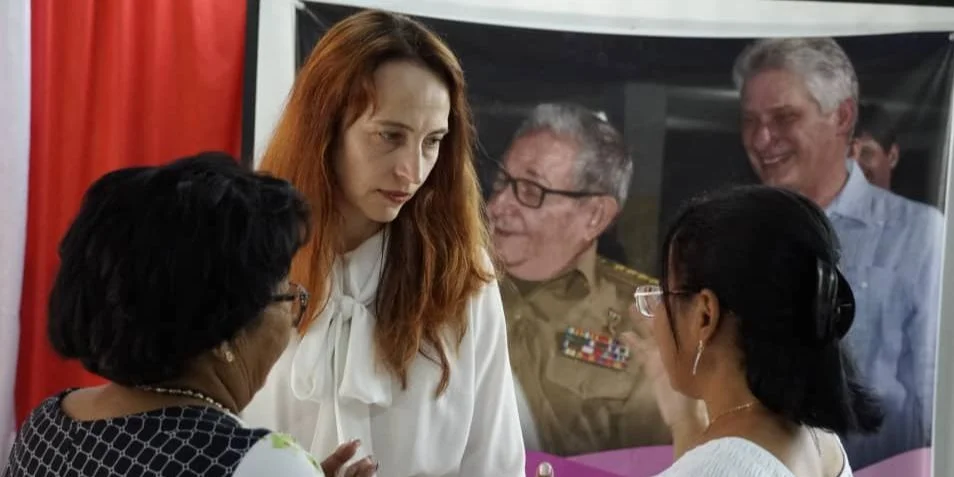
The organization sent a letter to Alena Douhan, UN special rapporteur on the negative impacts of unilateral coercive measures.
MIAMI, United States. – The Cuban Observatory of Human Rights (OCDH) He assured this Tuesday that the “misery that Cuba is experiencing today “is due to the failure of the communist political and economic system, and not to the measures of other countries,” in response to the UN special rapporteur on the negative repercussions of unilateral coercive measures, Alena Douhan, who just visited the island.
In a letter sent to Douhan, the Madrid-based organization maintains that only 3% of Cubans attribute their problems to the United States embargo, while disapproval of the Government’s economic and social management is around 92%.
The NGO also referred to the 8th Study on the State of Social Rights in Cubaprepared by the Observatory of Social Rights (ODS-Cuba), which indicates that 89% of Cuban families live in extreme poverty and that 78% of the population wants to leave the country or knows someone who wants to do so.
The study also shows that 92% of those surveyed disapprove of the economic and social management of the Cuban Government.
The response from the OCDH comes after Douhan visited Cuba from November 11 to 21 to evaluate the impact of unilateral sanctions, according to reported the Office of the UN High Commissioner for Human Rights (OHCHR). At the end of the mission, the rapporteur asked the United States to lift the sanctions and stated that, “for more than 60 years,” Washington has maintained “a broad regime of economic, commercial and financial restrictions against Cuba” that has marked the economic and social life of the Island and has deepened the hardships of the population, with shortages of machinery, spare parts, fuel, food and medicine, as well as massive emigration of qualified personnel.
While the rapporteur emphasizes the weight of the sanctions, the OCDH focuses on the priorities of the Cuban State. In its letter, the organization emphasizes that Havana “has prioritized the construction of hotels and not hospitals” and asks: “Why does the embargo not affect these activities, but it does, according to the Cuban Government, affect the purchase of medical supplies and food in the United States or other countries?”
The statement adds that the Cuban health system “faces collapse because the State prioritizes the capture of foreign currency and international propaganda over the real needs of its population.” As an example, the OCDH mentions “the lucrative business of exporting medical services,” which, in addition to violating the human rights of participating health personnel, “has also been detrimental to medical care for the population, by reducing the number of professionals, especially in primary care,” and also recalls the role of BioCubaFarma, oriented to the export of medicines.
At the institutional level, the organization reminds Douhan that the Cuban Government “repeatedly” denies the possibility of visiting the Island “to United Nations rapporteurs linked to issues of freedom of expression, association, arbitrary detentions, extrajudicial convictions and executions, human rights defenders or modern slavery, among others.”
These UN mechanisms, unlike the rapporteur on unilateral coercive measures, have found the country’s doors systematically closed.
Finally, the OCDH urges that the report that Douhan will present to the Human Rights Council in September 2026 include not only his own observations, but also the opinions of other UN rapporteurs and experts and Cuban democratic actors, both inside and outside the Island. The organization emphasizes that its data, based on thousands of interviews throughout the national territory since 2019, describe a reality of widespread extreme poverty, crisis of basic services and massive rejection of the management of the State, which it attributes to the failure of the system. current political and economic.