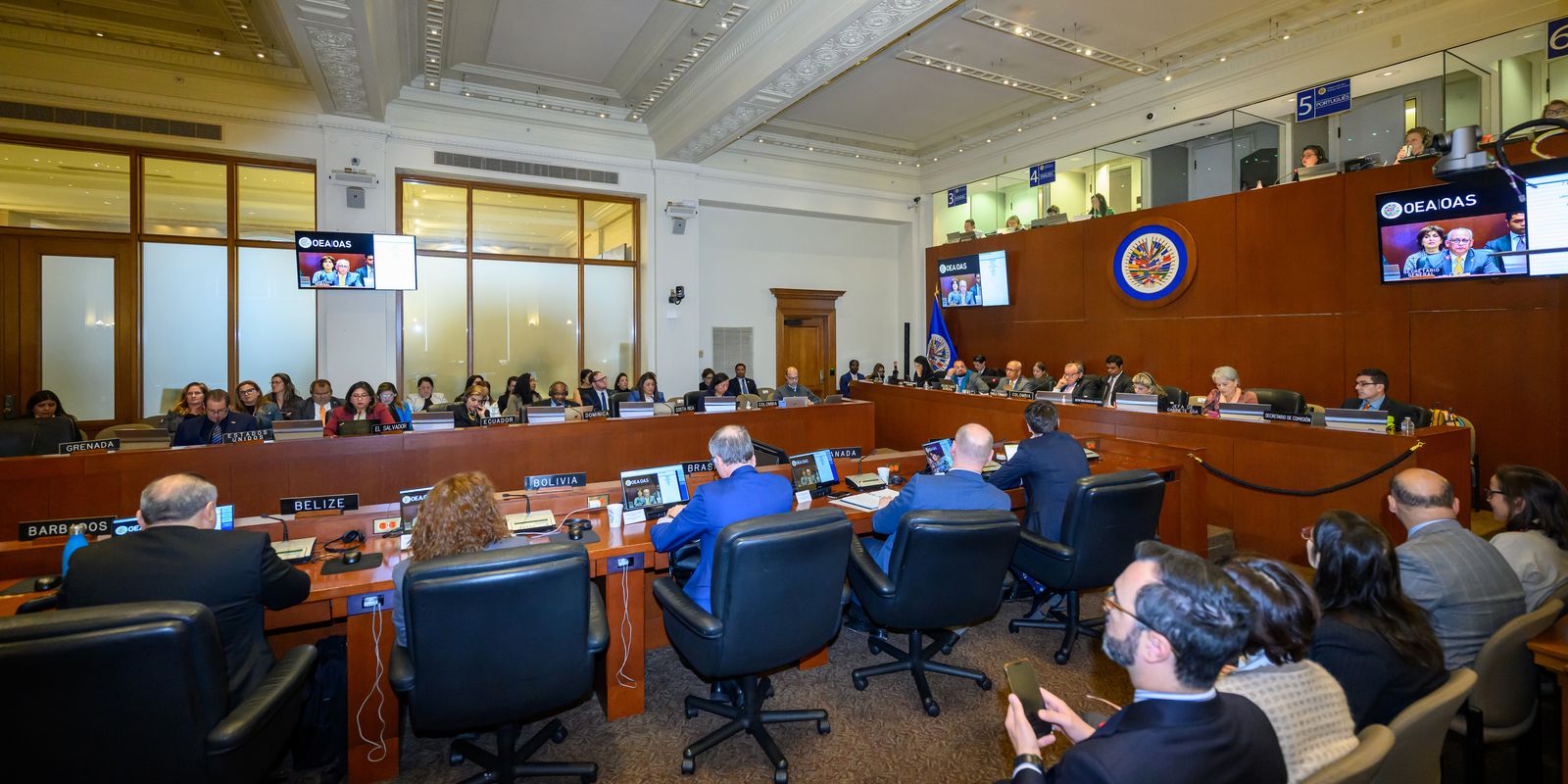
Member countries of the Organization of American States (OAS) were divided this Tuesday (6) when commenting on the United States’ military action in Venezuela and the kidnapping of President Nicolás Maduro and first lady Cilia Flores. The extraordinary meeting of the Permanent Council exposed political polarization on the continent.
During the meeting, there were no formal negotiations, publication of documents, or decision-making on the topic. OAS members and observer states only presented individual statements.
Governments of Argentina, Ecuador, Paraguay and El Salvador – aligned with the United States – defended military intervention in Caracas.
“Argentina appreciates the determination shown by the President of the United States and his government in the actions adopted in Venezuela. We trust that these events represent a decisive advance against narco-terrorism affecting the region”, said Argentine Ambassador, Carlos Bernardo Cherniak.
“Peace is not built through resolutions or decrees, nor through declarations of principles. But through decided and concrete actions. We sympathize with the victims of Venezuela who suffered from the dictatorship that, we hope, will come to an end”, said the ambassador of Ecuador, Mónica Palencia.
The governments of Brazil, Chile, Colombia, Mexico and Honduras were against the US action, defending the preservation of the countries’ sovereignty and the search for diplomatic and multilateral solutions to the Venezuelan crisis.
“The bombings on the territory of Venezuela and the kidnapping of its president cross an unacceptable line. These acts represent a very serious affront to Venezuela’s sovereignty and threaten the international community with an extremely dangerous precedent”, said Brazilian ambassador Benoni Belli.
“What occurred was a unilateral aggression in Venezuela. These regrettable actions demand responsible hemispheric reflection, adherent to international law and oriented towards the preservation of democracy, peace and stability in the region”, said the ambassador of Mexico, Alejandro Encinas.
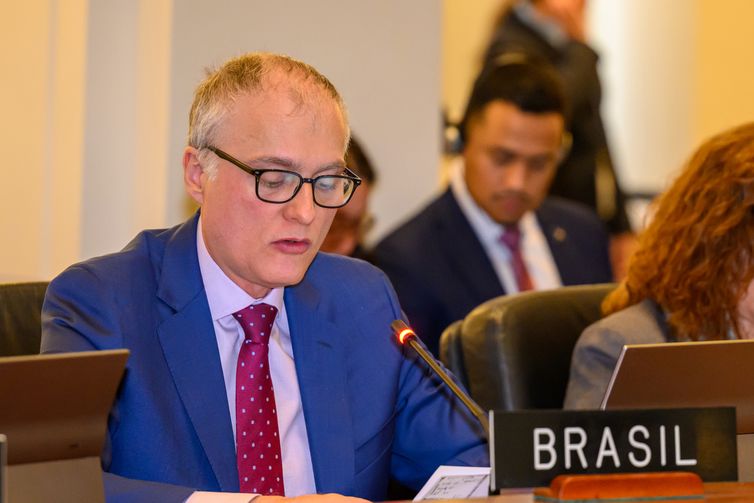
Ambassador Benoni Belli participates in a Special Meeting of the OAS Permanent Council. Photo: Juan Manuel Herrera/OAS
Venezuela without representative
Despite being an official member of the OAS, Venezuela was not entitled to any official demonstration during this Tuesday’s extraordinary meeting, contrary to what happened the previous day, at the United Nations (UN). The relationship between the OAS and Venezuela has been one of conflict in the last decade, and the country lives in an institutional limbo within the organization, without participating in debates and deliberations.
In 2017, Nicolás Maduro’s government announced the departure of the organizationin response to accusations he suffered from other member countries that he was a dictator and had caused a democratic rupture in the country.
After the 2018 presidential elections, contested by the international community, the OAS stopped recognizing Maduro’s mandate and decided to accept into the Permanent Council a representative appointed by Juan Guaidó, then leader of the National Assembly and self-declared winner of the presidential elections. Subsequently, with the weakening of the Venezuelan opposition, no new representatives were recognized by the organization.
In Tuesday’s official statement, OAS Secretary General Albert Ramdin avoided commenting directly on US action in Venezuela. Instead of taking a contrary or favorable position, he praised the arguments of all countries and the importance of multilateralism in the region.
At the same time that he spoke about the responsibility of member countries to obey international law, the principles of sovereignty, non-intervention and constitutional order – which can be read as criticism of the United States –, he expressed support for the democratic transition in Venezuela – which could be seen as criticism of Maduro’s leadership.
“A stable democratic Venezuela is good for its people and good for the entire hemisphere,” said Ramdin.
“We can support an in-depth democratic transition, strengthening institutions, supporting institutional reforms, assisting in electoral preparation, developing capacities, observing the electoral process and much more”, he added.
China x United States
This Tuesday’s meeting also marked a new chapter in the dispute between the United States and China for greater influence in the region. US Ambassador Leandro Rizzuto cited the Beijing government as one of the rivals in the Western Hemisphere who, according to him, want to control Venezuela’s natural resources.
“This is our neighborhood, this is where we live. And we will not allow Venezuela to turn into a hub [polo] of operations for Iran, Russia, Hezbollah, China and Cuban intelligence agencies that control the country. We cannot continue to have the largest oil reserves in the world under the control of adversaries from the Western Hemisphere,” said the diplomat.
The representative of China, whose name was not disclosed during the broadcast of the OAS meeting, refuted the US government’s accusations. He said they were “unnecessary, unjustified and false”, and that the country expressed dissatisfaction and opposition to them.
“Instead of fabricating information and criticizing, the United States should reflect on its arbitrary action. The use of force against a sovereign state and its leader seriously violates international law, undermines the country’s sovereignty and threatens peace and security in the region,” said the Chinese woman.
“Cooperation between China and Venezuela takes place between sovereign states and based on the laws and regulations of both countries,” he added.