*By Edith Febles
Santo Domingo.-The story of Nutri-Med CAS, Nutrition & Medicine is a story of a health program that went from being a “cornerstone” for SeNaSa, to receiving a complete dismantling order after an inspection by the regulatory authorities.
The questions and reasons raised by the Superintendence of Health and Occupational Risks (SISALRIL) focused on the legality of the services provided, the rationality of spending and the effectiveness of the program.
This company, specialized in the provision of supplements and nutritional evaluations to members of the subsidized National Health Insurance (SeNaSa) regime, was created by Cinty Acosta Sención after purchasing the shares of a small project whose owners she originally joined as a partner, but with whom she broke ties in a short time.
His company NUTRIMED received more than four billion pesos as compensation for a program questioned in several SISALRIL reports, whose technicians had warned since 2002 that it constituted a financial risk for the ARS and questioned its effectiveness and traceability.
However, the program remained active until the end of 2023.
At SENASA there were two nutrition programs with similar characteristics, Nutrimed and Flavorheart.
The latter received almost two billion pesos and its nutrients were destined for students, as well as the elderly.
Both services were dismantled by order of the regulatory body after several reports and even an audit that led to their facilities lacking a sign or other identification.
Unique customer
The two cases, their companies, their affiliates and their nutrients were registered at the same time as their contracting after 2020, with SENASA as the only acquirer.
The project was integrated into a program called “Senasa takes care of you”, which since 2018 has operated with modest financial allocations aimed at providing wheelchairs, disposable diapers and beds to elderly people.
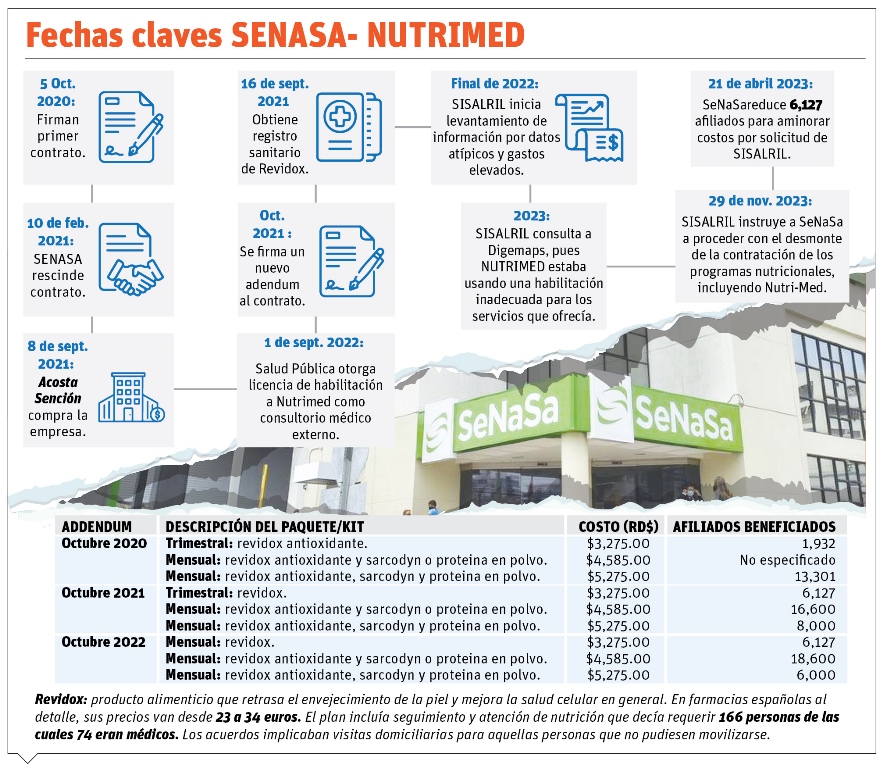
The “Older Adult Nutritional Evaluation” program consisted of providing consultations, nutritional and functional evaluations, exercise and food guides for older adults and supplementation kits (with costs ranging between RD3,275.00 and RD5,275.00). They mainly contained the antioxidant revidox.
The initial contract for the acquisition of proteins and antioxidants was signed on October 5, 2020, a few weeks after Santiago Hazim’s management began.
The original company was Nutrimed. But the coexistence between Acosta Sención and the original owners of the then modest project ended after tense relations.
The coup de grace to end the incipient agreement was the cancellation of the contract by Hazim, who on February 10, 2021 notified his decision in writing.
By then the former owners – a couple of doctors who came to the project invited by a relative of Acosta Sención – had lost control of the company.
Acosta Sención ended up buying the company and changed its name, according to the official records to which we have had access.
The nascent Nutrimed was called to sign new addendums to supply supplies that are outside the basic plan catalog.
In its justifications for the purchase, SENASA appealed to the Constitution and the spirit of social welfare promoted by the Social Security Law, among other arguments, which did not convince the technicians who prepared several reports until finally, its closure was ordered.
Finances affected
The alerts went off at the end of 2022 when SISALRIL identified a possible overspending reported by ARS SeNaSa and expressed concern about the effect that this amount would have on the general accident rate of the Basic Health Plan. By then, SENASA was registering delays in payments to some of its suppliers who initiated claims.
According to the SISALRIL report, “it was identified that Nutrimed subcontracted the services of another company, without adequate authorization, for the distribution of supplements.
Furthermore, the contract with SeNaSa empowered Nutrimed to distribute kits even though the authority granted by the Ministry of Health to do so was not evident,” they went on to point out.
SISALRIL technicians questioned “the absence of an evaluation that measures the favorable results of users, which makes it impossible to measure the positive impact of the program on the health of members in the short, medium or long term,” since the contract with Nutri-Med did not establish “result indicators related to the care process.”
In a letter addressed to Feris Iglesias, head of SILSARIL, on November 9, 2023, the director of SENASA, now under arrest, defended the results of the nutrition programs “the impact on this population has been so positive, that in recent months more than 17,000 older adults have been discharged for having reached an optimal state in their health conditions, positively impacting nearly 139,000 members, and providing more of 800,000 attentions.”
Six months earlier, on May 29, 2023, Senasa’s Health Manager, Francisco Iván Minaya, also wrote to Feris Iglesias saying that nutrition programs “have become our cornerstone, drastically preventing diseases in these vulnerable groups, all in accordance with what is established by current regulations, including the Constitution (…) and the Catalog of Benefits of our PDSS.”
Minaya, who is in prison, tried to find a place for nutrients in the PDSS.
Responsibilities
— Health habits
In the part of the catalog that addresses primary health care, the functions developed through first-level centers are described, and within these promotion and education actions are included.