Brazil has more speakers of indigenous languages than it did in 2010. According to the 2022 Demographic Census ─ Ethnicities and indigenous languages, released this Friday (24) by the Brazilian Institute of Geography and Statistics (IBGE), the number of speakers of indigenous languages increased by 47.7% between 2010 and 2022rising from 293,853 to 433,980 indigenous people aged 5 or over.
There was also an increase in the number of speakers outside indigenous lands (TIs). This number more than doubled in 12 years, from 44,590 to 96,685 speakers, an increase of 52,095 people.
When considering speakers aged 2 or over, the total number of speakers in 2022 increases even further, to 474,856. This data was not measured in 2010. These people are, for the most part, on indigenous lands (TIs), 78.34%.
The 2022 Census identified 295 indigenous languages spokena number also higher than the 274 recorded in 2010. Those languages used for communication in homes were considered.
The largest concentrations of speakers are in Amazonas (137,421 people), Mato Grosso do Sul (58,901) and Mato Grosso (42,511). In total, in 1,990 municipalities at least one indigenous person aged 2 or over speaks an indigenous language.
According to the manager of Traditional Territories and Protected Areas at IBGE, Fernando Damasco, Mapping where these speakers are is important for municipalities to develop public policies that recognize these languages and, therefore, provide greater access to indigenous people.
“The officialization of languages spoken by indigenous peoples contributes decisively to access to citizenship and the exercise of rights, as it facilitates the translation of formal documents and enables the presence of interpreters in public bodies”, he says.
“When we see this distribution, it points out the municipalities that are priorities in terms of linguistic recognition policies and the officialization of spoken indigenous languages”, he adds.
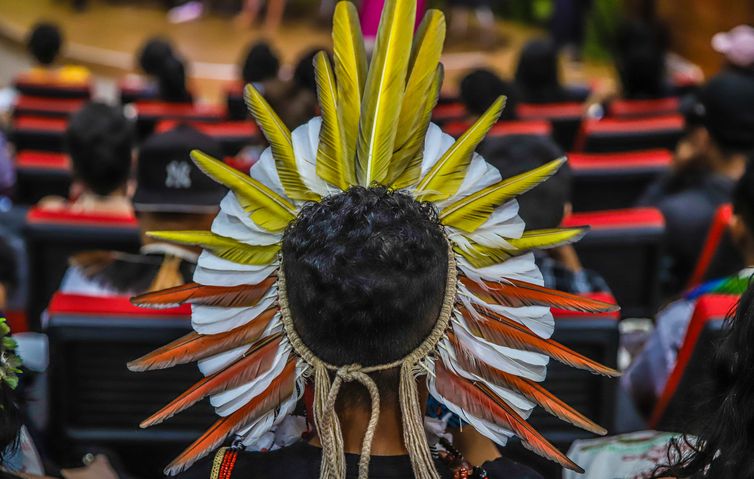
Indigenous Peoples and Transitional Justice Meeting, held in Brasília in 2023 Photo: Antônio Cruz/Agência Brasil
According to Census data, Manaus is the municipality with the largest number of declared indigenous languages, 99; followed by São Paulo, with 78 declared indigenous languages; and Brasília, with 61 declared indigenous languages. Outside the capitals, the highlights are São Gabriel da Cachoeira (AM), with 68 indigenous languages; Altamira (PA); with 33; and Iranduba (AM), with 31.
In relation to languages, the Tikúna language was the one with the largest number of indigenous speakers, with 51,978 people, 87.69% of whom lived within ILs, followed by Guarani Kaiowá with 38,658 speakers, the majority residing within ILs (81.83%); and Guajajara with 29,212 people, the majority in TIs (90.43%). Nheengatu is the most spoken indigenous language in urban areas, with 13,070 speakers, 41.94% of them, in cities.
Percentage drops
Although it has increased in absolute numbers, in relation to the total indigenous population, speakers have shown a decline in 12 years. In 2022, they are 28.51% of the indigenous population, which is about 1.7 million people. In 2010, speakers of indigenous languages represented 37.35% of the total population, which was around 897 thousand.
Outside indigenous lands, the number of speakers more than doubled, from 44,590 to 96,685 speakers, an increase of around 52,095 people. But, in percentage terms, it fell from 12.67% to 9.78% of the total indigenous population outside TIs.
In ITs, however, the scenario is reversed. The percentage increased. Indigenous language speakers rose from 57.35% in 2010 to 63.22% in 2022.
Damasco highlights that there is a movement to value and rescue languages by the indigenous people themselves and that this is reflected in the data measured. “We know that in the last decade many efforts were implemented in terms of ensuring that indigenous people could use and reproduce the use of languages, both through linguistic policies, education in the indigenous language, as well as a very strong movement to recover the use of indigenous languages, to value the use of the language by the indigenous people themselves”, he says.
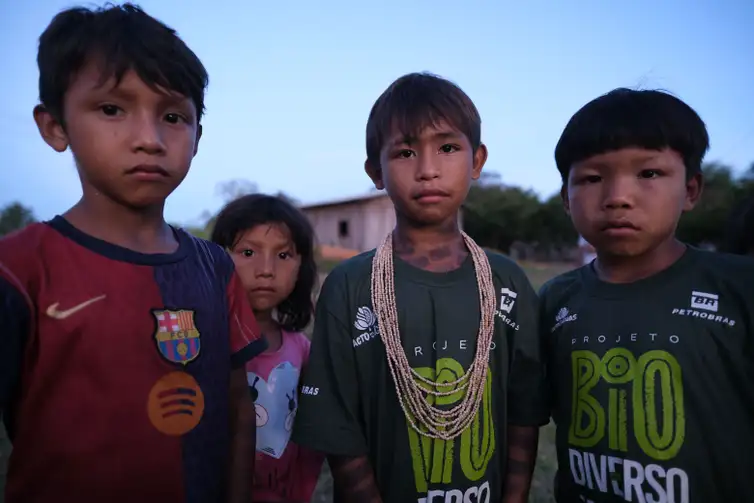
Indigenous children of the Rikbaktsa People in the Beira Rio village, Erikpatsa Indigenous Land. Photo: Fernando Frazão/Agência Brasil
Advancement of Portuguese
The data released shows that there was an increase in Portuguese speakers. In 2022, 1,404,340 indigenous people used Portuguese at home, corresponding to 86.32% of the country’s indigenous population. In TIs, the percentage of Portuguese speakers was 67.14% (394,237).
IBGE analyzed, on maps, the advancement of the language in indigenous lands. In 98 TIs, more indigenous people are speaking Portuguese. In these places, there was a variation of more than 25 percentage points. However, in 1942, there was a drop of more than 25 percentage points among Portuguese speakers.
In relation to indigenous languages, 55 ILs had positive variations above 25 percentage points, indicating that the population is speaking more indigenous languages as a percentage. In 27 TIs, this variation was negative.
According to Damascus, education and literacy can contribute to linguistic strengthening, but it should not be done only in Portuguesewith the risk of indigenous languages no longer being spoken in homes.
“Literacy, if done in a way that simply encourages the replacement of the indigenous language with Portuguese, can be absolutely harmful. Now, when it is bilingual education or education in the indigenous language, it contributes greatly to linguistic strengthening”, he argues.