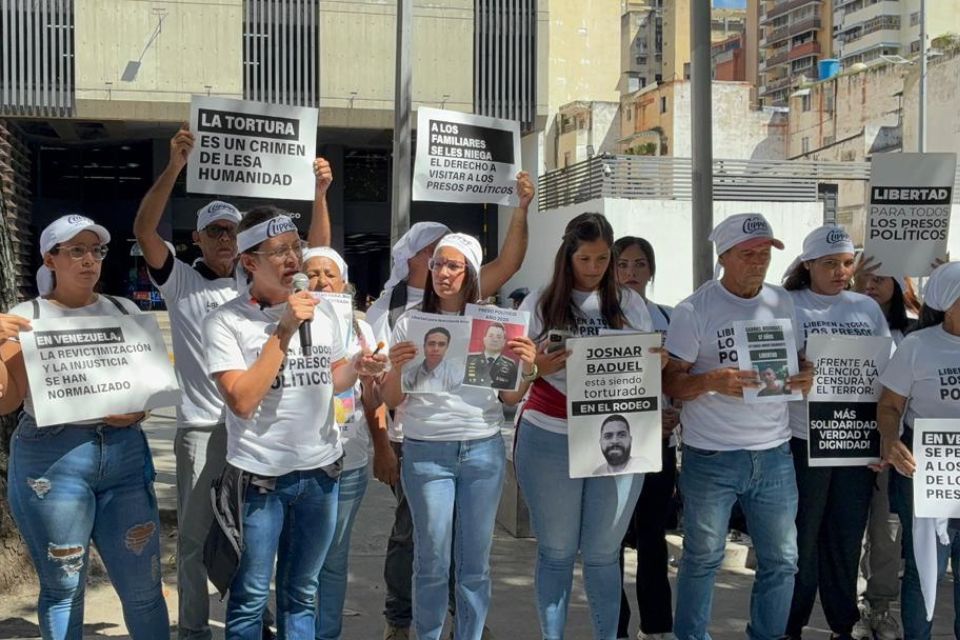
Justicia, Encuentro y Perdón stated that, from a humanitarian perspective, the balance of the releases of political prisoners “is devastating.” They consider that although these releases represent a “relief” for their families, the rest of the political prisoners observe that “their freedom depends on an incomprehensible chance and not on the proper following of legal criteria.”
The number of political prisoners currently registered in Venezuela does not decrease in proportion to the releases announced on December 25, which reached almost a hundred, according to official information. This was stated by the NGO Justicia, Encuentro y Perdón in an analysis made of the precautionary releases of dozens of people deprived of liberty for political reasons.
The organization was barely able to verify the release of 71 of the 99 citizens officially announced by the Ministry of Penitentiary Service, so the number of political prisoners stood at 1,041. These are just 43 fewer people than those identified in their last report from the past December 18.
Justicia, Encuentro y Perdón pointed out that this disparity is due to the fact that, in this process of releases, they reviewed 28 cases that were unknown to the organization although, in effect, they corresponded to arrests for political reasons.
“This discrepancy is not new and deserves an important stop: for each group that regains its freedom, the verification process brings to light arrests about which there was no information, confirming that the magnitude of the human rights crisis in Venezuela is a constantly moving target,” the NGO pointed out.
Likewise, they recalled that “probably” the number of political prisoners in the country “is higher than what we have a record of, so that our indicators are referential.”
Political prisoners behind bars
Of the 1,041 political prisoners registered by Justicia, Encuentro y Perdón until December 29, 877 are men and 164 are women, the majority belonging to civil society (532).
The organization stated that, from a humanitarian perspective, the balance of releases “is devastating.” Only two released suffer from serious illnesses, of the 91 who have various health conditions that require urgent and specialized medical attention.
In his opinion, this exposes “a systemic indolence towards the right to life and health” that has resulted in deaths in state custody.
*Read also: Vente Venezuela describes releases as a propaganda act
Two teenagers also remain in prison, of the five who were registered, including the teenager Gabriel Rodríguez (17 years old)who was recently sentenced to 10 years (six in prison and four in community service) for “terrorism.”
Among those detained for political reasons are also 31 older adults, some with serious pathologies, who “continue to be subjected to confinement that violates international conventions.”
The registry also included 158 people whose whereabouts were unknown, as well as 42 foreigners and 49 Venezuelans with dual nationality imprisoned for political reasons. Such is the case of Merys Torres de Sequea, Yosida Vanegas, Nélida Sánchez or José Elías Torres.
This group of released prisoners did not include press workers, who total 22 people, or human rights defenders such as Rocío San Miguel, Javier Tarazona, Kennedy Tejeda or Carlos Julio Rojas. In recent days, the United Nations High Commissioner for Human Rights called for the immediate release of this group when presenting an update on the situation in Venezuela.
Random releases
In the opinion of the NGO Justicia, Encuentro y Perdón, this process of releases is characterized “by strategic opacity and a discretionary line of selection that points to absolute randomness.”
They consider that although these releases represent a “relief” for their families, the rest of the political prisoners observe that “their freedom depends on an incomprehensible chance and not on the proper following of legal criteria,” as various NGOs have requested for several years.
Justicia, Encuentro y Perdón indicated that the selections of these people seem to have been motivated to benefit those detained after the 2024 presidential elections. “This represents an additional sentence to oblivion, of citizens subjected to prison for political reasons for years, and who in many cases have endured an early sentence.”
«The erratic handling of these measures has generated devastating collateral damage: the psychological torture of frustrated hope. The lack of clear criteria vs. black box logic, foreign to any human rights norm, has caused emotional crises and deep distress in the political prisoners who remain detained and their family units,” the NGO stated.
The anguish and trauma that the family members are experiencing worsened this weekend. The NGO indicated that they received complaints of new arbitrary punishments and isolation, although they did not offer further details. “Closing the year like this, with families broken by uncertainty and prisoners punished, turns these dates into a reminder of the citizen’s absolute defenselessness in the face of power.”
*Journalism in Venezuela is carried out in a hostile environment for the press with dozens of legal instruments in place to punish the word, especially the laws “against hate”, “against fascism” and “against the blockade.” This content was written taking into consideration the threats and limits that, consequently, have been imposed on the dissemination of information from within the country.
Post Views: 95