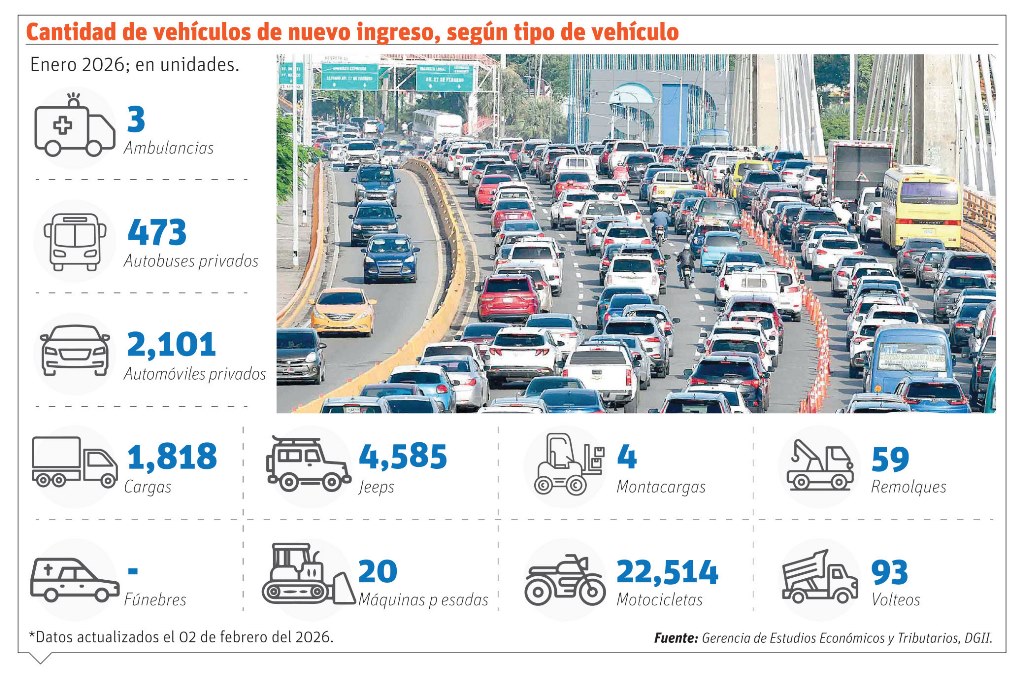
Santo Domingo.- In the last month of the year, 66,526 new motorcycles imported were registered by the General Directorate of Internal Taxes (DGII), which increased the quantity of this type of vehicles in the country to 3,872,238 unitsa figure that represents 58% of the 6.6 million motor vehicles that circulate in the Dominican Republic.
These new units come to increase chaos and non-observance of traffic rulesfactors that make the Dominican Republic one of the three countries with highest rate of deaths from traffic accidents in the world per 100 thousand inhabitants.
In practical terms, more than one in two vehicles that circulate in the country is a motorcycle, which is equivalent to almost one motorcycle for every three inhabitants.
The sustained annual growth of motorcycles is explained by their low costthe ease of financing and his intensive use as an informal work tool.
This disproportionate weight in the vehicle fleet has a direct correlate in road accidents. Health and traffic statistics indicate that More than 60% of traffic deaths involve motorcyclesa proportion that has remained high for several years and that places the country among those of highest road mortality in the world.
Read also: This will be the mandatory helmet that all motorcyclists in the DR must use
Emergency rooms and trauma units receive victims of motorcycle accidents daily, many of them with serious injuries, amputations or permanent disabilities.
The problem is not the motorcycle itself, but the way it is used and the absence of effective State control.
A pattern of reckless driving has become normalized on the country’s streets, with motorcyclists traveling the wrong way, They ignore traffic lights and traffic signs, They travel without protective helmets, carry more than two passengers, invade sidewalks and exclusive lanes, and maneuver between vehicles at high speed. These behaviors are not exceptions; They are part of the daily life of urban traffic.
Much of this phenomenon is associated with massive use of motorcycles as a means of informal subsistence.
Motoconcho, home delivery and courier services have grown without a clear regulatory framework, without training requirements, without adequate insurance and without periodic technical controls.
Informality has ended up imposing its own rules in the public space.
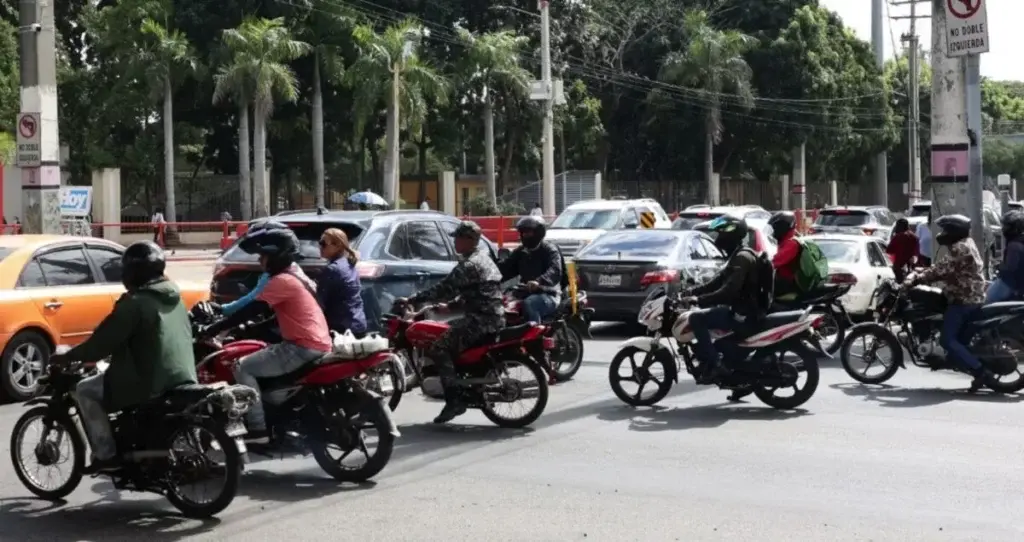
Road safety specialists warn that the problem is worsened by the chronic weakness of oversight. Control operations tend to be sporadic, concentrated at specific moments and without continuity. In most cases, police officers General Directorate of Traffic and Land Transportation Safety (DIGESETT) They prefer to turn a blind eye and look the other way.
The sanctions contemplated in the law are rarely applied on a sustained basis and, when imposed, they are often not collected or diluted in inefficient administrative processes.
The motorcyclists They have learned that, for them, violating traffic rules usually has no real consequences.
Added to this institutional weakness is a legal distortion that generates strong tensions in road coexistence.
Various experts in law and mobility point out that the current Traffic Law tends to mitigate the consequences for motorcyclists in accidents with four-wheeled vehicles, even when the responsibility for the accident clearly falls on them.
In practice, car and truck drivers end up facing greater legal, administrative and economic burdens, while the motorcyclist’s reckless behavior is put into perspective. This perception of inequality fuels conflicts, discourages reporting, and erodes trust in the system.
The ignored helmet
Doctors specialized in trauma emphasize that lack of helmet remains a decisive factor in the severity of injuries.
Despite its legal obligation, the helmet continues to be seen as optional, partly due to the absence of consistent controls and partly due to social tolerance of non-compliance. The human cost of this negligence is high and recurring.
International experience shows that the problem is not insoluble. Countries like Chile and Colombia They have made progress in the strict registration of motorcycles, the mandatory use of visible license plates, the requirement for insurance, and the application of technological controls.
In Spainpermanent inspection, the license point system and the extensive use of radars have contributed to a sustained reduction in road mortality. In all cases, the common denominator has been the constant application of the lawnot the occasional chase.
Load delivery
The rise of the service motorcycle delivery has introduced a new and worrying factor in the already complex dynamics of Dominican traffic.
In recent years, the accelerated growth of digital platforms, grocery stores, restaurants and businesses that depend on fast deliveries has multiplied the presence of motorcyclists on the streets, especially in high-density urban areas, without this phenomenon having been accompanied by specific regulation or effective control mechanisms.
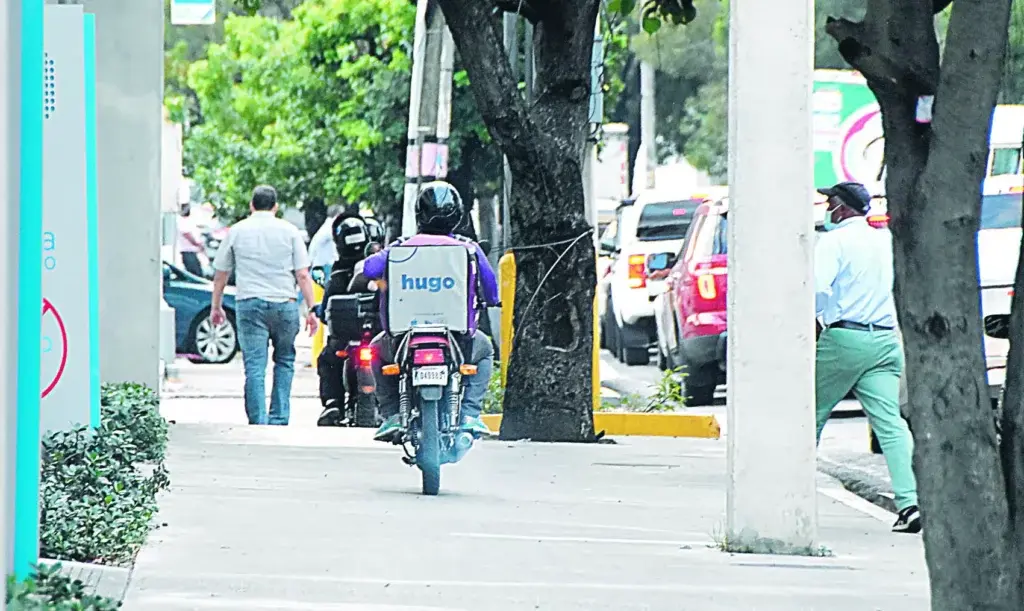
Unlike the traditional motoconcho, delivery operates under a extreme productivity logic. The delivery person’s income depends directly on the number of orders delivered per day, which generates a strong incentive to reduce times at any cost. This economic pressure translates into particularly risky driving patterns that are systematically repeated on the country’s main roads.
In practice, many delivery motorcyclists weave between vehicles, enter abruptly between lanes, travel at speeds higher than those permitted and take advantage of any available space to move forward, even when this means invading opposing lanes or pedestrian areas.
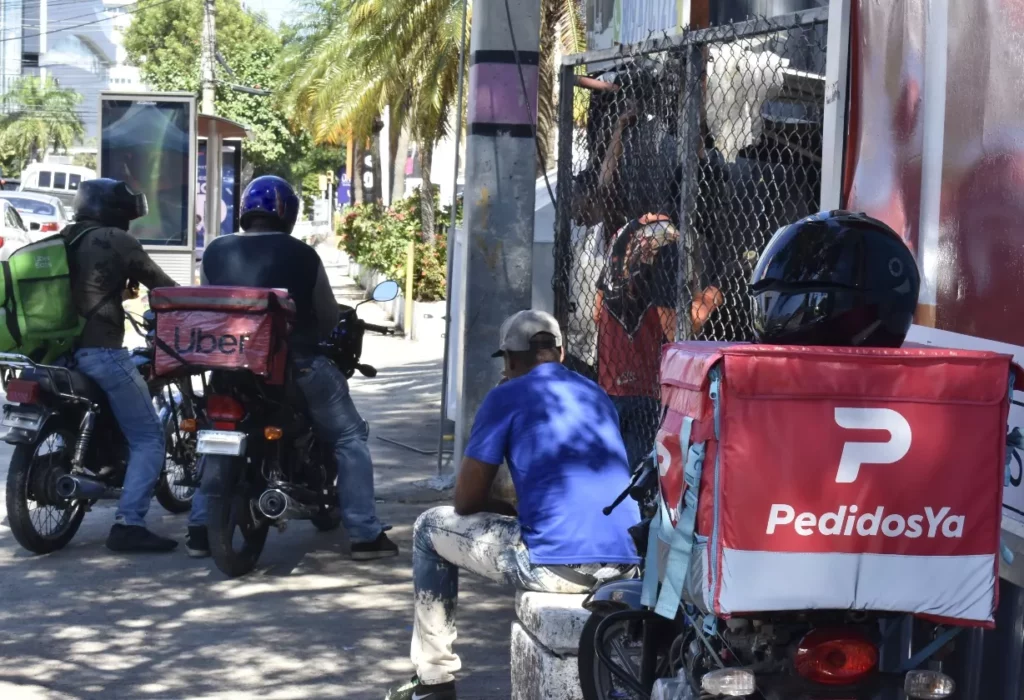
This behavior does not respond only to individual decisions, but to a operating model without controls.
Companies and platforms that use motorcycle delivery drivers usually lack enforceable protocols on safe driving, mandatory use of a certified helmet, respect for traffic rules or speed limits.
There are also no effective supervision systems or internal sanctions for those who fail to comply with road rules while on duty.
Added to this is the labor informality. Many delivery drivers do not have formal contracts, liability insurance or adequate coverage in the event of an accident.
They operate as independent workers, assuming all risks, while companies benefit from the service without assuming proportional responsibilities for any damages that may be caused to third parties.
The inspection is limited to general traffic controls, insufficient for a sector that operates in a intensive, continuous and under time pressure.
Specialists in mobility and road safety warn that, without specific regulationdelivery will continue to deepen road disorder.