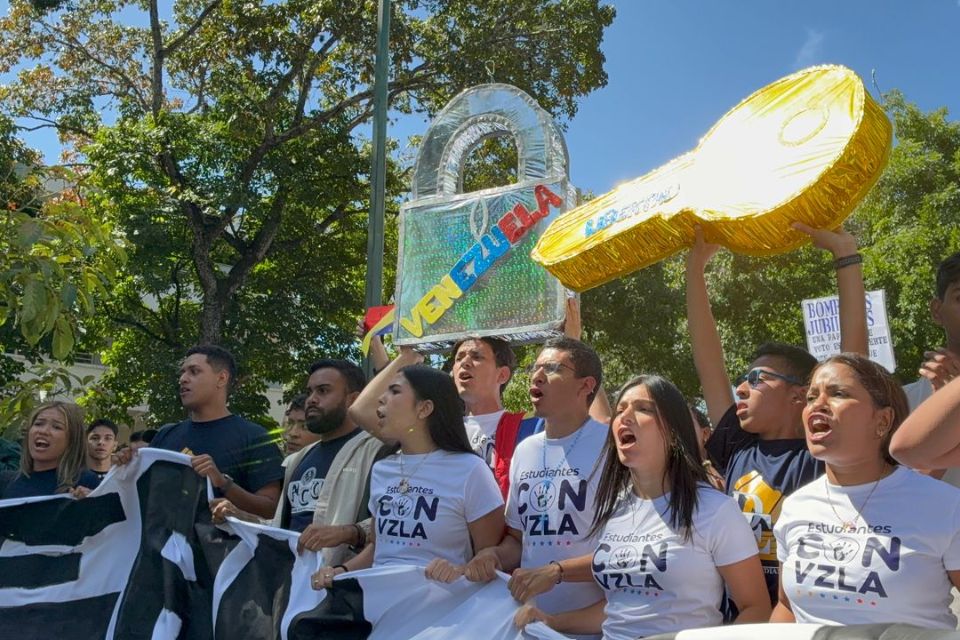
“Delcy responds, the Ucevistas are not hiding” and “not one, not two, free them all” were part of the slogans shouted by relatives of political prisoners and UCV students. Deputies of the National Assembly or former political prisoners such as Yandir Loggiodice, Carlos Azuaje and Javier Tarazona approached the rally to provide support
Dozens of relatives of political prisoners and students gathered this Tuesday the 3rd at the Central University of Venezuela (UCV) to demand the full release of all political prisoners, accelerate the amnesty process and the repeal of punitive laws that affect civil and political rights.
In a manifesto, read by university advisor Octavio González, they asked for a “broad scope” of the amnesty law proposed by Delcy Rodríguez on Friday, January 30, so that all cases of people detained for political reasons – even under arrest or with precautionary measures – benefit, after a review and analysis of each file, in which they ask the deans of the legal sciences faculties of the universities to participate.
The students also requested transparency in the execution of this process, the reestablishment of civil and political rights, the repeal of regulations such as the Constitutional Law against Hate, the Simón Bolívar Law or the Spring Law, as well as guarantees of non-repetition and “proportional, timely” reparation to all those affected by serious human rights violations.
“Delcy responds, the Ucevistas are not hiding” and “not one, not two, free them all” were part of the slogans shouted by family members and students. Deputies of the National Assembly or former political prisoners such as Yandir Loggiodice, Carlos Azuaje and Javier Tarazona approached the rally to provide support.
“The reconstruction of the country, the reunion of the country, involves not only the approval of a law but also the repeal of all the legal instruments that have been created to persecute, to annul, to politically eliminate those who think differently,” said Javier Tarazona, director of Fundaredes.
Other relatives were protesting for the first time, like Antonio*, a young man who asked to remain anonymous. His father, a 70-year-old economist, was arbitrarily detained on May 24, 2024 by Dgcim officials at his home in Chacao (Miranda state). His mother, a 58-year-old administrator, was arrested at work four months later: on September 9, 2024.
«They alleged a case of corruption in Fonden (Fund for National Development), but the truth is that they were never public officials and did not receive money from the State. “They got them involved in a cause that has nothing to do with it, I suspect it was to steal our assets and our companies,” he said.
His father remains detained in the Rodeo I prison, his mother in the INOF. «My father has lost around 20 kilos, he is in a two-by-two cell with two other people, with a latrine in the middle. They only let him out for one hour a day. The prison conditions are terrible. Previously he was in the Dgcim of Boleíta and spent six months without seeing the light of the sun.
Relatives of oil workers from Anzoátegui, Carabobo, Zulia, Falcón and the Capital District also denounced the procedural delay and lack of information in their cases. They estimate that there are 170 employees of the state-owned PDVSA and its subsidiaries who are detained for political reasons.
Wilmary Hernández is the wife of Jesús Romero, lodymaster of the marine terminal of the El Palito refinery (Carabobo state). He was arrested on June 21, 2025 and charged with terrorism. Along with 11 other workers, arrested on June 18 and 21 of last year, they were presented before a judge and since then the process has not progressed.
Along with 12 people, they were arrested by the Dgcim and accused of terrorism. They have only had one presentation hearing. “They tell us that it is a case that is handled under legal confidentiality, we believe that it is terrorism because it is the prosecutor’s office that handles the case… What we demand is justice.”
Gilda Suárez is the sister of René Suárez, an oil worker arrested on June 20, 2025 at the Amuay refinery. He reported that 24 oil workers were put on trial for “human error” due to the failure of a valve during fuel transfer.
He stated that the detainees are from “different guards” and from different places, since not only workers from the Amuay dock, like his brother, but also from the supply area were arrested.
On September 24, they were sent to trial by Judge José García, in charge of Trial Court 1 with jurisdiction over terrorism. They were accused of the alleged crimes of delay and intentional omission of their duties, money laundering, damage to critical infrastructure or damage to essential assets, criminal association and aggravated fuel smuggling.
#Now | Gilda Suárez, sister of René Suárez, an oil worker arrested on June 20, 2025 at the Amuay refinery. He denounces that 24 oil workers were put on trial for “human error” due to the failure of a valve during the transfer of fuel. He… pic.twitter.com/A7sSHKfae1
— TalCual (@DiarioTalCual) February 3, 2026
*Read also: The case of Aliannis Araujo: his mother faints during a protest after denouncing torture
The rally ended when Fanny Lozada, mother of Aliannis Araujo Lozada, fainted while giving her testimony during a rally for the freedom of political prisoners.
The woman said that her daughter has been in forced disappearance for seven months, after being detained on August 11, 2025 in Araya, Sucre state, for her alleged involvement in the placement of explosives in Plaza Venezuela. «I don’t know where they have it, he (Diosdado Cabello) does know. “I need you to help me please.”
Lozada also reported that his 15-year-old grandson was tortured. «They tied his head with bags, they gave him power. A baby starting life, fourth year of high school. “He didn’t want to continue studying.”
*Journalism in Venezuela is carried out in a hostile environment for the press with dozens of legal instruments in place to punish the word, especially the laws “against hate”, “against fascism” and “against the blockade.” This content was written taking into consideration the threats and limits that, consequently, have been imposed on the dissemination of information from within the country.
Post Views: 286