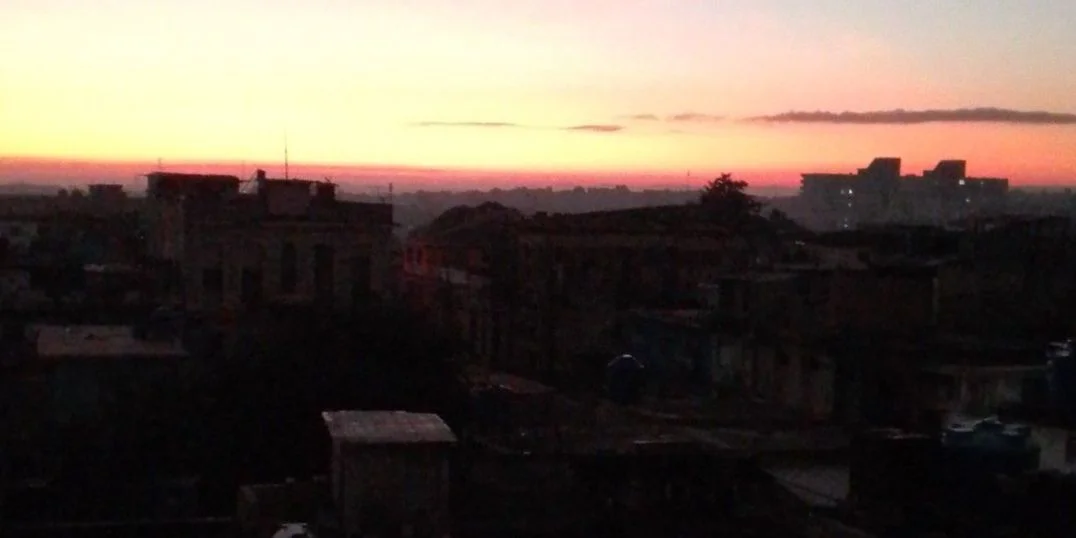
Cubans will experience the same electricity generation deficit this Thursday as on Christmas Eve.
MIAMI, United States. – Cubans will arrive on Christmas night with massive blackouts, according to the official part of the Electrical Union (UNE) published this Thursday. The entity predicted that, during peak hours, the deficit will be 1,935 megawatts (MW) and the impact will be 1,965 MW.
This level of impact is equivalent to approximately 60% of national demand.
The UNE also reported that on Wednesday “24-hour service was affected” and that the maximum impact was 2,015 MW at 6:30 p.m., “higher than planned because Unit 6 of the CTE Mariel did not enter.”
Among the main incidents, the official note reported breakdowns in units 5 and 6 of the CTE Antonio Maceo, units 5 and 8 of the CTE Mariel and Unit 2 of the CTE Felton, in addition to maintenance – including Unit 6 of Mariel – and “limitations in thermal generation” due to 549 MW out of service.
The report also attributed part of the shortage to fuel restrictions: “62 distributed generation plants with 576 MW”, “108 MW in the Moa fuel plant” and “129 MW unavailable due to lack of lubricant”, for a total of 813 MW affected by this cause.
As the only improvement planned for the afternoon-night, UNE calculated the entry of Unit 6 of the CTE Mariel with 70 MW and the “completion” of Unit 3 of the CTE Cienfuegos with 50 MW, but still maintained the forecast of an impact of 1,965 MW at the peak.
Before Christmas
The Electrical Union has recognized that in Havana unscheduled outages often exceed nine hours a day, while in several provinces homes have only two to four hours of electricity each day. Added to this are successive failures of aging thermoelectric plants that have caused repeated national blackouts in less than a year, in the midst of the worst economic crisis in decades.
Cuba has suffered five total disconnections from the system in less than 12 months: on October 18, November 6 and December 4, 2024, in addition to March 14 and September 10 of this year. In the case of September, the trigger was once again the unforeseen departure of the “Antonio Guiteras” Thermoelectric Power Plant (CTE).
Outside of general collapses, Havana and other provinces have suffered extended outages due to substation tripping and thermal unit outages, including Felton itself, as well as recent episodes of massive blackouts in the capital due to faults in lines and substations, according to media coverage and testimonies collected by the press.
The Cuban government blames US sanctions for the SEN situation, but activists and independent analysts put the responsibility on Havana, which has not invested in its thermoelectric plants for decades.
According to the UNE, the main causes of service interruptions are breakdowns in thermal power plants that have been in operation for decades and the lack of fuel and foreign currency to import it. The energy panorama, which has worsened since mid-2024, left averages of almost 16 hours a day without electricity in July and almost 15 in August, with outages of more than 20 hours a day in large cities such as Santiago de Cuba, Matanzas and Holguín.
According to EFE, various independent calculations estimate that the Executive would need between 8,000 and 10,000 million dollars to revive the electrical system, a sum that Havana does not have. The deterioration in supply impacts an economy that, according to official data, fell 1.1% in 2024 and has accumulated a decline of 11% in the last five years; Furthermore, ECLAC forecasts a negative Gross Domestic Product in 2025.
The long blackouts have fueled social discontent and were linked to the main protests in recent years, including the largest of all, that of July 2021. The regime, for its part, has responded with repression to demonstrations of discontent over the electricity cuts.