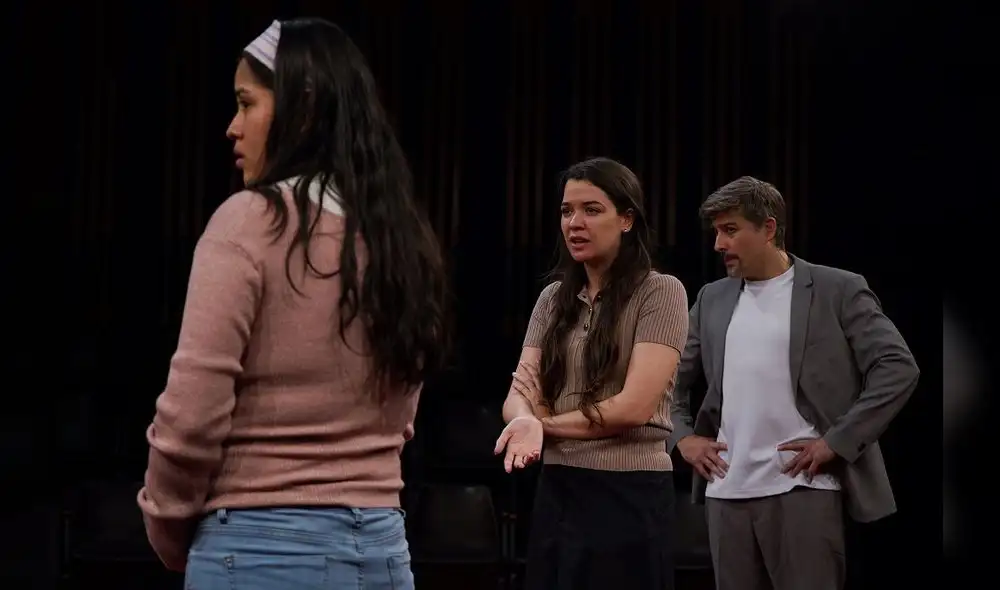
Norma Martínez directs the work Maybe Baby. In the story about surrogacy, a couple (he Spanish and she Peruvian) will have their first child after hiring an immigrant to carry the pregnancy. “We also discovered that there is a toxic relationship. Machismo manifests itself with subtlety,” he tells us at the Ricardo Blume Theater in Jesus Mary.
The actress will film her first film as a screenwriter next year. With Wild Explorations he will address sexuality after 50 years of age. “Art should break the molds, question what is established, create chaos when there is a lot of order and make order when there is chaos. That is the job of art for me.”
A few days ago, she was a guest celebrating 25 years of It happened in Peru.
YOU CAN SEE: Salvador del Solar: “Inertia and indifference are the worst paths”
What do you think that there are no more similar programs?
We have to continue defending the channel, but supporting a transition to public television. As long as it is not understood that way, but rather at the service of the government, it is not everyone’s channel. A public television is capable of sustaining its content and its independence beyond who governs, right?
Well, TV Perú has been questioned about that.
That’s what I’m going for. I have grown tired of proposing that the channel should be a tool at the service of education at all levels. We would have an integration tool.
Those who have seen your works as a director could connect to Maybe Baby with Stop Kissa work about homophobia. You were joking about inviting the cardinal. Why are you interested in theater that addresses these issues?
(Smiles) It’s been 10 years since we did Stop Kiss, it was a play that I proposed and I think I could put it on again now and it would have the same impact. In fact, I want to do it again, because I think it’s necessary; we have not advanced. We were closer before talking about marriage equality than we are today. Maybe Baby It fit perfectly with the spirit of Animalien (its production company), which is to put ourselves at the forefront of certain issues.
Have you ever thought about being a mother?
No. The truth is that there is not a single day in my life that I regret not being a mother. I thought about it at some point when they start telling you that, but I never felt that need. I talked about it with my mother relatively recently and she told me: “you have other things, you are an artist and you have projects, sometimes you have students, I mean, your life is full of other things.” And it’s true, I didn’t even imagine it as a child and I don’t think it’s a mandate for all women.
The “most controversial” thing in the work would be hiring someone vulnerable, right?
It is an issue that occurs, but is not talked about. It is not legislated in Peru, which allows a series of practices. In developing countries this encourages the exploitation of women. And the work also reflects these different conditions of the immigrant.
YOU CAN SEE: Wendy Vásquez Larraín: “Art and dissidence are not separate”
Of course, the protagonist is Peruvian and he is Spanish. They don’t have the same situation.
Exactly. He is not enough to be what he is: a white man, which is “supremacy.”
You arrive in Peru in another complicated situation. They could call you “caviar”, “progress”…
And all the “ists” (smiles). I have always avoided appropriating a label. As an artist, what interests me is observing the whole because if I stand alone in one place, my gaze becomes biased.
What if they ask you to direct a film financed by the military?
And that it exalts the military per se? I would say no. I have a view of the world that has to do with freedom, respect, equality, tolerance and that is hardly going to change. But we are in a dark stage where it seems that all those values mean nothing or are despised. For me, they are basic values not of an ideology, but of human beings.
YOU CAN SEE: Norma Martínez tells us about her departure from ‘It happened in Peru’
The march on October 15 was the one that brought together the most artists. Are you excited about the idea of partnering?
I think that artists need an association because we are not formally grouped. The SAIP exists, but it is not representative of all actors. Delfina Paredes was relegated from television due to unionism, because she went out to protest and that is the fear that always exists: “I am going to lose my job” and “if I am going to go out and complain, no one is going to cover my back.” But we have to associate, it is a necessity.
What did the march achieve?
It was a cry from all social sectors. It’s not that you’re caviar or you’re a DBA, you’re leaving for a minimum of institutionality and security. I fear for the candidates’ speeches, I fear radical speeches because they can take root in people, because some media are misinforming. It is very easy to say ‘let a Bukele come’ and it is also easy to ‘terruque’, like what Rospigliosi did by calling Mauricio (Ruíz) ‘terruco’, but people are now afraid and it is a problem.
Have you been afraid to speak out?
I try not to have it. Fear is a bad advisor because totalitarianism can crush you at any moment.