“Behind Maduro are Cuba, Russia, Iran, China and Hezbollah, which provide weapons, surveillance systems and means of economic survival,” denounced the president of the Norwegian Nobel Committee.
MIAMI, United States. – The president of the Norwegian Nobel Committee, Jørgen Watne Frydnes, publicly pointed out Cuba as one of the external pillars that support the regime of Nicolas Maduro in Venezuela, by accusing Havana of being part of a network of regimes and actors that provide weapons, surveillance systems and means of economic survival to Chavismo.
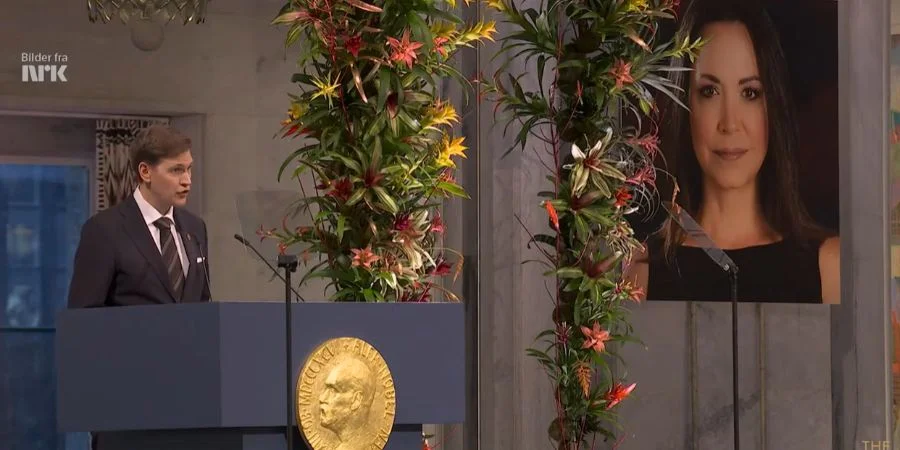
The statements occurred this December 10, during the official speech awarding the 2025 Nobel Peace Prize to the Venezuelan opponent María Corina Machado, at the Oslo City Hall, Norway, according to the full text of the speech published by the Nobel Foundation.
In his speech, Frydnes described how autocracies support each other and put Cuba at the center of that framework. “Authoritarian regimes learn from each other. They share technologies and propaganda systems. Behind Maduro are Cuba, Russia, Iran, China and Hezbollah, which provide weapons, surveillance systems and means of economic survival. They make the regime more robust and more brutal,” said the president of the Norwegian Nobel Committee.
Jørgen Watne Frydnes, Chair of the Norwegian Nobel Committee at the #NobelPeacePrize Ceremony today, 10 December.
«Your power is not permanent. Your violence will not prevail over people who rise and resist. Mr. Maduro, accept the election results and step down.”
As Ana Corina… pic.twitter.com/xYxL1zTYi5
— Nobel Peace Center (@NobelPeaceOslo) December 10, 2025
With that phrase, Frydnes not only positioned Cuba as a political ally of Caracas, but as a direct actor in strengthening the Chavista control and repression apparatus, by attributing to it the provision of military, technological and economic capabilities that contribute to sustaining the regime and increasing its brutality.
The pointing out to Cuba is part of a broader diagnosis of the Venezuelan drift. Frydnes recalled that “Venezuela has become a brutal and authoritarian State mired in a deep humanitarian and economic crisis,” where “a small elite at the top, protected by power, weapons and impunity, enriches itself,” while a quarter of the population has fled the country, in one of the largest refugee crises in the world.
To illustrate the severity of the repression, the president of the Norwegian Committee recalled that, after the 2024 elections, “more than 200 minors were detained” and cited United Nations documentation on torture suffered by children and adolescents, including suffocation with plastic bags, electric shocks to the genitals, blows so violent that it was difficult to breathe, sexualized violence, extremely cold cells and contaminated water. The United Nations, Frydnes stressed, has concluded that these acts constitute crimes against humanity.
Frydnes also harshly questioned those who, outside Venezuela, relativize or justify the nature of the Chavista regime. He recalled that, as Venezuelans lost “their rights, their food, their health and their security—and, ultimately, their own future—much of the world clung to their old narratives.”
In his speech, he alluded to those who continued to describe Venezuela as “an ideal egalitarian society,” to those who only wanted to see it “as a fight against imperialism” or as a simple board of “competition between superpowers.” Regarding these observers, Frydnes was blunt: “All these observers have something in common: the moral betrayal of those who actually live under this brutal regime.”
In a passage addressed directly to Nicolás Maduro, Frydnes urged the ruler to accept the results of the 2024 elections and leave power to make way for a democratic transition. “Venezuela’s future can take many forms. But the present is only one, and it is horrible,” he stated, before insisting that the democratic opposition must have support and not indifference or condemnation.
The targeting of Havana occurs precisely at the moment in which the Venezuelan democratic opposition receives one of the greatest international recognitions. Frydnes recalled that Maria Corina Machado receives the 2025 Nobel Peace Prize “for his tireless work in promoting the democratic rights of the people of Venezuela and for his fight to achieve a peaceful and just transition from dictatorship to democracy.”
Machado could not be present at the Oslo City Hall. Instead, the ceremony culminated with the presentation of the diploma and medal to her daughter, Ana Corina Sosa, who received the award on behalf of her mother.
The ceremony, presided over by King Harald V and King Sonia of Norway, was also attended by, among other dignitaries, the president-elect of Venezuela, Edmundo González Urrutia, and the presidents of Argentina, Javier Milei; Panama, José Raúl Mulino; and Paraguay, Santiago Peña.